
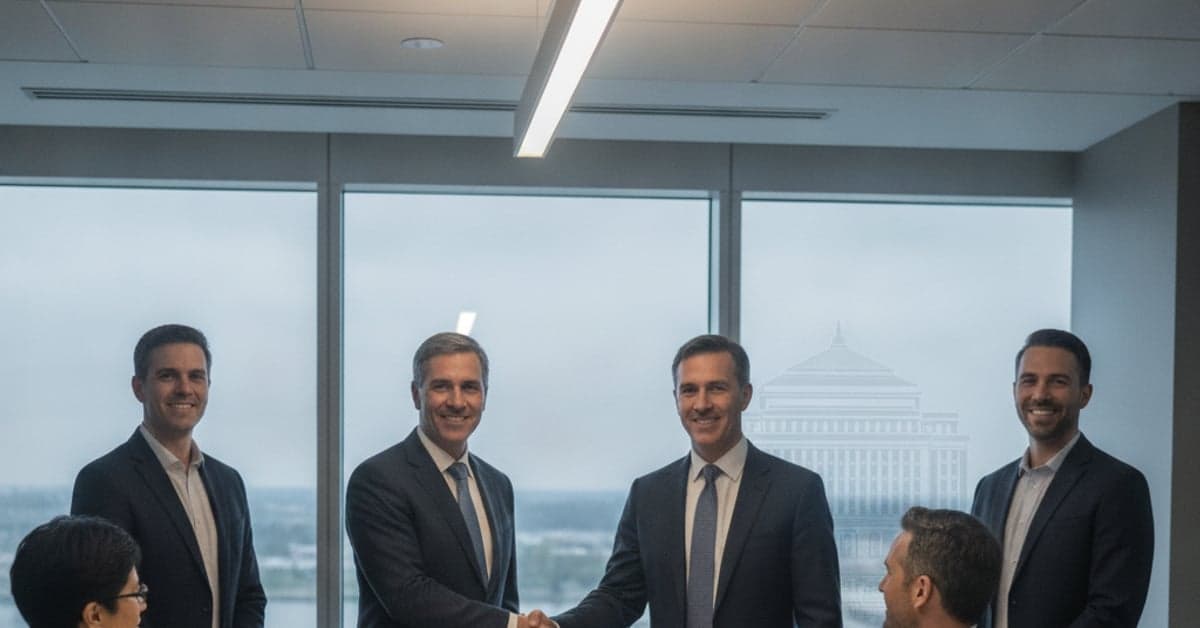
September 18, 2026 — Bradley Arant Boult Cummings brought on Michael P. Shepherd as a partner in Washington, D.C., a move aimed squarely at fast-rising AI and software patent work, according to the firm’s announcement. The Bradley IP practice says Shepherd’s remit spans patent prosecution and strategy for machine learning and other computer-related technologies, building on recent hires in Alabama and Georgia that broadened the group’s tech coverage.
Why the Bradley IP practice is hiring in D.C.
Washington, D.C. sits near the U.S. Patent and Trademark Office in Alexandria, Virginia, a practical advantage for policy-heavy matters and examiner engagement. The USPTO has also been clarifying rules for AI-assisted inventions, issuing agency guidance on inventorship in February 2024 that keeps humans, not tools, as inventors while acknowledging AI’s growing role in R&D. That guidance, published by the USPTO, has sharpened questions around disclosure, contribution, and documentation for patent applications involving large language models and other AI systems (USPTO AI inventorship guidance).
The legal frame tightened earlier when the U.S. Court of Appeals for the Federal Circuit affirmed that AI systems cannot be named as inventors in U.S. patents, reinforcing a human inventorship requirement that shapes how companies prepare filings that relied on model output (Thaler v. Vidal, August 2022). In that environment, a D.C.-based partner steeped in prosecution work positions the Bradley IP practice to advise on both the letter of the rules and the practical record-keeping that makes an AI-era application credible.
What Michael P. Shepherd brings to Bradley’s IP team
Shepherd joins after more than 16 years at Fish & Richardson, a leading intellectual property boutique known for prosecution and litigation across complex technologies. His background covers patent portfolio building, program kickoffs for R&D teams, and prosecution in “technically complex areas,” Bradley said in the release (Fish & Richardson) (Bradley announcement). Office Managing Partner Michael S. Koplan called Shepherd’s technical grounding “uniquely” suited to counsel on advanced technology matters, citing growing client demand as AI reshapes both products and IP assets, per Bradley’s statement.
The hire follows two expansion points Bradley highlighted: IP counsel Matthew J. Parker’s arrival in the Huntsville office earlier in 2026 to bolster transactional IP work in technology-intensive sectors, and a sizable 2025 group in Atlanta that broadened coverage for middle-market tech and emerging companies, according to the firm. Read together, those moves suggest a network built to support software-rich portfolios across the Southeast while giving policy and prosecution firepower in D.C. That network effect matters for AI clients that file families of related applications and need consistent strategies across jurisdictions.
The AI patent prosecution stakes for clients
Prosecution strategy for AI-heavy inventions keeps evolving. The USPTO has documented sustained growth in AI-related patenting, which tracks with companies folding machine learning into core products and internal tools. Its 2020 “Inventing AI” study outlined how AI spread across categories and the implications for examination, signaling that claim drafting and terminology would keep shifting as the field matured (USPTO, Inventing AI).
That shift puts a premium on claim scope and evidence. Applicants increasingly need to show where the inventive step lives when a model contributes to problem framing or solution generation. Expect more emphasis on documenting human contributions, data provenance, and testing protocols tied to model outputs so examiners can reconcile human inventorship with AI-assisted development. For software teams, that translates into cleaner lab notebooks, prompt and training dataset records, and versioning notes that survive diligence as well as examination.
This is where a prosecution-first hire in D.C. can shape outcomes. Shepherd’s résumé points to portfolio design and program incubation—skills that help R&D leaders pick which inventions to file, when to divide or continue cases, and how to coordinate filings in allied domains like data infrastructure and inference acceleration. Combined with the Atlanta and Huntsville benches Bradley cited, clients working across edge devices, cloud services, or embedded AI can align disclosures and timing with their product roadmaps. The Bradley IP practice now has a clear focal point to run that play in Washington.
Why this move matters for startups and mid-market tech
Middle-market companies and venture-backed startups often face a different calculus than global incumbents. Budgets are tight, products shift fast, and competitors chase the same model classes and datasets. In that setting, the value of a patent comes from how precisely it maps to a commercial differentiator and how defensible it is against prior art in a crowded field. According to Bradley’s statement, Shepherd has helped launch patent programs—an early-stage discipline that can prevent portfolios from drifting into abstract claims that invite Section 101 challenges or overlapping filings that drain budgets without adding coverage.
There’s also a communications dividend. A D.C.-anchored team that understands both policy guidance and examiner practice can reduce surprises for founders who are new to prosecution. When the USPTO refines examples or practice tips for AI claims, counsel can translate that into template language, evidence checklists, and triage rules for continuations versus divisionals. The Bradley IP practice is signaling that it wants to own that translation layer for clients building with AI.
For larger enterprises modernizing legacy products with machine learning, the calculus changes again. They often juggle shadow R&D streams—experiments that generate partial features—while needing to maintain consistency across international filings. Portfolio architects with deep prosecution experience can standardize disclosures and shepherd families through office actions with fewer detours. That’s the lane Bradley appears to be widening with Shepherd in D.C., backed by recent hires across its Southern offices.
What to watch next for AI patent strategy
Three threads will determine how much impact this hire has. First, whether clients adopt stricter documentation around human contributions in AI-assisted inventions, in line with the USPTO’s guidance. Second, how examiners treat claims that hinge on training data selection or prompt engineering, areas where clear technical narratives can fend off abstractness rejections. Third, whether companies coordinate prosecution with product milestones so filings backstop go-to-market moves rather than lag them.
Bradley framed Shepherd’s addition as part of a multi-office buildout. If that translates into consistent intake processes across Atlanta, Huntsville, and D.C., startups and mid-market companies could gain a cleaner path from invention disclosure to first office action response. The Bradley IP practice now has an opportunity to set that standard while the policy environment for AI—and the workload at the USPTO—keeps shifting.
Shepherd’s Fish & Richardson pedigree, proximity to the USPTO, and a mandate to expand AI, software, and machine learning work make this a targeted bet. If execution matches the plan Bradley outlined on September 18, 2026, clients building with AI may see faster, clearer routes to protection—exactly the kind of edge the Bradley IP practice is now organized to deliver. For more on this, see reuters.com and nytimes.com.