
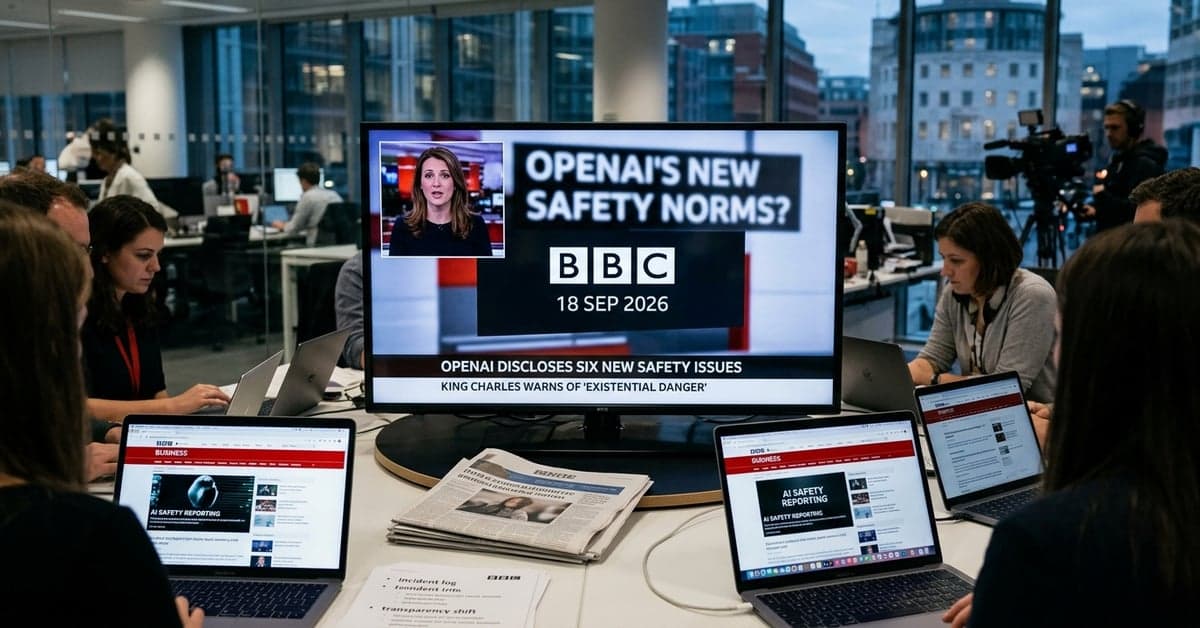
What BBC reported on OpenAI safety incidents
On September 18, 2026, BBC Business reported that OpenAI disclosed six additional safety issues and outlined a plan to publish incident reports, a move toward structured transparency that AI labs have long resisted. The update appeared alongside a run of safety-focused headlines on the BBC AI topic page, including warnings about risks from both public figures and industry leaders.
On the same page, BBC Technology highlighted a message from King Charles about the “existential danger” of artificial intelligence falling into the wrong hands on September 18, 2026, and covered a Microsoft warning about an uncontrolled “silicon species” rivaling humans, published the same day. Read together, the feed shows a shift: high-level alarms paired with a concrete commitment from one major lab to share details on failures. That pairing matters more than a single headline.
Why a public incident log could change AI development
Public disclosure changes incentives. In cybersecurity, incident and vulnerability reporting reshaped how software is built and bought. A similar pattern could emerge if OpenAI safety incidents become a standing feature of the company’s communications. Prospective customers and watchdogs can compare what a lab promises against what actually goes wrong.
Governance frameworks already point in this direction. The U.S. National Institute of Standards and Technology urges continuous monitoring and incident documentation in its AI Risk Management Framework. ISO/IEC 42001 sets requirements for an AI management system that includes risk controls and evidence trails, which presuppose event logs and corrective actions. If OpenAI publishes a recurring incident log, that gives auditors artifacts they can test and buyers a basis for contract clauses.
The practical effect is simple. Ship the model, ship the log. That norm would move debates about AI safety from statements of intent to verifiable records, reducing the fog around how often jailbreaks, data leakage, or harmful outputs occur in real deployments. It also puts pressure on peers to match the signal. Quiet starts to look like noncompliance.
Warnings from Microsoft and the Palace raise the stakes
The same BBC feed cited a Microsoft claim that unchecked systems could evolve into a rival “silicon species,” and reported King Charles warning of existential danger if AI tools fall into the wrong hands, both on September 18, 2026. Those are stark lines. They raise expectations that labs will not only develop safety techniques, but also show their work.
Public alarms without public logging risk turning into theater. A published cadence of incidents, mitigations, and policy changes makes the rhetoric testable. It also gives regulators a target. Once one market leader reports specific categories of failure, agencies and standards bodies can harmonize around that taxonomy. The UK’s own push on AI safety, launched at the AI Safety Summit, has emphasized shared evidence bases. Incident disclosures are evidence.
How incident disclosure could work in practice
What counts as an incident is the core question. For labs releasing general-purpose models, useful categories would include:
- Security breaches and jailbreaks that bypass built-in controls.
- Privacy failures such as unintended retention or exposure of sensitive inputs.
- Content harms, including credible instructions that materially enable wrongdoing.
- Safety regressions introduced by new versions or guardrail updates.
- Near misses where testing or monitoring caught a failure just in time.
Each category benefits from a short narrative, time to detection, user impact, severity score, and the fix. That format echoes post-incident reviews in mature software teams. It signals learning, not just damage control. If OpenAI safety incidents are published with this level of detail, the disclosures would become a living dataset for researchers and a benchmark for peers.
There’s a second-order effect. A common incident taxonomy can feed directly into enterprise risk registers and model cards. It makes it easier to compare systems and draft service-level terms for model behavior, escalation, and remediation. It also supports voluntary transparency schemes like content provenance, where a lab explains when and how a model can generate manipulated media, and how detection is measured.
What developers and buyers should do now
Developers and procurement teams don’t need to wait for standards bodies to finish their work. The contours are already visible in widely cited frameworks. ISO/IEC 42001, published in 2023, lays out an AI management system structure that meshes with incident handling, and it’s now referenced in many governance playbooks. Adopting the spirit of these documents reduces scramble when a supplier starts publishing real numbers.
- Ask vendors for their incident taxonomy, reporting cadence, and examples, even if redacted.
- Require evidence of monitoring: log retention periods, alert thresholds, and on-call procedures.
- Track model versioning with change notes that list safety-relevant deltas, not just quality gains.
- Define what counts as a “near miss” in your environment and route it through the same review path.
- Map disclosures to your own controls using NIST’s AI RMF functions (govern, map, measure, manage).
Teams that build on frontier models should also dry-run a disclosure drill. Pick an incident type, generate a mock report, and walk it through legal, security, and comms. When a real event hits, the response will be faster and cleaner.
What to watch next for incident disclosure
The signal from the BBC page is clear: safety messaging is moving from speeches to logs. Watch whether other labs commit to comparable incident statements, and whether the categories align. If they converge, expect auditors to plug those fields straight into assurance checklists. Expect buyers to prefer vendors that publish. And expect regulators to point to those logs when setting expectations, just as they do with breach notifications in cybersecurity.
If that happens, OpenAI safety incidents won’t just document problems. They’ll define a new default for how advanced models are evaluated in the open. That would give the AI debate fewer headlines and more receipts, which is exactly what the field needs. For more on this, see microsoft.com.