
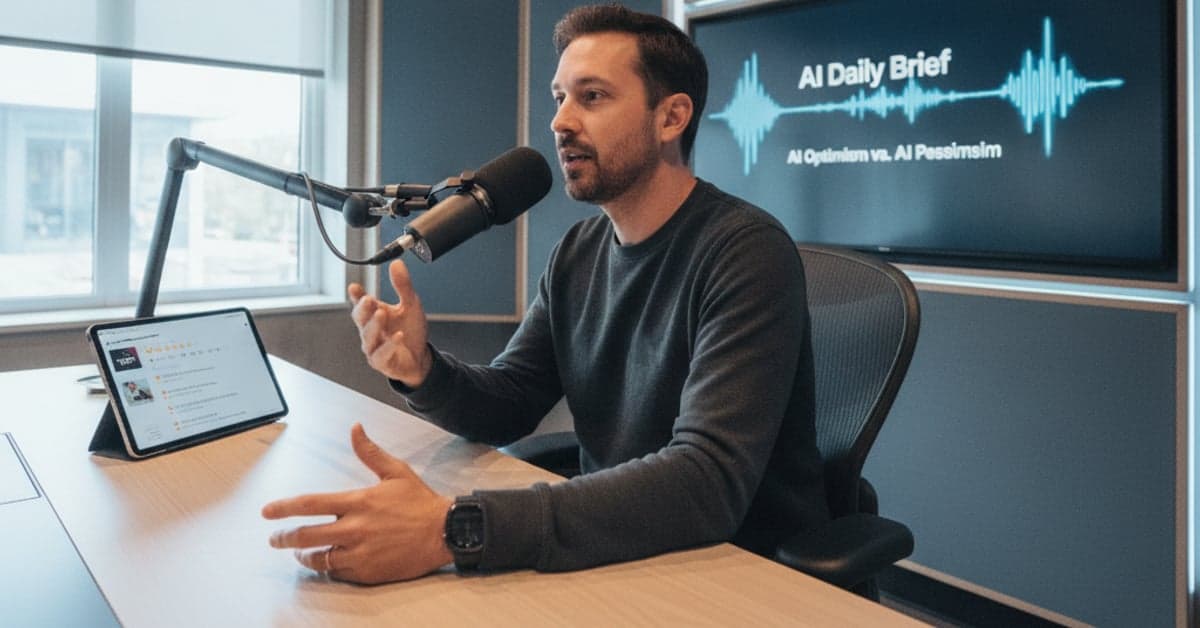
With a 4.7 score from 733 Apple Podcasts reviews and a semiweekly cadence, the AI Daily Brief podcast has become a reliable barometer for where the AI debate is heading. On July 14, 2026, the show’s listing highlighted an episode titled “AI Optimism vs. AI Pessimism,” signaling a turn from splashy demos toward harder questions about jobs, safety, and control (Apple Podcasts).
What the AI Daily Brief podcast is actually doing
Hosted by Nathaniel Whittemore, known to listeners as NLW, the show promises “daily news analysis” on artificial intelligence. The Apple Podcasts listing points to coverage that spans creative tools like Midjourney and ChatGPT, workplace disruption, and the thornier questions around advanced general intelligence, alignment, and existential risk. The pitch sounds broad, but the format keeps it tight: clear takes, frequent releases, and a focus on what operators can use that day (Apple Podcasts).
The latest episode description references two poles shaping the moment: Anthropic’s stark ad about AI risk and Demis Hassabis’s call for standards at the frontier of model development. That pairing captures a climate in which rhetoric is giving way to concrete asks. Safety language meets implementation details. The AI Daily Brief podcast is leaning into that shift by weighing real trade-offs rather than hype cycles alone.
Why a tougher tone helps an AI news podcast land
Listeners don’t just want a recap. They want the contours of a decision. According to the Apple Podcasts page, NLW argues that the public debate is getting more grounded and useful, even as disagreements hold over jobs, superintelligence, and government reach. That matches what policy watchers are seeing: regulators are sketching the rules of the road, which raises the bar for any show claiming to do analysis.
Europe’s new AI law underlines the point. The European Commission describes the AI Act as a risk-based framework that sets obligations for developers and deployers and aims to build trustworthy systems across the bloc (European Commission). When an episode talks standards and accountability, it resonates differently in a world where enforcement timelines and compliance checklists are real. The AI Daily Brief podcast earns its keep by mapping headlines to those practical stakes.
From Anthropic to DeepMind: why these references matter
When a show cites Anthropic or Demis Hassabis, it’s pointing listeners to where influence lives. Anthropic has styled itself as a safety-first lab; linking its public messaging to the labor market or deployment choices gives operators a way to read intent. Hassabis, who leads Google DeepMind, has pressed for norms on powerful systems, which turns a values stance into an engineering and process question (Google DeepMind). By putting both in the same frame, the episode asks a simple question: are we setting standards to match the systems we’re building?
That’s the gap many listeners are trying to close. They’ve seen the demo videos. They need cues on what to adopt, what to test behind a feature flag, and what to sideline until auditing is feasible. A show that links an ad campaign to governance, and governance to team choices, shortens the time from “interesting” to “actionable.” That’s been the AI Daily Brief podcast edge when it’s at its best.
Business signals: how the model is evolving
The listing also makes a business story plain: there’s a paid ad-free feed for $2.99 per month or $29.99 per year, on top of sponsor reads from enterprise vendors and tools (Apple Podcasts). Taken together, that suggests the audience isn’t just the curious; it’s managers, engineers, and policy leads who will pay for a frictionless listen. In a crowded field, predictable cadence and a clear editorial stance can support both subscription and sponsor revenue.
For media operators, that mix is a tell. AI shows that survive this cycle will speak to how teams actually adopt models: costs, guardrails, and the battle over which “frontier” standard becomes the default. A subscription option reinforces that the value sits in curation and context, not raw volume. The AI Daily Brief podcast is aligning to that reality.
What to watch next from the Brief
The show’s framing puts three threads on deck: real-world audits of model claims, the pace of enterprise rollouts, and how policy hardens into practice. Expect tighter links between what labs say in public and what regulators codify. The Commission’s AI Act page lays out obligations and support channels for implementation, including a service desk and industry “pact” to move early on compliance (European Commission). Episodes that translate that into decisions for product, security, and legal teams will travel.
There’s also a credibility check for every AI news show right now: can it make sense of fast turns without bogging down in abstraction? When the next training run lands, or another safety pledge hits the wires, listeners will look for connection to budgets and risk registers. That’s the bar the AI Daily Brief podcast has set for itself—and the reason its tighter, standards-focused arc feels timely.
“From the explosion of creativity brought on by new tools like Midjourney and ChatGPT to the great philosophical, ethical and practical questions of advanced general intelligence,” the show promises to hit the full range of what matters to builders and watchdogs alike (Apple Podcasts).
If NLW keeps matching that range with clear stakes and well-chosen examples, the AI Daily Brief podcast will stay on the shortlist for people who have to ship features, write policy, or brief a board—listeners who can’t afford vague takes. That’s a high bar, but it’s also the opportunity.
Related reading: Hugging Face • Fine-Tuning • Open Source AI