
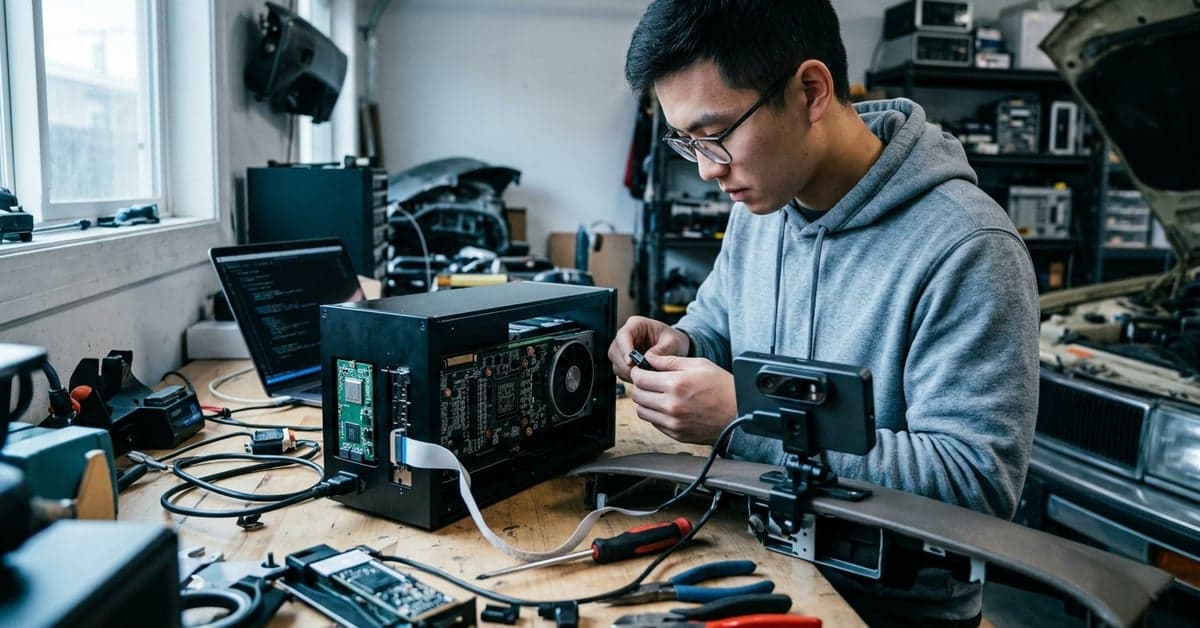
By August 16, 2026, the Hacker News thread for “Chestnut – eGPU dock with open-source firmware” had 121 points and 35 comments. The discussion wasn’t just hype over a new enclosure. It turned into a referendum on open hardware in cars, reliability of existing comma.ai devices, and whether a do‑it‑yourself chain of adapters can beat a purpose‑built box on price.
What the Chestnut eGPU dock is — and isn’t
The listing on Hacker News points to coverage on HWBusters, describing Chestnut as an external GPU dock with open-source firmware. A photo hosted by comma.ai shows a tidy footwell mount, suggesting the unit targets in‑car installs rather than a desk setup. The promise here is simple: add more GPU compute to a driver-assist stack, in a package owners can audit and modify. That last part is the hook; open firmware invites tinkering and scrutiny, which matters when the kit lives in a vehicle.
The Chestnut eGPU dock also lands at a junction where consumer eGPU habits meet automotive constraints. A desktop eGPU can live with fan noise and a chunky power brick. A car install competes for space, deals with heat from the cabin and firewall, and shares power with systems that actually steer and stop. Those trade‑offs frame the whole Hacker News debate.
Why open-source firmware in cars matters
One commenter, posting as alex0com, said their comma C3X audio hardware failed just past warranty, and their car wasn’t officially supported. They kept things running by staying on a fork and making a few line changes to regain lane centering. They also passed on upgrading to the C4 after seeing reports of hardware failures, and added, “Wish they figured out how to bulletproof the device, would love to add the GPU.” That account, shared on Hacker News, lays out the real demand signal Chestnut is tapping: owners want more capability, but not at the cost of reliability.
“When people ask me about the device, I tell them it’s the next version of power steering.” — alex0com on Hacker News
Open-source firmware can’t fix a bad PCB, but it can shorten the time from bug to patch, and it lets unsupported cars stay in the fold. That’s already how some users live with comma hardware today, by forking and tweaking. If Chestnut keeps that door wide open, it gives modders an official place to contribute, and a clearer way to verify what the dock is actually doing inside the car.
Price and DIY routes: OCuLink, Thunderbolt, and trade‑offs
Another commenter described a €150 experiment: an OCuLink dock wired to an M.2 connector, then a USB4 M.2 SSD enclosure to make it speak Thunderbolt. It’s a classic hacker’s chain of adapters, and it worked for them in theory. The post didn’t cite exact performance, but it highlights how commodity parts tempt budget‑minded builders. For context, OCuLink is a PCIe cabling standard often used for compact external GPU links, while USB4 and Thunderbolt carry PCIe lanes behind a different connector and protocol.
DIY can save money, yet cars raise the stakes. You’re routing high‑bandwidth links near a heat source, with frequent vibration and limited airflow. Power delivery has to survive cranking, cold starts, and noise on a 12‑volt bus. A ready‑made unit like the Chestnut eGPU dock might add cable retention, thermal management, and firmware checks you won’t get from a pile of adapters. The flip side: if those checks are open, owners can audit them, and even contribute fixes.
This is where a desk eGPU and an in‑car GPU part ways. An external GPU on a laptop can be moved, reset, or unplugged without safety implications. In a vehicle, any added compute that informs driver assistance should be treated with the caution regulators urge for ADAS features. The U.S. safety agency explains these systems and their limits in plain terms on its driver-assistance technologies page. More frames per second won’t change the need for oversight and testing.
Reliability worries frame the stakes
The reliability thread ran through many comments. The same user who praised lane centering also described failed audio hardware and a reluctance to trade up to the C4. That hesitation matters. For performance gear in a car, perceived fragility kills adoption faster than a missing feature. Open firmware can build trust by making failures legible and fixes trackable. It also lowers the risk of orphaned hardware, since a community can keep it useful longer.
There’s a second trust vector: fit and finish. The eGPU world tolerates blocky enclosures and desk‑friendly power supplies. Drivers won’t. A clean fit in the footwell, solid mounting, and sane cable routing are part of the sales pitch as much as FLOPs. An image hosted by comma.ai already shows a compact, side‑of‑tunnel install, which explains why some saw Chestnut as more than another GPU box.
What it means for ADAS tinkerers next
If the goal is faster perception or headroom for larger models, a dedicated dock is a clear path. The question the Hacker News crowd raised is whether a shelf of adapters can deliver that headroom for less. In a desk setup, maybe. In a car, the calculus shifts toward a purpose‑built unit that handles power, heat, and serviceability without drama.
The other question is community gravity. If Chestnut’s firmware stays open, and the company accepts outside fixes, the dock could become the place where hobbyists and small shops standardize their add‑on GPU work. That reduces the number of unique, fragile builds on the road. It also helps independent garages learn one system well, instead of troubleshooting ten.
The Hacker News thread isn’t a verdict; it’s a map of concerns. Price pressure will keep the DIY route alive. Reliability and service support will push buyers toward something closer to an appliance. If the Chestnut eGPU dock threads that needle—open where it counts, solid where it must—it will earn space in more footwells than a pile of cables ever will. For more on this, see bloomberg.com and nytimes.com.