
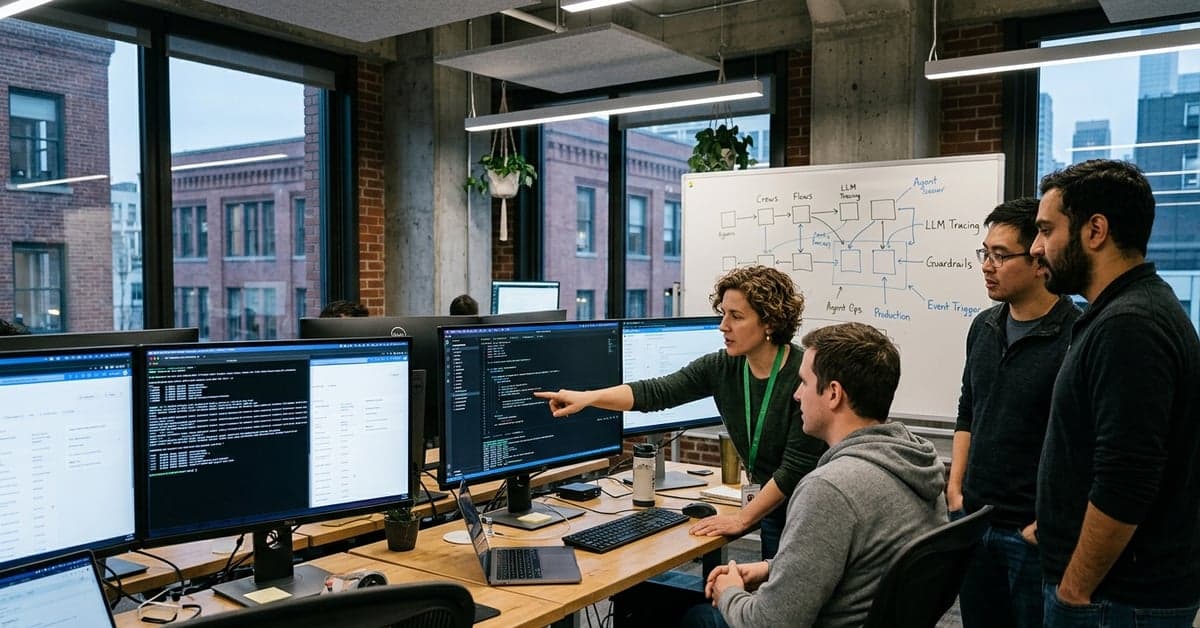
CrewAI’s GitHub page pitches a Python framework that marries role-based agents (“Crews”) with an orchestration layer called Flows, aiming to turn demos into durable services. According to the project, more than 100,000 developers have passed community coursework, a sign the toolkit is spreading beyond hobby use. At the center is CrewAI event-driven automation, which promises tighter control over when and how agents act, and how their work gets observed.
How CrewAI event-driven automation changes agent ops
The project’s own overview describes two pillars: Crews, which coordinate role-based AI agents, and Flows, which route events through a workflow that can mix single LLM calls with multi-agent collaboration (GitHub: CrewAI). That framing matters. It shifts attention from prompts and tool selection to triggers, state, and handoffs. In practice, that’s where production systems break or scale.
On top of the open-source core, CrewAI promotes an AMP Suite for organizations that want a commercial control layer. The listed features read like a checklist for taking agents live: tracing, dashboards, centralized management, and security. It’s a bid to solve the operational gaps teams hit once pilot projects start handling real data or real customers.
- Tracing and observability with metrics, logs, and traces in one place
- A centralized console to manage and scale agents and workflows
- Integrations with enterprise systems and cloud infrastructure
- Built-in security and compliance measures
- Analytics to guide tuning and performance decisions
- Round-the-clock enterprise support
- Deployments on-premises or in the cloud
That stack signals a pragmatic read of where agent projects stall. Teams don’t just need autonomy; they need sequencing, audit trails, and backpressure. CrewAI event-driven automation targets that middle ground: let agents collaborate when it helps, but pin their work to events you can see and govern.
From role-based crews to production guardrails
“Role-playing agents” grabbed attention in early prototypes. The approach is still here in Crews, but Flows move the locus of control from personas to system events. According to the repository description, Flows can combine precise workflow steps with calls out to Crews, which lets a planner or reviewer agent contribute without owning the whole process (GitHub: CrewAI).
That’s an important change in emphasis. Events map to business triggers: a new customer ticket, a failed build, a nightly reconciliation batch. Workflows map to compliance and risk: who touched the data, what tools ran, which outputs were accepted or rejected. The more these systems tie actions to discrete events, the easier they are to test and to explain.
The argument for guardrails isn’t ideology; it’s operational debt. Long-running agents drift. Tool access expands faster than oversight. Incident reviews suffer when you can’t reconstruct why a decision was made. By anchoring logic in events and traces, teams can rehearse failure modes, quarantine bad tools, and document outcomes without freezing innovation. That’s the promise behind event-driven agent automation.
Observability as the moat: where LangSmith fits
CrewAI isn’t alone in chasing the operational layer. LangChain’s LangSmith platform bills itself as framework-agnostic observability, evaluation, and deployment for agents. Its new LangSmith Engine clusters production failures into issues, hunts through traces and code for root causes, and even proposes fixes for review (LangChain: LangSmith).
The overlap is telling. Both camps stress tracing for multi-turn, tool-using systems, where control flow can branch and loop. LangSmith highlights native tracing for popular frameworks and OpenTelemetry alignment, with SDKs in Python, TypeScript, Go, and Java. That breadth hints at the next phase: buyers will expect their LLM tracing platform to ingest events from any agent stack, CrewAI included.
This is where differentiation will come from. Framework choices can be swapped, but clean traces, calibrated evals, and a hardened deployment path create real switching costs. CrewAI event-driven automation positions the framework closer to that operations tier, while LangSmith pushes from the tracing side outward. The likely winner in enterprise accounts is the toolchain that makes drift, dead ends, and flaky tools obvious before customers feel them.
Open standards matter here. If teams can export traces using OpenTelemetry conventions, they can plug agent runs into existing APM stacks and SIEM workflows. That reduces the burden on security and compliance groups, and it keeps observability from becoming yet another silo.
Opacity is rising; governance has to keep pace
There’s a bigger backdrop. Stanford’s AI Index reports that in 2025, industry produced more than 90% of notable AI models, and the most capable systems disclosed far less: training code, parameter counts, dataset sizes, and training duration went missing for several high-end models from OpenAI, Anthropic, and Google (Stanford HAI: 2026 AI Index, Research & Development).
Less upstream transparency pushes more responsibility downstream. If you can’t audit pretraining and fine-tuning recipes, you have to be sharper about what your agents did, with which tools, and why a given output shipped. That makes event logs, replayable runs, and policy enforcement non-negotiable. The case for CrewAI’s workflow control and for LangSmith’s diagnostics grows stronger under that reality.
Enterprises will also ask tougher questions. Which decisions were automated, and which required a human checkpoint? Which tools had write access, and under what conditions? How fast can you roll back a tool or model version that starts to misbehave? Event-driven agent automation sets clearer places to answer those questions, because each step has a name, a trigger, and a trace.
What to watch as agent ops mature
Three tests will separate marketing slides from production truth. First, can a team model complex handoffs without turning workflows into spaghetti? Second, do tracing and evals catch regressions before users do? Third, can the control layer integrate with ticketing, CI/CD, secrets managers, and data catalogs without weeks of glue code?
Both CrewAI and LangSmith are moving toward those answers. CrewAI wraps multi-agent collaboration in workflows that can be observed and governed. LangSmith brings a framework-agnostic tracing and evaluation stack that can sit beside any agent framework. If either path lowers mean time to diagnosis after a failure, or trims the cost of quality reviews, that will show up on a quarterly report.
The framing on CrewAI’s repository makes the bet clear: production-readiness lives where events meet agents. Expect more customers to care less about which planner model you picked and more about how the system handled a burst of 10,000 concurrent tasks, or how it suppressed a risky tool call. That’s the ground CrewAI event-driven automation targets, and it’s where adoption will be won or lost.
The implication is simple. Over the next year, buyers will compare control planes and tracing pipelines as closely as they once compared prompts and tool libraries. The teams that commit to clean events, portable traces, and measured rollouts will earn trust. The ones that don’t will keep chasing ghosts in logs. CrewAI event-driven automation puts a flag in the first camp. For more on this, see nytimes.com.