
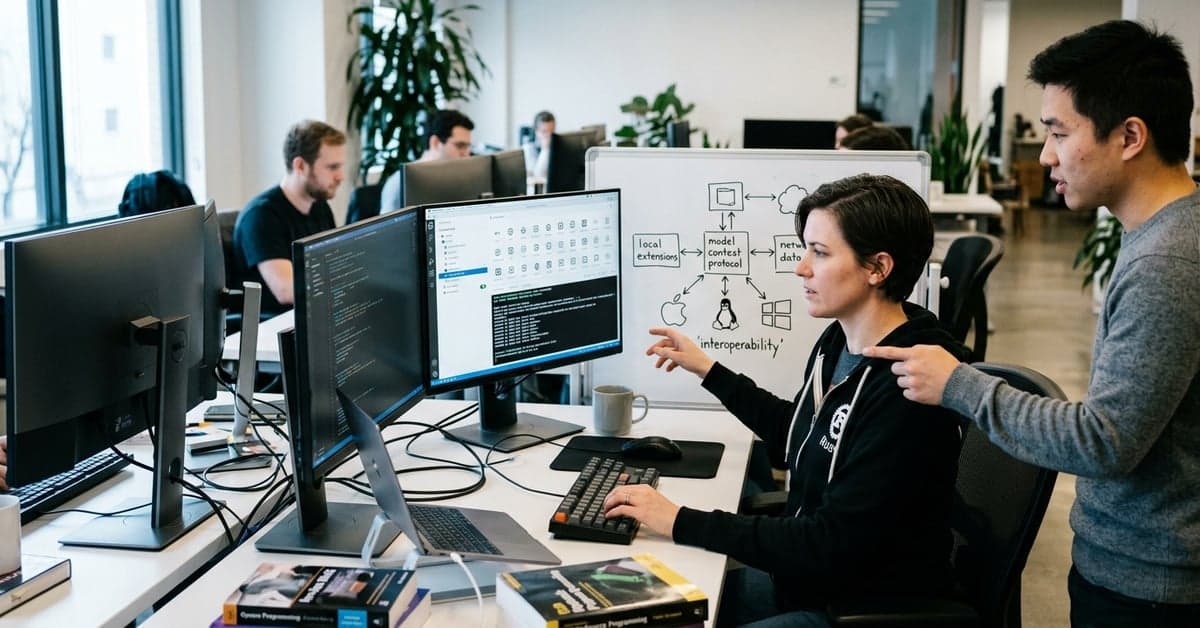
Goose connects to more than 70 extensions through the Model Context Protocol and runs as a native desktop app on macOS, Linux, and Windows, all built in Rust for portability and speed. According to Goose’s documentation, the project aims to be a general-purpose, open agent you can run locally for research, writing, automation, and code.
Why Goose MCP integration matters for developers
The case for Goose rests on interoperability. The agent speaks two emerging standards at once: the Model Context Protocol (MCP) for tools and data, and the Agent Client Protocol (ACP) for coding-agent connections. The former lets Goose tap databases, browsers, GitHub, and Google Drive via a growing ecosystem; the latter lets editors and coding agents talk to Goose directly. That mix reduces lock-in and shortens the distance between where work lives and where an agent can act.
On the MCP side, Goose’s claim of “70+ documented extensions and growing” is a big practical lever, because MCP focuses on a simple, tool-agnostic handshake for capabilities. Developers can browse active work on the spec and ecosystem at the Model Context Protocol GitHub. Goose layers an interface over that sprawl, so extensions show up as callable tools, with permissions, inside a single conversation. That’s the promise of the Goose MCP integration: one agent, many tools, without bespoke glue for each vendor API.
On the ACP side, Goose can act as a server that coding environments connect to, while also using ACP agents—like Claude Code—as providers. Per Goose’s docs, that means editors such as Zed, JetBrains IDEs, or Visual Studio Code can route tasks through Goose as a control hub for longer, multi-step work. It’s a small shift that matters in practice: code review or refactoring no longer feels like a separate chatbot task, but part of the editor’s workflow.
Inside the Goose desktop agent: apps, recipes, subagents
Goose ships as a native app, a CLI, and an API, so teams can pick their comfort zone. The desktop app is more than a chat window. Its “MCP Apps” feature lets extensions render embedded UIs—buttons, forms, and visualizations—inside Goose, which is a useful bridge between headless tools and human-in-the-loop tasks. Recipes capture repeatable workflows as portable YAML, and subagents can split off to run in parallel for code review, research, or file processing. According to Goose’s documentation, security is woven into that loop with prompt injection detection, tool permission controls, a sandbox mode, and an “adversary reviewer” that flags risky actions before they run.
The local-first posture is deliberate. Being built in Rust pushes toward performance and safety on-device, while support for more than 15 model providers—Anthropic, OpenAI, Google, Ollama, OpenRouter, Azure, Bedrock, and others—lets teams bring their own API keys or subscriptions. In a world where model preferences shift by workload, decoupling an agent from a single provider is a practical hedge.
Taken together, this is a familiar bet from developer tooling: standardize the plumbing, let the best tool for each job plug in, and keep the workflow portable. The Goose desktop agent sits at that junction, routing tasks to tools, models, and even other coding agents without forcing a wholesale rewrite each time something in the stack changes.
Open standards, real-world tooling: MCP meets ACP
Standards talk is cheap unless it touches daily work. Goose claims one of the deepest MCP integrations, then layers ACP to meet developers where they live—inside editors and CI. According to Goose’s documentation, Zed, JetBrains, and VS Code can connect to Goose as an ACP server. That brings code-editing context, file systems, and terminal workflows into the same agent loop, which is often the missing piece for long-running refactors, test triage, or doc generation.
The bidirectional angle matters as well. Goose can act as an ACP client to coding agents such as Claude Code, so you can keep the multi-step planning in Goose while offloading specialized coding execution when needed. That division of labor helps avoid “one-agent-does-all” pitfalls. With MCP handling tools and data, and ACP bridging editors and coding agents, the Goose MCP integration positions the desktop app as connective tissue for the broader agent stack.
Governance and what to watch next
Goose says it is part of the Agentic AI Foundation under the Linux Foundation, which signals an intent to keep the project’s standards-first direction intact. Readers can explore the foundation’s mission at agentic.ai. The details that matter for teams are simpler: does the MCP extension catalog keep growing, do ACP bridges stay compatible with the editors developers use every day, and do security controls hold up under adversarial prompts?
On the roadmap-by-implication: more MCP Apps that turn tool calls into mini-interfaces, richer Recipes for CI and team sharing, and tighter subagent orchestration so parallel tasks don’t step on each other. If those pieces firm up, the Goose MCP integration could become a default choice for local-first agent work—especially where portability, editor fit, and model neutrality are higher priorities than one-click cloud convenience.
The agent space shifts fast, but the direction here is consistent. By anchoring to MCP and ACP, keeping a local runtime, and treating editors as first-class, Goose gives teams a way to standardize agent workflows without backing into vendor lock-in. If the extension catalog and ACP links keep compounding, the value of that neutrality will rise with each new tool and model that snaps into place.
Related reading: Hugging Face • Fine-Tuning • Open Source AI