
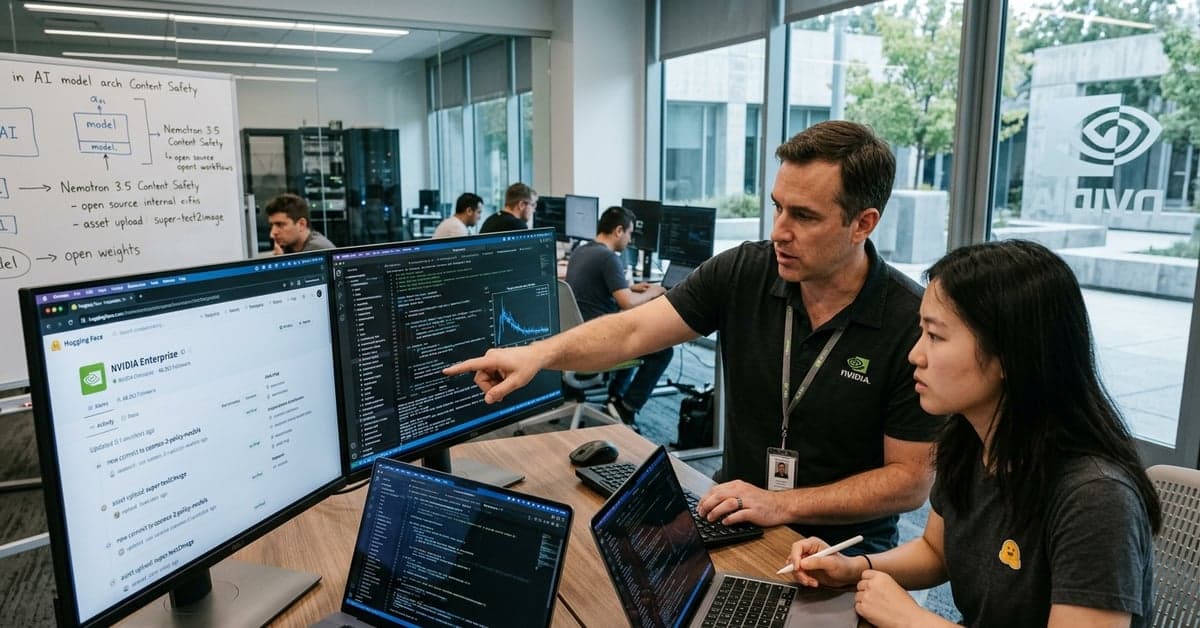
On September 16, 2026, NVIDIA’s organization page on Hugging Face listed 68,562 followers and a Verified badge for NVIDIA Enterprise. The activity feed shows fresh updates to Cosmos 3 policy models and a Super Text2Image asset under the nvidia/ namespace. That steady cadence makes the NVIDIA Hugging Face hub look less like a mirror and more like a primary release channel.
Why NVIDIA Hugging Face activity looks like a strategy shift
NVIDIA has long shipped SDKs, CUDA libraries, and enterprise stacks through its own portals. According to its Hugging Face organization page, the company is now using the Hub to publish model updates, papers, and hands-on articles that walk developers through training, tuning, and deployment. Titles on the page span real-time simulation for robotics, safety tooling for multimodal systems, and step-by-step guides for speech and image pipelines.
The move matters because the Hub is where many teams already compare checkpoints, read model cards, and wire up demos. By meeting developers there, NVIDIA lowers the friction between reading a post and cloning a repo. It also puts versioning and reproducibility in the open, which many enterprises now require. The pattern is consistent across posts listed on the page: announce capability, link code and weights, then show how to run it with standard tooling like Diffusers or NeMo.
Open weights in practice: Cosmos 3 and physical AI
Physical agents are a recurring thread in the organization’s feed. The page highlights “Welcome NVIDIA Cosmos 3: The First Open Omni-model for Physical AI Reasoning and Action” and a follow-on “Introducing Cosmos 3 Edge.” The activity log shows updates to policy checkpoints such as nvidia/Cosmos3-Edge-Policy-DROID and nvidia/Cosmos3-Nano-Policy-DROID, plus a Super Text2Image model under the Cosmos 3 banner. All of this sits alongside robotics content that points developers to the open-source LeRobot ecosystem; NVIDIA’s page links to work making Isaac Teleop and GR00T accessible in LeRobot, and the LeRobot repository gives useful context for training and evaluation loops.
The takeaway: by distributing Cosmos 3 policies and related assets on the Hub, NVIDIA gives labs a common shelf for experiments in perception, planning, and control. Teams can pin a specific checkpoint, reproduce a benchmark, and swap in their own data. That is how open-weight robotics research spreads—one reproducible baseline at a time.
Safety, speech, and retrieval: what the drops add
The NVIDIA page also collects applied building blocks. “Nemotron 3.5 Content Safety” outlines customizable multimodal filters aimed at enterprise deployments, while “How to Fine-Tune Nemotron 3.5 ASR for Your Language, Domain, or Accent” targets practical speech workloads. Both are presented as hands-on posts on the organization’s Hub page, linking back to models and code. For teams designing voice experiences, the article “Build Low-Latency Multilingual Voice Agents: Open Weights & Full Deployment Control with NVIDIA Magpie TTS” offers a path to on-prem or VPC control without handing audio to a third party—again, from within the same Hub presence.
NVIDIA also claims embedding gains. One article on the page states “NVIDIA Nemotron 3 Embed Ranks #1 Overall on RTEB, Advancing Agentic Retrieval.” Because it appears as an NVIDIA-authored post on Hugging Face, readers should treat the score as vendor-claimed until they verify on a public leaderboard. The benefit of publishing this claim on the Hub is auditability: model cards, configs, and scripts live beside the boast, so practitioners can rerun the evaluation and challenge the result if it doesn’t hold.
For implementation details across these components, developers can turn to NVIDIA’s NeMo documentation for training and serving, and rely on standard Hub workflows for version tracking. Many of the posts reference Diffusers pipelines; the Diffusers docs remain a solid companion for getting image and video generation running alongside NeMo-based models. If your team is new to the Hub itself, the Hugging Face Hub guide explains model cards, Spaces, and artifact management.
What developers should do now with the NVIDIA Hugging Face hub
There’s signal in this feed. Treat the NVIDIA Hugging Face page as the changelog for open-weight capabilities, then structure your evaluation and rollout accordingly.
- Subscribe to the organization to watch model updates like the Cosmos 3 policy checkpoints as they land, then snapshot versions you test against.
- Prototype in a private Space to isolate prompts, inputs, and seeds; document settings in the model card for reproducibility.
- Use NeMo Automodel recipes cited in NVIDIA posts to fine-tune on your own data, and record metrics that matter for your task rather than generic scores.
- Run safety tooling, including Nemotron 3.5 Content Safety, early in the pipeline; log both blocked and allowed samples for audit trails.
- If you build voice experiences, benchmark Magpie TTS alongside any managed TTS you already use to compare latency, cost, and control.
- For retrieval, validate the Nemotron 3 Embed claim on your corpora. Publish your setup so others can replicate or refute.
The benefit of this approach is simple: the same place that announces a model holds its weights, configs, and demos. Tighten that loop and your evaluations move faster with fewer surprises.
What to watch next on NVIDIA Hugging Face
Expect more policy releases around Cosmos 3 as the physical AI thread deepens. Watch for tighter integration notes between NeMo Automodel and Diffusers, and for clearer guidance on enterprise deployment patterns that keep data in your control plane. A growing safety section would signal that NVIDIA is trying to meet procurement checklists inside the Hub rather than across scattered PDFs. If that happens, the NVIDIA Hugging Face presence could become the default starting point for teams that want open weights without giving up version control or auditability.
The direction is clear: NVIDIA is using the Hub as a first-run outlet, not an afterthought. For developers, that means faster access to workable pieces—Cosmos 3 policies, Magpie TTS, Nemotron safety—and fewer custom bridges to build. Keep an eye on the NVIDIA Hugging Face feed; the next useful building block is likely to show up there first.