
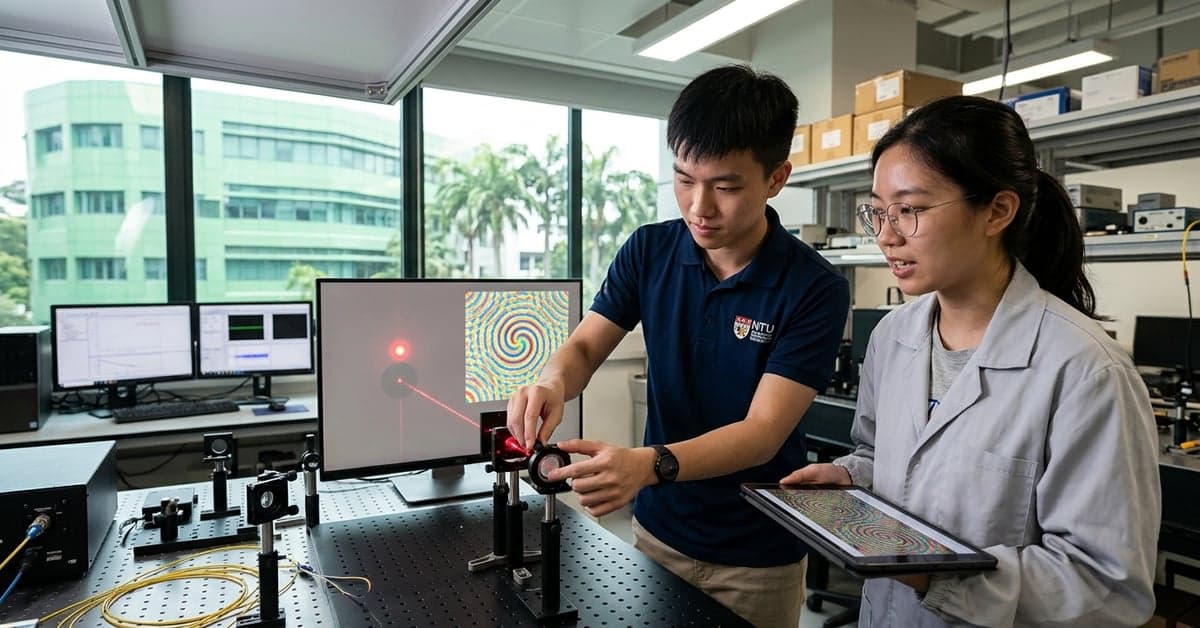
July 13, 2026 — A team at Nanyang Technological University in Singapore used a 200-year-old optical effect, the Poisson spot, to create optical skyrmions, according to ScienceDaily on July 13, 2026. The draw here isn’t only the physics headline. It’s the simplicity: a classroom-grade diffraction effect doing work that often needs custom structures and painstaking alignment.
What ScienceDaily said, and what it implies
ScienceDaily’s summary attributes the finding to NTU and describes a “surprisingly simple way” to generate exotic light structures using the Poisson spot. That spot, also called the Arago spot, is a bright point that appears at the center of a circular object’s shadow because of diffraction. The phenomenon is a classic in optics; Britannica credits it with settling a 19th‑century debate over whether light behaves like a wave.
Why does this matter beyond a neat demo? Skyrmions are topological textures. In optics, they’re structured light fields with twists that are resilient to small disturbances. If you can make them with everyday diffraction, not only in bespoke labs, you lower the activation energy for new photonic devices. That’s the quiet significance buried in the ScienceDaily brief.
Why optical skyrmions could matter for computing
Photonic computing has chased three goals for years: lower energy per operation, higher bandwidth, and cleaner signal integrity. Optical skyrmions hint at the last two. Topological light textures can carry information in their structure, not just in intensity or phase. That gives designers new degrees of freedom for routing, multiplexing, or error-resistant encoding.
There’s also a pragmatic angle. If researchers can shape skyrmion-like light using the Poisson spot — a staple of undergraduate optics — then labs worldwide can try variants without waiting for scarce nanofabrication time. That speeds iteration. It widens the pool of ideas. And it shortens the path between a physics preprint and a benchtop logic gate that uses structured light.
None of this guarantees a fast lane to commercial chips. Photonic hardware still fights size, alignment, and integration with electronics. But moving from exotic tooling to a simple diffraction setup changes the slope of the effort. It puts skyrmion light fields within reach of more teams, which is often how progress compounds.
From a Poisson spot to photonic logic
The Poisson spot is deceptively simple: place a circular obstacle in a coherent beam and you get a bright dot in the shadow’s center. With the right beam, obstacle, and distance, that diffraction pattern can host rich spatial structure. If NTU can coax that structure into stable, controllable patterns that resemble skyrmions, you suddenly have a building block for photonic logic elements that exploit topological features.
Background matters. Skyrmions originated in particle physics and later appeared in magnetism; the optical form is younger but growing. An accessible overview of skyrmions’ topological character is available on Wikipedia, which captures the core idea: a field configuration that can’t be unwound without a discontinuity. Translated to light, that means patterns that resist small nudges — a property engineers crave when fighting noise.
If the NTU method scales, it suggests a path to on‑chip implementations that mimic the Poisson diffraction conditions with integrated optics. That’s speculation until device work appears, but the research direction is clear: use simple optics to seed complex, stable light patterns, then tie those patterns to logic or interconnect tasks.
The efficiency context: from light fields to compressed AI
The timing also lands amid a broader shift toward thrift in computing. On March 24, 2026, Google Research detailed “TurboQuant,” a suite of quantization methods that compress high‑dimensional vectors for faster search and cheaper memory footprints in large language models. The Google Research blog explains how quantization tames the key–value cache and speeds similarity lookups by shaving bits per number without wrecking accuracy.
These are different domains — photons in one case, integers in the other — but they rhyme. Both chase more work per joule. Both prize structures that survive noise. And both reward tricks that turn complex control into simple primitives. The NTU result does that with light; TurboQuant does it with math. Read together, they point to an era where efficiency isn’t an afterthought. It’s the main design brief.
That context helps frame the NTU finding. If basic diffraction can produce structured light fit for information tasks, the barriers to experimenting with photonic logic fall. Meanwhile, compression keeps pushing AI systems to do more within the same memory and bandwidth. The convergence is an engineering mindset: use the simplest tool that still protects the signal you care about — whether that’s a quantized vector or a skyrmion-like beam.
What to watch next for photonic computers
Three checkpoints will show whether the promise holds. First, independent replications using standard optics kits. Second, controlled switching or modulation of these light textures at useful speeds. Third, early demonstrations that link the patterns to error‑resistant encoding or multiplexed channels in a working photonic circuit.
ScienceDaily’s brief is an early flag, not a finished device. But its core claim — a simpler route to optical skyrmions via the Poisson spot — is the kind of twist that can unlock more hands in the lab. In fast‑moving fields, that often matters more than any single setup. If the method proves reliable, expect photonics groups to adapt it into their testbeds and push toward practical logic built on structured light. For more on this, see reuters.com and bloomberg.com.
Related reading: Hugging Face • Fine-Tuning • Open Source AI