
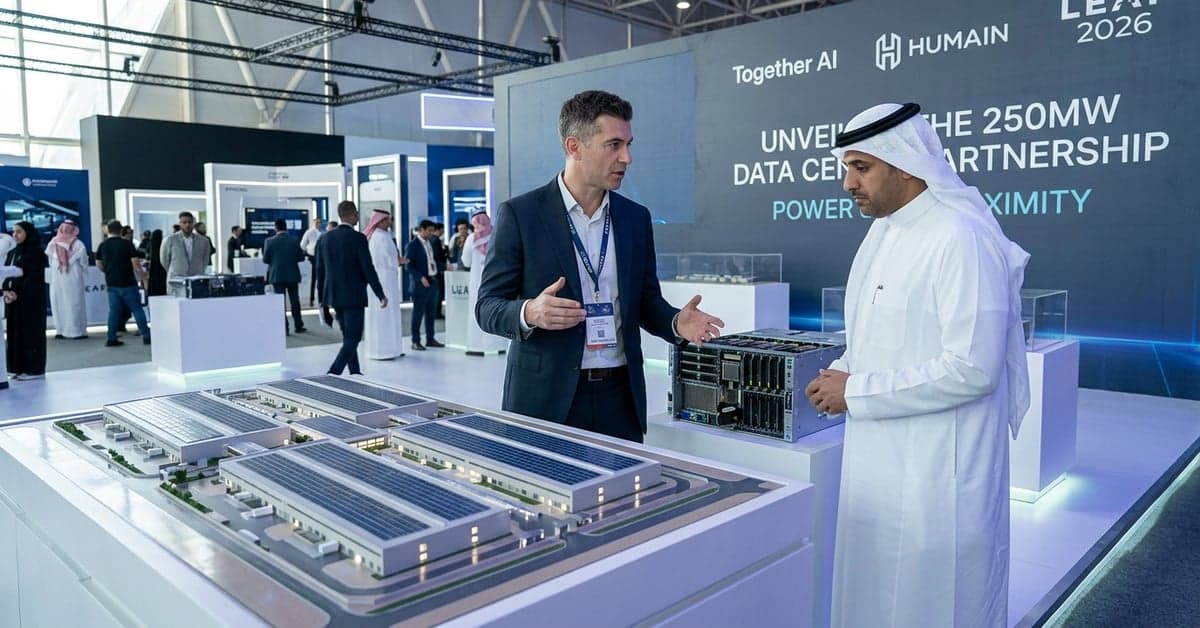
On September 1, 2026, Together AI and Saudi sovereign entity HUMAIN unveiled plans for a 250‑megawatt data center in the Kingdom, targeting $5 billion in first‑year gross revenue, according to Middle East AI News. The deal was announced at LEAP 2026 in Riyadh and links HUMAIN’s multi‑chip hardware footprint with Together AI’s global customer base and open‑source inference platform.
Why the Together AI HUMAIN deal landed in Saudi Arabia
The partners are making a simple bet: power and proximity. Saudi Arabia has been investing heavily in grid capacity and industrial build‑outs under its state‑backed programs. HUMAIN is part of the Public Investment Fund’s orbit, which signals deep capital support and policy alignment; the PIF’s own materials outline its role in national strategic projects (Public Investment Fund).
Power‑constrained markets in North America and Europe face stalled substation timelines and rising tariffs. The International Energy Agency has tracked sharp growth in data‑center electricity demand, with AI training clusters pushing the curve higher. Placing 250MW in Saudi Arabia positions capacity near Europe, the Middle East, and Africa with lower latency than far‑flung regions, while sidestepping grid queues choking many Western metros.
According to Middle East AI News, Together AI brings the software layer and developer reach, and HUMAIN supplies capital deployment and the chips. That pairing turns a regional build into a globally addressable service rather than a local silo.
The 250MW Saudi data center economics
The headline number—$5 billion in gross annualized revenue—deserves context. On a 250MW footprint, that implies roughly $20 million per megawatt per year. In another lens, it’s about $20,000 per kilowatt‑year, or around $1,670 per kilowatt‑month.
Those densities are far above traditional colocation, which doesn’t sell GPUs by the minute or wrap in managed AI services. They are, however, within reach for high‑utilization GPU clouds that monetize training and inference at premium rates. Hitting the projection depends on two things Together AI can influence: keeping the hardware busy and making it easy for developers to shift workloads without rewrites. That second piece is where its open‑source inference platform matters.
Per the Middle East AI News report, the initiative routes global demand from Together AI’s customer base directly onto Saudi‑hosted capacity. That shortens the go‑to‑market timeline. It also lowers friction for enterprises that want a second region for resiliency or data‑residency reasons but don’t want the pain of new integration work.
What developers get from the platform linkup
The promise is straightforward: deploy models on Saudi hardware using the same interfaces you already know. Together AI’s tooling is built to serve open‑weight models and custom fine‑tunes without the complexity of bespoke orchestration. For teams juggling training jobs and inference endpoints, a new region on the same API is a fast way to add capacity, reduce queue times, and diversify geography. Developers evaluating the stack can review platform details at Together AI.
Location also matters for compliance and performance. Hosting EMEA AI workloads closer to users can trim latency and aid with sector rules that discourage cross‑border data hops. The Together AI HUMAIN structure tries to blend those benefits with a global marketplace of demand rather than building a one‑off regional cloud.
What could slow the build—and what to watch next
Desert heat, power‑distribution upgrades, and cooling choices set the engineering bar high. That’s solvable, but timelines hinge on interconnect milestones and supply chains for transformers, switchgear, and accelerators—items that have been tight in every market. Policy direction should be favorable given HUMAIN’s sovereign ties, yet execution still rides on construction, permitting, and import logistics.
On the commercial side, the $5 billion target implies strong demand and high utilization from day one. Securing long‑term compute commitments from anchor customers would de‑risk the ramp. Clear network paths into Europe, the Gulf, and Africa will matter for latency‑sensitive inference. Pricing will need to reflect regional bandwidth costs while staying competitive with other GPU clouds. Developers should look for published service‑level targets, queue transparency, and instance mix as the facility phases in capacity.
Why this matters for buyers of AI compute
If the partners deliver on schedule, buyers gain a new EMEA‑adjacent region with substantial headroom and a familiar software surface. For teams boxed out by long GPU queues, that’s immediate leverage in negotiations elsewhere. For those under data‑residency pressure, a second region that doesn’t force a tooling shift is rare.
The signal is bigger than one site. It shows how capital and grid access in the Gulf can be paired with software distribution from San Francisco to move faster than power‑limited incumbents. If the Together AI HUMAIN plan hits its utilization marks, expect more hybrid deals that look less like classic colocation and more like sovereign‑backed cloud extensions. For more on this, see bloomberg.com and nytimes.com.