
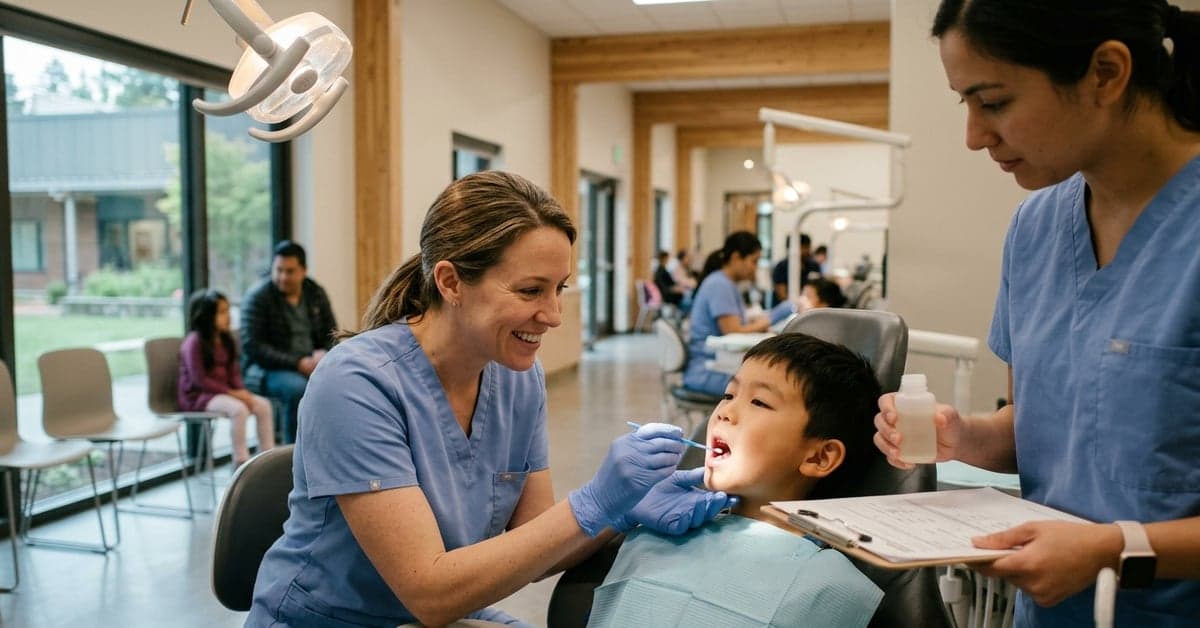
On July 29, 2026, ScienceDaily reported that a major U.S. trial found silver diamine fluoride stopped decay in more than half of treated baby teeth. The brush-on liquid takes seconds to apply. For many children, that could mean fewer drills, fewer infections, and fewer surgeries.
What the ScienceDaily trial says about silver diamine fluoride
ScienceDaily describes a fast, noninvasive treatment that arrests decay in primary teeth after a simple application. The report points to clinical results strong enough to matter in everyday practice, especially for kids who struggle to sit through conventional drilling or need hospital care.
Guidelines have been moving this way for years. The American Dental Association in 2018 recommended SDF as a nonrestorative option to arrest cavitated lesions in primary teeth, based on moderate to high certainty evidence. A Cochrane review later found SDF often outperformed fluoride varnish for arresting active caries in children. The new trial, highlighted by ScienceDaily, scales that evidence and signals it’s ready for broader deployment.
How SDF could cut drilling, sedation, and costs
For public health planners, programs that adopt silver diamine fluoride could ease backlogs for dental surgeries under general anesthesia. Many of those procedures address rampant decay in preschoolers. Every hospital slot freed up matters to families waiting months for care.
There’s a cost story here too. SDF is inexpensive, quick, and can be applied in community settings, which makes it a fit for school clinics and mobile van programs. According to the U.S. Centers for Disease Control and Prevention, untreated cavities affect millions of children, with the heaviest burden falling on low‑income families. A brief appointment in a school nurse’s office can be the difference between a contained spot of decay and a crisis that ends in the emergency department.
Policy also shapes impact. Several states allow hygienists to apply SDF in community settings under standing orders from a dentist, which cuts friction and travel time for parents. When state Medicaid programs reimburse SDF in primary teeth—and pair it with follow-up care—uptake rises. The trial ScienceDaily cites gives coverage committees and dental boards fresh, U.S.-specific data to justify expansion.
What SDF does — and its trade-offs
The agent stops the bacteria that fuel caries and hardens the softened dentin. That’s why a single application can halt a lesion and buy clinicians time to address diet, hygiene, and fluoride at home. As the American Academy of Pediatric Dentistry notes, the main drawback is cosmetic: the decayed area turns dark where the medicine arrests it. Parents must consent to the stain, which is permanent on the treated cavity but doesn’t discolor healthy enamel.
Silver allergies are rare, and dosing is small, but clinicians still screen for sensitivities and ensure careful application on soft tissues. Follow-up matters, too. Many protocols call for reapplication at set intervals, then a sealant or restoration once the lesion is fully inactive and the child can tolerate a longer visit. In these workflows, silver diamine fluoride isn’t the end of care; it’s the stabilizer that keeps a small problem from spiraling.
Expect more research on where it works best. Deep lesions near the pulp, spontaneous pain, or swelling typically push clinicians toward urgent restorative care. That’s where triage—often in schools—helps: treat what SDF can arrest today, and route complex cases to clinics before pain escalates.
The bigger picture is access. If school clinics, Medicaid plans, and boards align, silver diamine fluoride could narrow dental inequities by moving effective care closer to where children live and learn. ScienceDaily’s report gives policymakers cover to act—and gives families a simple option that keeps kids in class and out of the operating room. For more on this, see bloomberg.com and nytimes.com.
Related reading: Hugging Face • Fine-Tuning • Open Source AI