
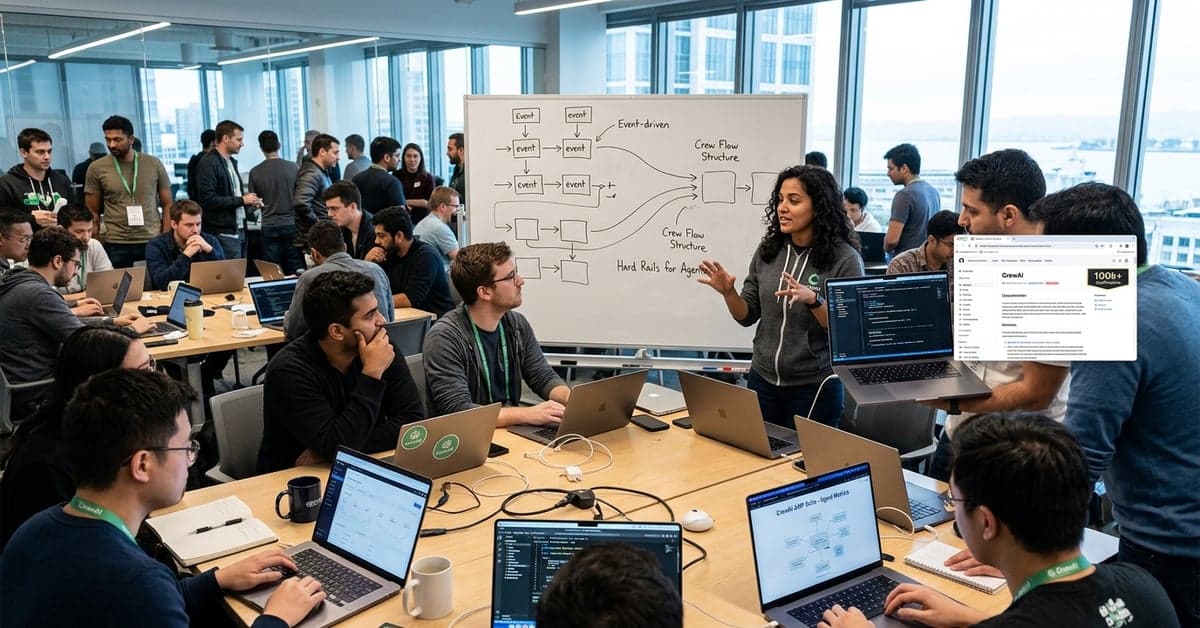
Over 100,000 developers have earned CrewAI certifications, according to the project’s GitHub page. That crowd is rallying around one idea baked into the framework: pair autonomous agents with hard rails. The feature doing the heavy lifting there is CrewAI Flows, which stitches event-driven steps together with calls to single models and with role-based agent teams called Crews (GitHub: crewAI).
What CrewAI Flows add to agent orchestration
CrewAI’s open-source core offers two building blocks. Crews coordinate multiple role-based agents to work together. CrewAI Flows give developers a way to define precise, event-driven paths around those agents. That division matters for anyone trying to move from demos to production. According to the repository, Flows combine strict workflow control with the option to call a single LLM where needed, and they natively support Crews inside the same pipeline (GitHub: crewAI).
In practice, this looks like a series of explicit states and triggers. A retrieval step fires, a policy check passes, then an agent team drafts a plan, and a final validator model signs off. Because the steps are defined as events rather than a single monolithic prompt, teams get clearer execution paths and easier debugging. That aligns with long-standing engineering patterns for building reliable systems around events and state transitions, not opaque chains of side effects (Martin Fowler on event-driven architecture).
The takeaway: giving agents room to explore inside a Flow, then pulling them back to a declared next step, is a pragmatic compromise. It preserves creativity where it helps and restores determinism where auditors and operators demand it. That mix is the product’s real bet.
Choosing observability: AMP Suite or Langfuse?
The open-source repository stops at the framework itself. For enterprises, CrewAI sells a separate bundle called the AMP Suite. The company describes the add-on as a commercial control plane for deployment, monitoring, governance, and security, with on‑premises and cloud options, and a free tier for its Crew Control Plane. The feature list includes tracing and observability across agents and Flows, centralized management, integrations with existing systems, built-in security controls, analytics, and around-the-clock support (GitHub: crewAI).
There’s a second path, and it’s already popular in LLM teams: pair the open-source CrewAI core with an open-source observability stack. Langfuse positions itself as an LLM engineering platform covering tracing, evaluations, prompt management, datasets, and a playground for rapid iteration. The Langfuse README also notes that as of January 2026, the project became part of ClickHouse, which hints at deeper analytics horsepower over time (GitHub: Langfuse; ClickHouse).
Both routes can work. The question is where you want to concentrate operational complexity:
- If you need a single vendor for deployment, tracing, access controls, and support, the AMP Suite’s Crew Control Plane wraps those around CrewAI Flows with less integration work.
- If your team already runs ClickHouse or a data lake and favors open tools, Langfuse plus CrewAI can centralize tracing and evaluations while keeping the framework layer vendor-agnostic.
- If audits and incident response timelines drive your roadmap, pick the option that gives you the cleanest end‑to‑end traces, role histories, and policy hooks for every Flow step.
The competitive angle here is clear: frameworks are absorbing platform features. CrewAI is pushing “observe and govern where you build,” while Langfuse is saying “standardize how you observe, whatever you build on.” That’s good news for buyers, because both sides are racing to reduce blind spots in agent behavior.
Designing event-driven workflows with role-based agents
How should teams structure projects to make the most of event-driven workflows? Start with the outcomes that must be deterministic: data writes, external calls, and user‑visible changes. Put those behind guarded steps in the Flow with explicit checks and idempotent behavior. Keep agent exploration inside safe spans. Then surface both parts—creative spans and gated steps—in the same trace, so on‑call engineers can replay what happened and why.
One effective pattern is to use a Flow gate to pick the right team, then let the Crew handle the messy middle. A retrieval gate picks which knowledge source applies. A policy gate selects a “review” Crew when a confidence score falls below a threshold. A human‑in‑the‑loop gate pauses risky actions until a reviewer approves. These gates make CrewAI Flows the primary control surface for compliance, while keeping the agents flexible inside their roles.
This approach also helps evaluation. According to Langfuse’s documentation, structured datasets and mixed evaluation modes (LLM-as-judge, code tests, and user feedback) support continuous improvement. When Flows are explicit, you can align each evaluation with a specific step, turn failing spans into test cases, and track improvements over time (GitHub: Langfuse).
How CrewAI Flows reshape 2026 stack choices
Enterprises are under pressure to show how AI systems make decisions. The CrewAI repository emphasizes real-time tracing in its commercial Control Plane, with logs and metrics that follow agents and workflows end to end. Tying those traces directly to CrewAI Flows strengthens the audit trail, because each event and state change is already named and ordered (GitHub: crewAI).
That design has two consequences. First, it rewards teams that move the “hard parts” into explicit Flow steps, where failures are easy to detect and roll back. Second, it creates a natural seam for policy enforcement. If your legal team needs to prove a model never touches a certain data class, you can show the gate that screens it, the trace that logs it, and the integration that blocks it. Observability tools become less about collecting everything and more about confirming the right things happened in the right order (OpenTelemetry is a useful reference for tracing concepts).
The open question is where you want to invest. If you bet on platform consolidation, the AMP Suite’s features around security and governance will feel attractive, and your team will live where the agents live. If you prefer composability, Langfuse’s focus on tracing, evaluations, and prompt management pairs well with a CrewAI core and a broader data stack. Either way, treating CrewAI Flows as the system’s backbone makes it easier to explain behavior to users, regulators, and your own SREs.
The next twelve months will turn on boring capabilities that ship fast: cleaner traces, clearer gates, and fewer surprises. Teams that design around CrewAI Flows—and prove each step with observable, testable signals—will spend less time firefighting and more time shipping features that matter. For more on this, see reuters.com and bloomberg.com and nytimes.com.