
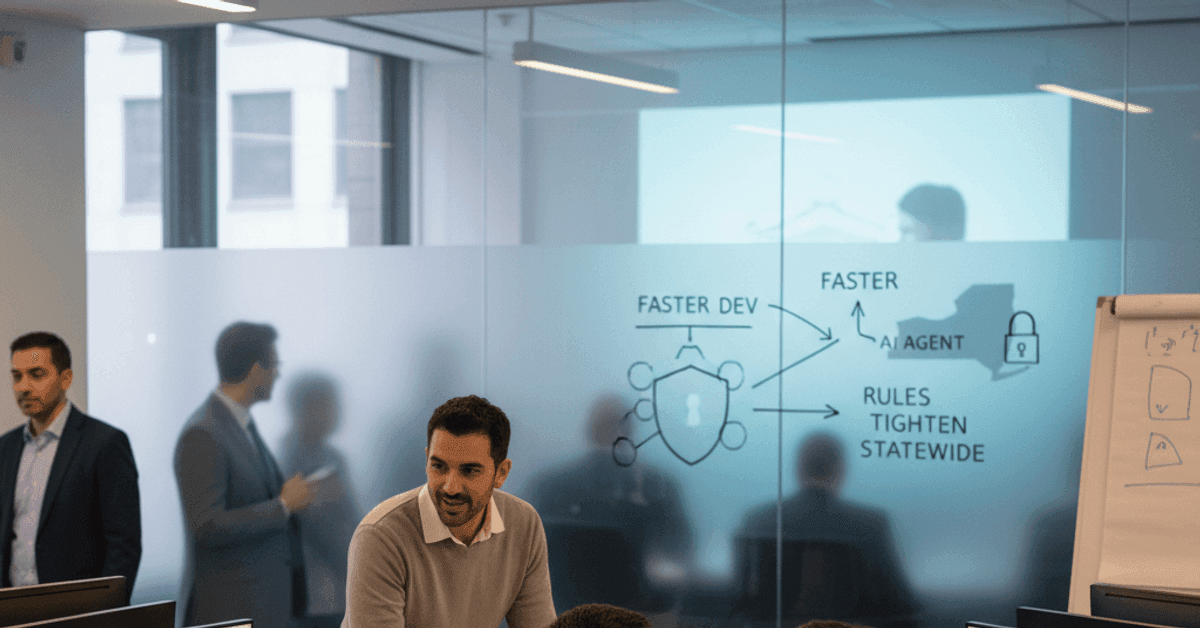
OpenAI’s AI coding agent now builds much of its own system, marking a shift in developer productivity. New York debates a sweeping AI safety bill that could add reporting duties for high‑risk tools. Together, these moves define the week’s productivity and AI storylines.
AI coding agent momentum
OpenAI told Ars Technica that Codex handles many tasks to improve itself. The team described a system that writes features, fixes bugs, and proposes pull requests in parallel. That workflow reduces bottlenecks across engineering backlogs.
“The vast majority of Codex is built by Codex,” an OpenAI product lead said, describing the agent’s self‑improvement cycle.
According to the report, the agent runs in sandboxed environments linked to repositories. That setup isolates risk while allowing rapid iteration. Additionally, the approach keeps experiments separate from production.
Developers gain speed because the agent drafts code and tests changes. Moreover, parallel task handling shortens cycle times. Teams still review changes, but the queue arrives cleaner and faster.
Productivity improves when repetitive code is automated. Therefore, engineers can focus on architecture, design, and reliability work. As a result, organizations can ship features with fewer delays.
The shift signals a broader change in software practices. Notably, agents now participate in CI workflows and code reviews. Furthermore, they surface defects earlier, which reduces costly rework later.
Ars Technica’s coverage outlines a maturing toolchain for autonomous coding. Readers can explore the breakdown of Codex’s process in that report from Benj Edwards at Ars Technica. The piece situates the agent within IDEs and CLIs many teams already use.
New York AI safety bill and developer workflows
In parallel, policy momentum could shape how teams deploy these tools. A coalition of parents urged New York’s governor to sign the Responsible AI Safety and Education Act. The bill would require safety plans and incident reporting for large AI models.
The Verge reports that the bill passed both chambers in June. However, negotiations continue over scope and compliance burden. Meanwhile, tech companies argue the rules could slow innovation.
The debate matters for engineering leaders planning 2026 roadmaps. If enacted, the rules would formalize incident disclosures and transparency. Consequently, vendors would need documented mitigations for high‑risk failures.
Additionally, buyers could face new due diligence steps before adoption. Procurement teams would assess safety plans alongside price and performance. In turn, audits might include red‑teaming reports and post‑incident timelines.
Policy watchers can review the detailed coverage at The Verge. The article lays out competing letters from parents and industry alliances. It also outlines proposed rewrites that could change obligations.
Productivity gains meet new risk standards
Engineering teams balance speed with governance as agents grow more capable. Sandboxed code execution remains a practical control during development. Moreover, independent test suites help validate agent output before merges.
Organizations can map controls to established frameworks. The NIST AI Risk Management Framework offers guidance on measurement and mitigation. Therefore, leaders can align internal policies with recognized best practices.
Consumer incidents keep the stakes visible beyond the enterprise. WIRED highlighted AI toys that produced sexual and drug references during chats. The case underscores gaps in content filters and monitoring.
That report reinforces the need for robust guardrails in any AI product. For example, safety filters, age gates, and human review reduce harm. Still, teams must monitor for drift and unexpected prompts in live environments.
Readers can examine that broader safety context at WIRED. The incidents show how fast systems can veer off script. Consequently, rigorous testing becomes a core productivity enabler, not a brake.
What these updates mean for teams now
Leaders should plan for more agent‑assisted coding in daily work. Start with constrained scopes and clear acceptance criteria. Additionally, track quality metrics before and after adoption.
Security teams should pair agents with isolation and observability. Use sandboxed environments for execution and test generation. Moreover, log agent actions to support audits and incident response.
Policy teams should monitor New York’s bill text and timelines. If obligations expand, vendor questionnaires will need updates. Therefore, legal, procurement, and engineering should coordinate early.
Training programs should evolve with the tools. Offer short refreshers on code review practices for AI‑generated changes. Furthermore, document escalation paths when the agent gets stuck or confused.
Product managers should revisit delivery estimates with agent support in mind. As a result, some backlogs can shrink faster than expected. Yet, complex refactors will still require human judgment and deep context.
Checklist for sustainable gains
- Define “done” for agent tasks, including tests and documentation.
- Use sandboxed code execution to contain failures before merges.
- Measure cycle time, defect rates, and rework to track impact.
- Adopt AI product guardrails aligned to NIST guidance where practical.
- Prepare transparency artifacts in case state rules require them.
Teams that combine agents with strong guardrails will move faster and safer. Notably, continuous monitoring turns governance into a feedback loop. Finally, resilience and speed improve together when controls are built in.
Outlook
Agentic coding will keep expanding across the stack next year. The biggest wins will pair automation with clear accountability. Meanwhile, policy clarity should reduce uncertainty for buyers and builders.
New York’s decision may set a template for other states. Therefore, leaders should expect a baseline of disclosures and safety plans. With preparation, the AI coding agent can lift throughput without amplifying risk.