
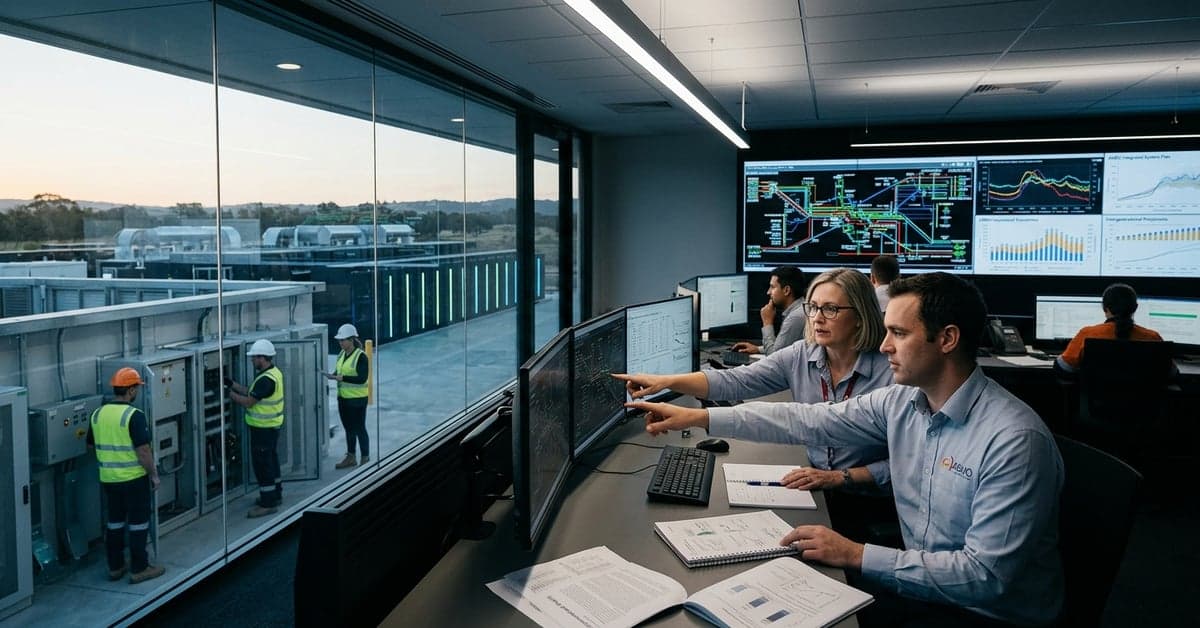
On September 21, 2026, Treasurer Jim Chalmers’ latest Intergenerational Report set an ambitious tone: artificial intelligence could lift growth and supply new ideas for decades. As Capital Brief reports, Treasury’s scenarios suggest faster productivity if AI adoption takes hold, and a shortfall if it stalls. That puts Australia AI productivity at the center of the country’s long-term economic story—and squarely in the political inbox.
What the Intergenerational Report projects
Treasury models three paths. The optimistic case lifts productivity to between 1.5% and 2% a year, up from a 1.2% baseline, by assuming AI helps “accelerate the production of ideas itself,” according to Capital Brief’s summary of the report. A slower-uptake case would leave gains “meaningfully below” those assumptions. The choice is not abstract. It’s a policy program: speed adoption and capability, or cede the upside.
There are hard inputs behind the headline. Treasury points to economies such as Taiwan and South Korea, where a surge in advanced manufacturing and computing is feeding the strongest GDP growth in years. Australia’s own signals are flickering to green. Since the last IGR in 2023, new capital spending on buildings and structures in information media and telecommunications—where data centres sit—has nearly doubled, Capital Brief notes. Momentum is building, but the system constraints are real.
Why Australia AI productivity hinges on energy and adoption
The IGR flags one constraint in stark numbers: data centre power. The Australian Energy Market Operator’s outlook, cited by Capital Brief, sees data centre electricity use rising 32% per year to hit 15 terawatt hours by 2029–2030, or about 7% of the National Electricity Market. Do the math and that equates to an average continuous load near 1.7 gigawatts. That’s a standing draw on the grid every hour of every day.
That load is the hidden variable in any forecast for Australia AI productivity. If compute capacity can’t connect to reliable, affordable power, AI adoption slows and the optimistic scenario fades. If it can, productivity lifts in the places where software firms, miners, banks, hospitals, and public agencies embed new tools. This is why the politics of planning approvals, transmission build-out, and firmed renewables now bleed into economic strategy.
Energy policy also drives cost curves. The International Energy Agency has warned that global data centre and AI electricity demand is climbing fast, pushing operators toward power purchase agreements and on-site generation. Australia is no exception. Aligning AI build-out with the federal net‑zero pathway and state renewable targets will decide whether power prices undercut, or reinforce, the returns from automation and augmentation.
A 15 TWh surge: the grid math policymakers can’t duck
Fifteen terawatt hours by 2029–2030 is not just a line in a spreadsheet. It implies new transmission, more firming capacity, and faster interconnection queues in the east coast market. It also implies siting choices. Locate a hyperscale campus near spare capacity and you avoid curtailment risk. Drop it in the wrong zone and delays erase years of projected gains.
This is where national ambition meets state reality. Planning timeframes for large energy projects can stretch across multiple budgets. The IGR’s own window is tight: the demand curve steepens before 2030. If Canberra wants the upside in its Australia AI productivity bet, incentives for behind‑the‑meter renewables, clearer rules for grid connections, and faster environmental assessments will matter as much as training grants or tax settings. The Australian Energy Market Operator’s materials can help map the least‑cost nodes and align approvals with real capacity, rather than wishful thinking (AEMO).
There is a workforce component too. Treasury expects a mix of automation and augmentation across roles. That is a distributional question as well as a macro one. The speed and breadth of rollout—who gets tools first, who gets reskilled, who gets displaced—will shape whether AI lifts average output or deepens gaps. Countries that moved early on skills pipelines and targeted migration have pulled forward adoption. Australia has the policy levers; it needs the sequencing.
What governments and firms should do next
The report’s promise won’t cash itself. Three steps would turn forecasts into output:
- Lock the energy plan to the compute plan. Co‑site new data centres with firmed renewables and transmission access, and publish a queue that links grid nodes to expected AI capacity. Firms can plan; states can budget.
- Move talent at the speed of demand. Expand targeted visas for AI engineering, power systems, and advanced construction; fund short‑cycle upskilling tied to deployments in healthcare, finance, and mining.
- De‑risk adoption in the real economy. Use procurement and co‑funded pilots to take AI from proofs to production in priority sectors. Measurable productivity gains beat generic promises.
None of this dodges safety or governance. It sequences them. Canberra has already framed responsible AI workstreams; the question now is execution while the window for compounding gains is open. Treasury’s scenarios make the stakes clear: slower uptake means weaker gains. Faster uptake, backed by power and people, makes the IGR’s growth path credible.
Capital markets are already reading the tape. Capital Brief highlights the near‑doubling of new structures investment in the sector since 2023. If that capex is matched by grid connections, trained operators, and clear rules, the country can sustain the climb. If it isn’t, stranded assets and missed productivity will follow.
The political calculus if the bet pays off—or doesn’t
This is now a governing choice, not a tech debate. Treasury has tied long‑run growth to AI adoption, and the energy and skills to support it. That makes Australia AI productivity a cross‑portfolio project: Treasury, Industry, Energy, Home Affairs, and state planning. It also reframes opposition lines. Critics will ask whether 7% of the NEM by 2030 for data centres is worth it, and whether the benefits reach beyond tech hubs. Supporters will point to higher output per worker and faster service delivery.
The stronger reading of the evidence favors moving, and moving smart. The energy math is solvable if planned early. The skills pipeline can be built if funded now. And the demand is there if procurement pulls and regulation clears paths for safe deployment. Treasury has put a number on the power draw, and a range on the growth payoff. The next budget will show whether policy follows through—so the forecast for Australia AI productivity becomes an outcome, not a hope.
For readers who want to examine the underlying policy context, the Australian Treasury’s publications page offers historical IGR materials (Treasury), while the energy system outlook that frames data centre demand lives with the market operator (AEMO). For a global view on data centre and AI electricity trends, see the International Energy Agency. For more on this, see reuters.com and bloomberg.com and nytimes.com.