
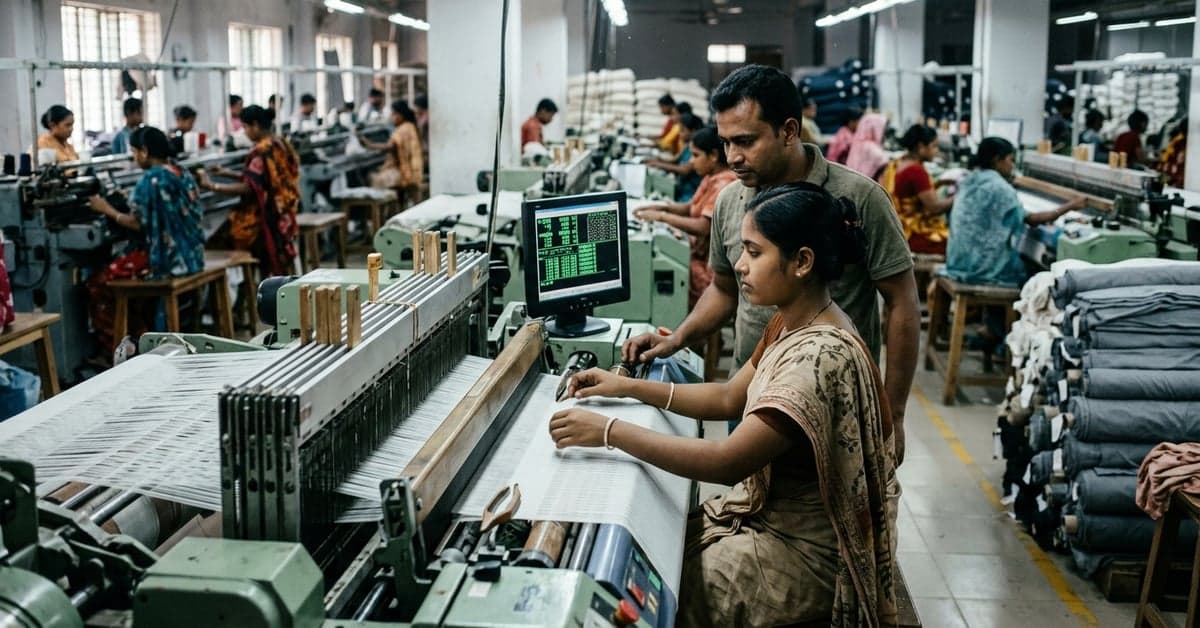
Only 2.44 percent of Bangladesh’s manufacturing establishments use computers or information technology in production, according to the Economic Census 2024 cited by The Daily Star on August 17, 2026. That figure hangs over the country’s bold AI plans in the FY2026-27 budget, which envisions new laboratories for AI, machine learning, and big data, plus broader deployment in public services. The question is whether Bangladesh AI productivity can rise fast from a base this thin—or whether the gains will cluster in a few islands and widen the gap.
What the new numbers say about Bangladesh’s AI readiness
The Daily Star frames the challenge with two stark facts. Between 2016 and 2022, 14 million Bangladeshis reached working age, but the economy added only 8.7 million jobs. Nearly 70 percent of those jobs were in low-productivity agriculture. The country’s last big leap connected a vast labor force to global production lines, with ready-made garments as the showcase. The next leap will be different: turning software, data, and power into output per worker.
That is a harder shift when most factories haven’t digitised basic workflows. AI thrives on structured data, repeatable processes, and connected systems. If fewer than three in 100 plants run even simple IT in production, most will struggle to use models for quality control, predictive maintenance, or demand forecasting. The risk is a two-speed economy, where a small set of already-digitised exporters capture the first wave of gains while everyone else watches from the sidelines.
Where Bangladesh AI productivity will show up first
Early wins tend to arrive where the data and workflows already live on screens. Knowledge workers can see tangible gains with even modest tools. As one case in point, Platformer’s Casey Newton wrote on August 18, 2026 about using a large language model to maintain a personal “LLM wiki” that speeds research and writing. That’s a single user story, not a factory line, but it shows how digitised work compounds AI benefits: the more that’s already organized, the more a model can help.
In Bangladesh, the first visible gains are likely to arrive in services, outsourcing, finance, and government back offices—places where email, documents, and databases already exist. In manufacturing, adopters will cluster among export-oriented firms with ERP systems, sensor data, and trained technicians. That pattern won’t fix the jobs gap by itself. It could even widen it if productivity jumps in small pockets, while most firms lack the prerequisites to plug AI into daily work.
Digitisation, power, and skills: the missing rungs
Three inputs determine whether AI raises productivity or stalls: basic digitisation, affordable and reliable electricity, and skills at the operator and manager level. Bangladesh’s plan for AI labs is a start, but labs alone won’t push data into production lines or connect maintenance logs to models. Companies need support to digitise inventory, workflows, and quality records first. Without that layer, model pilots become one-off demos that never scale.
Power is the second constraint. AI doesn’t just need more compute somewhere else; real use cases on the shop floor need steady electricity for sensors, networks, and servers. That’s harder if outages force plants to rely on diesel or if grid power is unstable. Those costs can erase any efficiency gains. The global picture matters here too: CMC Markets reported on August 18, 2026 that heavy AI infrastructure investment is lifting demand for chips, construction materials, and electricity, adding near-term inflation pressure. When global equipment and energy costs rise, late adopters pay more and wait longer.
Skills are the third rung. Many AI projects fail not because the model is weak, but because teams can’t redesign a workflow, clean data, or act on a model’s output. Bangladesh has a young workforce; that’s an advantage if vocational programs pair digital basics with line-of-business training. It’s a drag if graduates can code a demo but can’t make a cutting table, loom, or clinic schedule run faster.
Global AI costs that Bangladesh can’t ignore
The short-term macro picture is a headwind. The same AI boom that promises long-run efficiency is pushing up certain input costs today. According to CMC Markets, tech giants’ data center buildouts are drawing scarce chips and electricity, which complicates rate-cut paths and increases financing costs in places tied to the dollar. For a firm in Dhaka weighing a server purchase or retrofit, higher prices and longer lead times can turn a 12-month payback into a 24-month gamble.
This is where policy sequencing matters. If Bangladesh tries to jump straight to frontier AI while electricity and connectivity remain patchy in industrial zones, the benefits will skew toward multinationals and a few top-tier locals. If policy instead focuses first on cheap, reliable power, basic factory IT, and mid-skill training, the next wave of AI tools will land on ready ground. That’s how you spread Bangladesh AI productivity beyond a handful of exporters.
What policy would close the gap
The Daily Star’s framing—who can turn AI into higher productivity, and how benefits accrue—is the right litmus test. The evidence points to four practical moves that would change where the gains land:
- Make digitisation a capital good. Offer accelerated depreciation or targeted rebates for production IT—barcode systems, MES/SCADA, and quality databases. Tie any AI grant to proof of foundational IT adoption.
- Target power where factories stand. Publish a zone-by-zone reliability plan with timelines for upgrades. Offer time-of-use tariffs that reward off-peak AI training and batch analytics jobs.
- Train for operator decisions, not just coding. Fund short courses that teach supervisors to run with AI outputs: adjusting machine settings, scheduling maintenance, and tracking yield improvements.
- Create shared data and model services for SMEs. A public-private clearinghouse could host sector templates—garments, leather, light engineering—so smaller firms can “rent” proven workflows rather than start from scratch.
Each move lowers adoption risk. Together, they make it likelier that a mid-tier factory can capture gains that today accrue only to the top decile. They also shorten the lag between a budget line for AI labs and a line operator seeing fewer reworks or less downtime.
There is a related opportunity in services. If government back offices adopt model-assisted case processing and scheduling, they can cut permit times and inspections. Faster state services reduce working capital needs for firms stuck in queues. That indirect effect can be as large as any model in a factory. It’s also a channel to seed Bangladesh AI productivity in places where the data already exists and the public benefit is immediate.
Bangladesh’s last growth chapter rode scale and stitches; the next will rely on data and decisions. The Daily Star’s data points—2.44 percent factory IT usage and a surge of young workers headed for low-productivity roles—show the stakes. The path where AI closes the gap runs through dull but essential groundwork: digitise processes, stabilize power, and train managers to act. If that groundwork slips, the costs rising abroad and the skills missing at home will push gains into a few enclaves, and Bangladesh AI productivity will become another winner-take-most story. For more on this, see bloomberg.com and nytimes.com.