
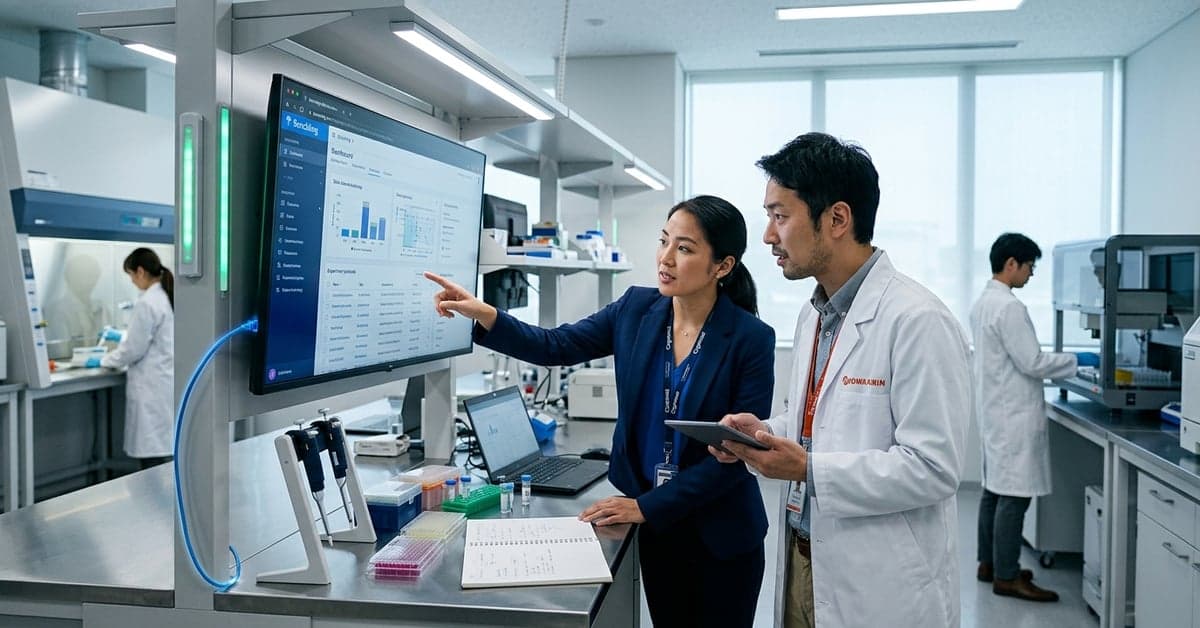
On August 16, 2026, Kyowa Kirin selected Cognizant and Benchling to roll out an AI-enabled R&D platform across its Tokyo and Fuji Research Parks in Japan. According to StockTitan, the Cognizant Benchling partnership will centralize experiment planning, execution, data capture, and AI use under a single contract, with Cognizant delivering setup, migration, implementation, and ongoing support.
Inside the Benchling rollout: scope and services
Cognizant is tasked with an end-to-end deployment that goes beyond a software switch. As described by StockTitan, the company will configure the Benchling environment, migrate historical records, connect the platform to Kyowa Kirin’s existing systems, and provide maintenance. Benchling’s cloud suite is designed to serve as a unified hub for lab workflows, electronic records, sample tracking, and collaboration across research teams. For readers new to the product, Benchling outlines its modules and data model on its platform overview.
Centralization is the point. Kyowa Kirin aims to move fragmented protocols and notes into standardized templates, automate capture of experimental parameters, and give scientists shared visibility across projects. The plan, per StockTitan’s summary, is to improve productivity and collaboration while shifting costs from capital expenditure to operating expenditure through a single-contract SaaS model.
Why the Cognizant Benchling partnership matters in Japan
This deal signals a broader shift among Japanese biopharma firms toward cloud-native lab systems. On-premise ELNs and LIMS once dominated because of validation overhead and data residency concerns. A SaaS approach changes the cost profile, update cadence, and integration surface. In practice, that means labs can standardize faster across sites like Tokyo and Fuji, and they can adopt new capabilities without multi-year upgrade cycles.
The Cognizant Benchling partnership also concentrates accountability. One contract means one owner for uptime, validation support, and change management. That reduces the coordination load on internal R&D IT. It also raises the bar for execution because gaps can’t be waved away as “third-party” problems. For Kyowa Kirin’s scientists, the value will be measured in time saved on documentation, fewer data silos, and faster handoffs between biology, chemistry, and analytical teams.
There’s a regulatory subtext as well. Any electronic records and signatures used in regulated work must meet requirements such as 21 CFR Part 11 and broader GxP validation expectations. Cloud delivery doesn’t remove those obligations; it changes how they’re shared between vendor and sponsor. Cognizant’s role suggests Kyowa Kirin wants a systems integrator experienced in validation to steward that shared-responsibility model.
Migration and compliance: getting Part 11 right
The hard work starts with data. Moving years of protocols, assay results, and metadata into a new schema is where cloud projects can bog down. Teams need clear rules for what to migrate, how to map fields, and how to retire legacy systems without losing context or traceability. The FAIR data principles—findable, accessible, interoperable, reusable—are a useful north star; a plain-language summary is available from GO FAIR. In practice, that means consistent identifiers, controlled vocabularies, and versioned records that survive system changes.
Validation is the parallel track. Benchling’s features must be qualified in Kyowa Kirin’s environment, with documented user requirements, risk assessments, and test evidence. Change control and training plans should precede any go-live date. Even with a SaaS platform, sponsors typically retain responsibility for demonstrating that the configuration used for regulated activities is fit for purpose under Part 11 and local regulator expectations.
- Prioritize high-value workflows for day-one migration (for example, assay request intake and protocol templates) to create quick wins.
- Define a clear data governance model: ownership, naming standards, and approval flows for template changes.
- Stage integrations gradually—connect identity, inventory, and key analytics tools first, then expand to niche instruments and apps.
What success looks like for Kyowa Kirin’s teams
Scientists should see fewer clicks and less copy-paste between notebooks, inventory, and analytics. Project managers should get cross-site dashboards that show experiment status and handoffs at a glance. IT should see a reduction in one-off requests as standardized templates and permissioning replace ad hoc workflows. Kyowa Kirin’s public materials emphasize long-term innovation; readers can explore the company’s research focus on its R&D page.
The most interesting near-term test will be how quickly the platform’s AI features move from pilot to routine use in experiment design and data review. Benchling has marketed assisted authoring and pattern-spotting features within its suite; the value only shows up when suggestions are trusted, traceable, and aligned with validated templates. That’s where careful change control and scientist feedback loops matter as much as the model quality itself.
What to watch next from the Cognizant Benchling partnership
StockTitan’s summary did not include financial terms, timelines, or target user counts, so the real milestones will be operational: first site live, first validated workflow, first successful decommissioning of a legacy tool. Expect phased rollouts by team or assay type, with adoption tracked against concrete metrics like template reuse, time to document completion, and reduction in duplicate records.
If those numbers move in the right direction, Kyowa Kirin will have more than a new system; it will have a faster way to coordinate science across locations. That’s the deeper bet behind the Cognizant Benchling partnership: standardize the everyday work of research so new ideas move from whiteboard to bench—and into development—with fewer delays. For more on this, see bloomberg.com and nytimes.com.