
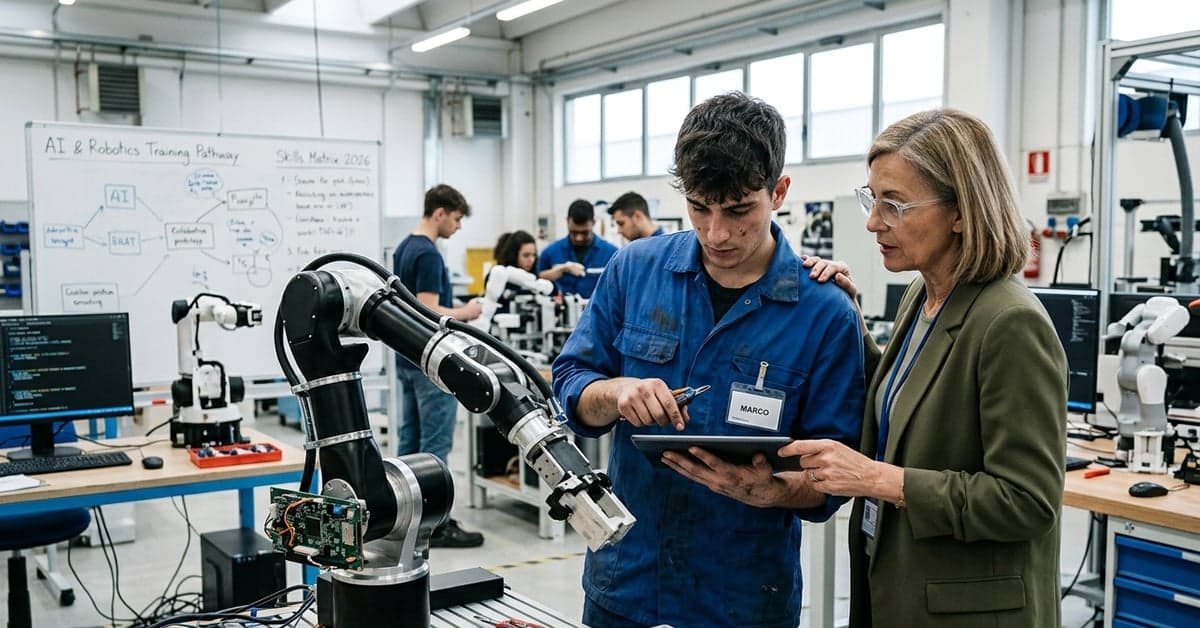
By 2036, 1.2 billion young people will seek work while only about 420 million jobs are projected, the UN Youth Office warned on August 11, 2026. The same brief says artificial intelligence will reshape skills demand at speed. Against that backdrop, the ILO lifelong learning agenda reads less like policy theory and more like a survival plan.
What the ILO lifelong learning agenda requires now
The International Labour Organization’s skills program boils down to four moves: governments need forward-looking skills policies; schools must adopt new technologies and prioritize digital skills; employers should invest in training and reskilling; and workers must treat learning as a career constant. That framing appears on the ILO’s topic portal for skills and lifelong learning, which also compiles evidence that training works. According to the ILO page citing IRPP (2021), skills training raises a participant’s chance of getting a job by 14%. The same page, pointing to the UK’s National Apprenticeship Service (2018), reports that 86% of employers see more relevant skills from apprentices.
The ILO also quantifies AI’s upside. Its 2023 analysis estimates generative AI could augment at least 13% of jobs worldwide, across regions. That matters because the UN Youth Office, summarizing research from the IMF and World Economic Forum on August 11, 2026, notes that AI could affect almost 40% of jobs, with technology creating 170 million roles and displacing 92 million by 2030. Put bluntly: there is a wide gap between jobs affected and jobs upgraded. The ILO lifelong learning mandate is how countries and companies move work into the “augmented” column.
Lifelong learning in practice: apprenticeships that stick
Work-based training scales because it solves two problems at once: it builds employer-relevant capabilities while keeping people attached to the labor market. The ILO portal’s apprenticeship figures track what many firms already report anecdotally: on-the-job pathways cut mismatch and speed time-to-productivity. That is why a green transition story on the same portal—spotlighting young workers in South Sumatra pivoting away from coal in August 2026—rings true. When sectors evolve, the fastest path is often a short, job-embedded program, not a four-year reset.
For policymakers, that suggests prioritizing modular routes. A six-week safety course for wind technicians paired with a paid placement can move a displaced miner into a growth sector before savings run out. For employers, the math is direct: if apprenticeships raise the relevance of skills for 86% of firms, then building a repeatable apprentice-to-hire model is a predictable way to fill hard roles without bidding wars.
Digital skills need the same pragmatism. The ILO emphasizes that education systems should adopt new technologies and foreground digital basics. Make that visible: hands-on projects, vendor-neutral certifications, and task-focused micro-credentials. The goal is less “learn to code” as a slogan, more “learn to query data, validate outputs, and document changes” as a routine.
Design for augmentation, not churn
Two numbers set a design brief: the IMF’s “almost 40% of jobs affected” and the ILO’s “at least 13% augmented.” Those are not contradictions; they describe the same transition from different angles. The risk is churn—workers pushed out of roles faster than they can re-enter. The fix is task redesign, backed by training and new tools, so AI changes the job before it replaces the worker.
That means moving routine steps to AI while raising the share of human work in non-routine tasks: troubleshooting, judgment calls, client communication, safety checks. It also means paying for time to learn. If employers expect teams to integrate new systems, then protected hours for practice are part of the job, not an after-hours favor.
- Set augmentation targets at the task level. Track which steps get AI assistance, which stay human, and why.
- Budget for micro-credentials linked to those tasks. Tie completion to pay progression or role expansion.
- Publish “AI + apprenticeship” pilots in high-turnover roles. Measure error rates, time-to-competence, and retention.
According to the ILO skills portal, governments have a matching role: steer policy and funding to programs that prove placement or progression. That is where evidence—like the IRPP 14% job-lift from training—should govern grants and tax credits. The point is not more courses; it is more mobility.
Turning ILO lifelong learning into policy and budgets
Several moves convert principle into practice fast:
- Fund outcomes, not seat time. Tie public money to verified placement or wage gains six months after completion, drawing on the ILO’s evidence base for training impact.
- Stand up sector skills councils with employer majority. Use them to define short, stackable curricula for critical roles—technicians, care workers, logistics coordinators—updated each quarter.
- Back apprenticeship hiring with predictable incentives. Make the incentive expire if training quality or completion falls below a threshold verified by external assessment.
- Create a national registry of micro-credentials. Require plain-English descriptions of the tasks each credential covers and how employers can verify competence.
- Require AI literacy across public education. Focus on prompts, verification, data ethics, and safe-use policies that map to everyday work.
For employers, the parallel checklist is shorter: name the roles you cannot fill; map the tasks most likely to be automated; and launch a dual-track response—an apprenticeship to fill the role and a learning sprint to move current staff up the value chain. The ILO lifelong learning playbook is agnostic to sector. Construction, retail, and healthcare can all run this cycle if success is measured the same way: output, error, and time-to-competence, not course hours completed.
What the numbers mean for young workers
The UN Youth Office highlights the stakes for first-time jobseekers. On August 11, 2026, it set the scene with a stark projection: 1.2 billion young people entering the labor market against roughly 420 million jobs. It also cites World Economic Forum estimates that by 2030, technology could create 170 million roles while displacing 92 million. If AI affects almost 40% of jobs, as the IMF estimates, then a large share of entry-level work will change during a single cohort’s first five years.
That is why the ILO’s emphasis on digital and human capabilities—communication, problem-solving, ethical judgment—matters as much as technical training. These are the skills that let new workers adopt tools, not fear them, and that help them move laterally when sectors lurch. And because the ILO’s data points to real gains from apprenticeships and targeted courses, countries with tight budgets have somewhere concrete to start.
The path forward is clear enough. Blend policy and practice so more jobs land in the “augmented” bucket. Use apprenticeships to anchor transitions. Fund only what moves people into work or up the ladder. If governments, schools, and employers align on that, ILO lifelong learning becomes less a slogan and more an engine for turning an AI shock into a youth dividend.