
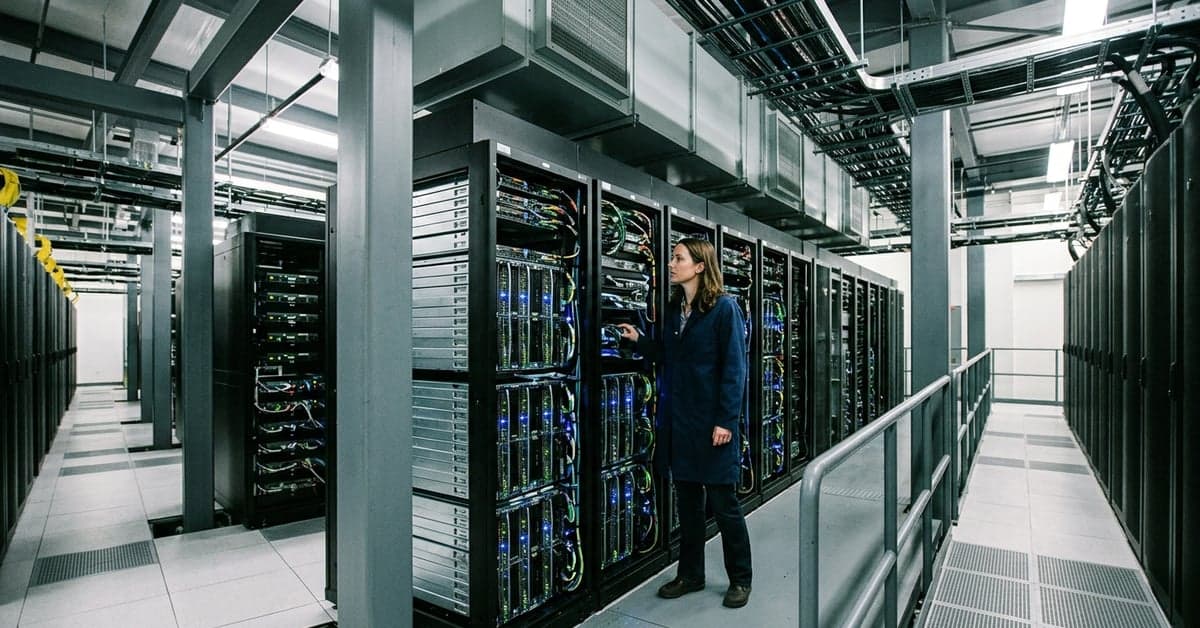
The U.S. Department of Energy says its Genesis Mission will connect the nation’s top supercomputers, experimental facilities, AI systems, and unique datasets through a new American Science and Security Platform. The agency describes the effort as a cross-sector push spanning national labs, industry, and academia to speed discovery in energy, basic science, and security (Department of Energy).
What DOE is building with the American Science and Security Platform
DOE’s overview frames the American Science and Security Platform as a complex, integrated environment that links compute, instruments, and data so researchers can move from experiment to model to application without starting from scratch at each step. It sits inside the Genesis Mission, which aims to “build a national AI-for-science ecosystem,” expand partnerships, and develop new capabilities to accelerate results for the public and for national priorities (Department of Energy).
The department has also opened funding opportunities to advance the Mission’s work on national science and technology challenges, signaling intent to move beyond pilots and into fielded systems. DOE says those challenges are picked to deliver clear benefits for Americans, implying that the platform is meant to serve not just lab insiders but also external partners who rely on federal science for energy, climate, health, and security advances (Department of Energy).
Why a national AI-for-science platform changes workflows
If it delivers on the promise, the platform could let a beamline, a national climate dataset, and a large supercomputer operate as one workflow instead of three disjointed stops. America already hosts world-class systems such as Frontier at Oak Ridge and Aurora at Argonne. DOE’s plan suggests researchers could stream data from instruments into AI models, train or fine-tune at scale, then push results back to facility operations without manual shuttling or ad hoc tooling (Department of Energy).
That shift would matter far beyond convenience. When a materials scientist can route diffraction images into a pre-vetted model catalog, schedule training on a leadership-class machine, and then deploy a lightweight predictor to a facility console, the cycle time shrinks from months to days. The American Science and Security Platform, as described by DOE, is aimed at making those playbooks repeatable across labs and universities, so models, data semantics, and security rules don’t have to be reinvented at every site.
What “integrated” will require: identity, data, and security
Stitching multiple labs and facilities together raises day-one questions about identity, policy, and observability. Expect the platform to depend on shared identity and access management across DOE institutions, riding proven network backbones such as ESnet, which already links national labs. A single sign-on that respects lab-specific rules, project memberships, export controls, and time-limited credentials is table stakes for any integrated platform.
Data governance will be just as important as bandwidth. Provenance, consent, and retention policies need to travel with datasets and models as they move from an instrument to a supercomputer queue and back to a user’s environment. Model registries and dataset catalogs will have to expose audit trails and bias documentation, aligning with emerging best practices like the NIST AI Risk Management Framework. Because DOE emphasizes national security outcomes, expect extra segmentation between open science and restricted workloads, with hardened pathways for any cross-domain transfer.
On the operations side, success will hinge on consistent APIs for scheduling, data movement, and model packaging. That’s what will turn today’s one-off integrations into reusable building blocks. For researchers and startups, the payoff is the same: fewer bespoke pipelines, more time on experiments and products, and a clearer path from a lab proof to real-world deployment on the American Science and Security Platform.
Signals to track: proof the platform is real
DOE says Genesis will “turn vision into action,” but the best evidence will come from concrete milestones that researchers can touch. Here’s what to watch:
- First cross-lab workloads provisioned through common platform APIs, with public examples and repeatable guides.
- Shared data catalogs that let users search and request access across multiple DOE facilities with consistent metadata.
- Vendor-neutral standards from the consortium for model packaging, instrumentation metadata, and reproducibility checklists.
- Grant calls and RFPs that require or reward use of the platform, plus adoption by universities and small companies.
The direction is clear from DOE’s own description: an integrated environment that couples compute, instruments, and data under common governance. If those signals start to land, the American Science and Security Platform will shift from vision deck to daily tool. Researchers get faster cycles, industry gains clearer on-ramps to federal capabilities, and the public sees quicker translation of science into energy and security outcomes. For more on this, see bloomberg.com and nytimes.com.
Related reading: Copilot • OpenAI • Productivity & AI