
1,600 small and midsize business leaders say they want AI, yet many admit they are not ready to deploy it. That tension sits at the heart of the SAS pitch today: anchor AI in governance and real decisions, not just demos. The company is backing that with a new sports deal, a global readiness report, and an emphatic 50-year message about trust. In short, the SAS trusted AI story is less about flash and more about earning a deployment.
What SAS trusted AI looks like in practice
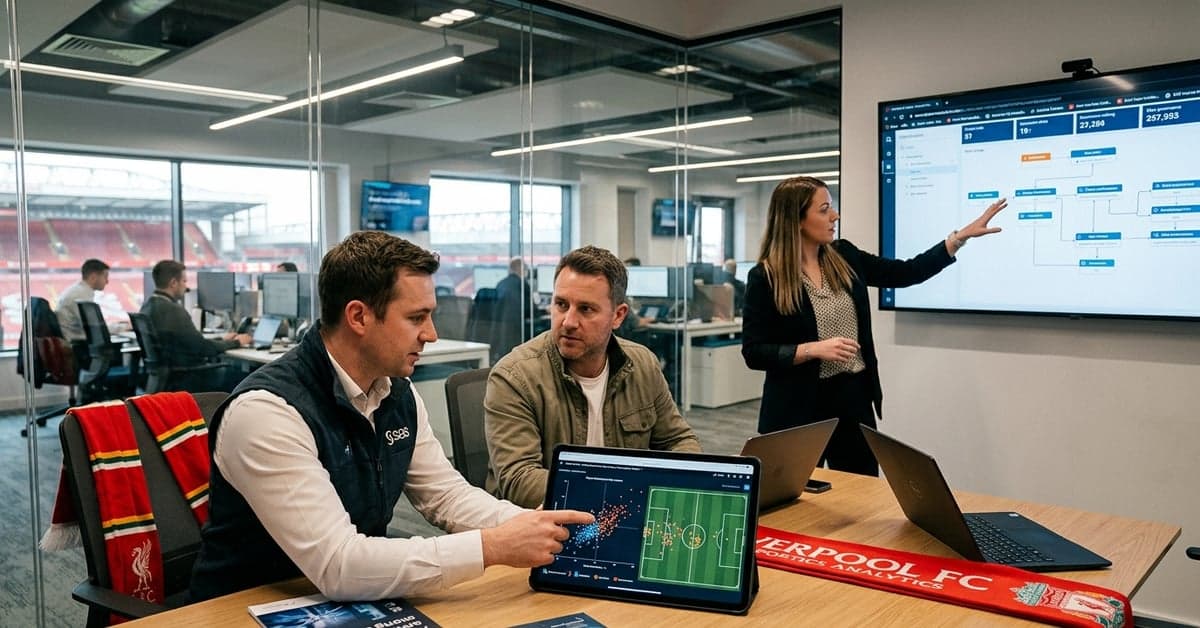
SAS highlights two concrete moves on its site. First, a partnership with Liverpool FC aimed at bringing advanced data and AI into football operations and business strategy. SAS positions the tie-up as a way to feed performance analysis and fan engagement with governed analytics. Second, a global SMB report that polled 1,600 leaders and mapped a gap between ambition and action, paired with an assessment tool to plot the next steps. Both are presented as proof that trust and outcomes, not hype, drive adoption, according to the SAS home page.
Neither example is flashy. That is the point. The Liverpool project aims at real match and commercial decisions. The SMB survey acknowledges that many firms want AI but are stuck, then offers a path forward. Framed together, these moves show how SAS trusted AI is being sold: governance first, outcomes next, and celebrity logos only as evidence that the approach scales.
Why a trust-first AI pitch lands now
Context matters. The current AI boom, as summarized by Wikipedia, is marked by rapid model progress and expanding use across industries. Buyers are also contending with legal, privacy, bias, and IP questions. Many want AI that their compliance teams can sign off on without months of rework or surprise findings.
Contrast that with the tone of model marketing. On its model hub, Google DeepMind showcases Gemini 3.5 and calls out benchmark leads and agent workflows, with scorecards across coding and multi-step tasks (Google DeepMind). Those pages target developers and tout frontier performance. They are useful for capability checks. But they do not answer how a payroll team, a stadium ops crew, or a claims desk should govern and operationalize those models.
SAS leans into that gap. Its message centers on transparency, governance, and decisions that hold up in the real world. For risk-aware buyers, that framing has weight. It sets expectations for audits, monitoring, and lineage. It also implies fewer pilot purgatories and faster time from proof to production.
Sports as showcase: the Liverpool FC tie-up
The Liverpool announcement on the SAS site does two jobs at once. It injects cultural relevance into enterprise analytics. It also provides a public lab for applied data science. SAS says the partnership spans football operations and business strategy, which hints at use cases from training insights to ticketing and merchandising. The choice of a global club raises the stakes: if the models overfit, or the data pipelines drift, it will show on the pitch or on the balance sheet.
Sports has become a proving ground for analytics because impact is visible and fast. A mispriced player, a poorly scheduled recovery window, or a blunt promo offer shows up in results within days. A vendor confident in its stack often embraces that scrutiny. Here, the SAS trusted AI message meets an audience that understands both pressure and iteration.
SMBs, assessments, and the decision to commit
SAS also points readers to a global SMB survey and an “AI readiness” assessment. The number—1,600 leaders—is the sharp detail. It signals breadth without implying a census. The framing matters more than the count: ambition outpaces action. That finding tracks with what midmarket CIOs often report in earnings calls and public forums. Tool sprawl, talent shortages, and unclear ROI block lift-off even when a CEO wants momentum.
The company’s approach is to meet those firms with a staged path. Map where you are, then align governance, data quality, and deployment workflows. It’s a sober answer to a noisy market. It also keeps the focus on how teams make and track decisions. That is the thread tying SMB guidance back to the Liverpool project and forward to any regulated industry that has to show its work.
How the messaging stacks up against model-first hype
There is nothing wrong with chasing frontier capability. Developers need fast, strong models. The Gemini 3.5 page brims with benchmarks, agentic coding claims, and task coverage, and it is clear about the idea: build more capable agents (Google DeepMind). The issue for buyers is translation. Which guardrails fit? How does an audit trail look? What happens when a regulator asks for rationale?
SAS seeks to own that translation layer. Its homepage leans hard on governed AI, with language about transparency and real-world complexity. For teams under scrutiny—from healthcare to banking to public sector—that pitch lands. It does not compete with frontier labs on raw scores. It competes on whether the CFO, the GC, and the board can sleep at night. That is the bet behind SAS trusted AI.
What to watch from SAS next
Events matter in enterprise software because they show product direction. SAS plugs “Innovate on Tour,” a series of one-day stops billed as hands-on and practical. If the company wants to turn its trust-first promise into momentum, those rooms need more than slides. Expect customers asking for concrete blueprints: data contracts, approval workflows, model cards, bias tests, and rollback plans. The site’s emphasis on governance suggests that is where the content will go.
SAS also marks its 50-year run, which serves a simple purpose. It invites buyers to see the vendor as durable. In an AI cycle where startups appear and vanish, tenure can be a filter. That does not win a deal on its own. It does, though, give air cover for teams to pick a platform that can be audited next year and the year after.
The larger signal is consistency. Sports, SMBs, and events push the same idea: measure outcomes, show your work, and make changes traceable. The next tranche of case studies will tell whether the company is converting that into deployments. If those examples keep tying decisions to data with clear governance, the SAS trusted AI pitch will have legs.
In a market obsessed with model races documented on pages like the Gemini hub and chronicled during an ongoing AI boom, SAS is taking a different line. It is selling how to make a call and prove it later. For buyers worried about risk and ready to ship, that may be exactly what they are shopping for—and why SAS trusted AI keeps showing up in the company’s story. For more on this, see reuters.com and bloomberg.com and nytimes.com.
Related reading: Copilot • OpenAI • Productivity & AI