
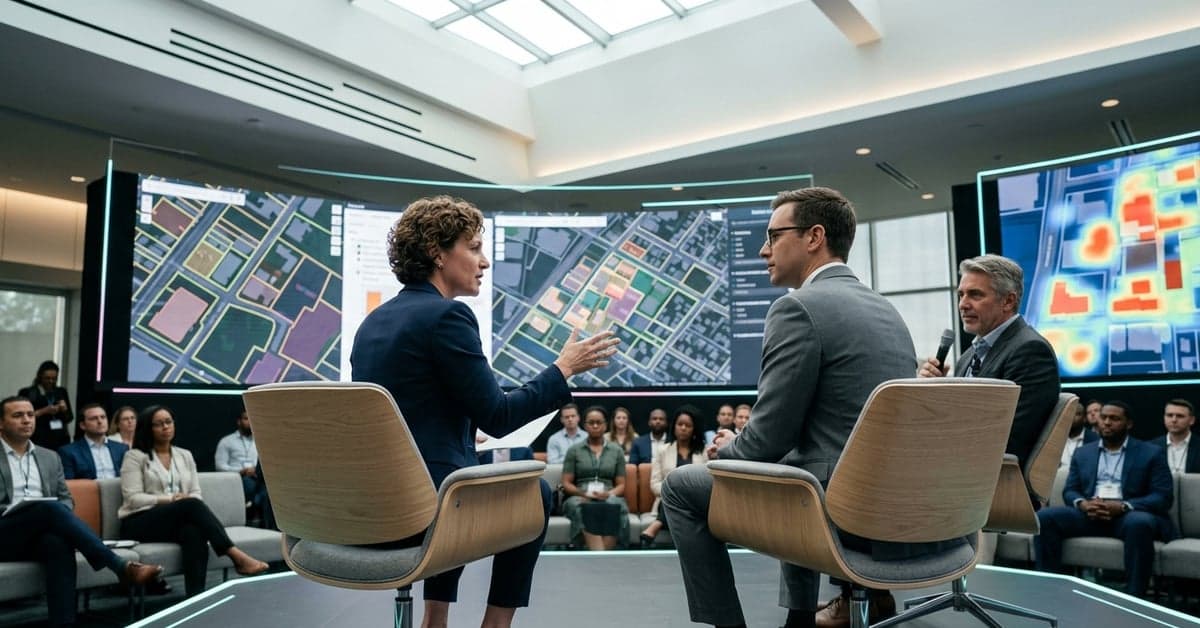
August 2026: the Council for Quality Growth is turning its flagship INTERSECTION Quality Development Conference into an AI stress test for development. The group bills artificial intelligence as “the new playmaker” from permits to punch lists, and says the event will probe site selection, underwriting, construction, infrastructure, and permitting workflows across the region (Council for Quality Growth).
The pitch isn’t just about tools. It’s about the people who make projects happen. The Council’s program aims to put developers, investors, designers, contractors, and public officials at the same table to ask where AI can shave time, cut cost, and reduce risk in a market that has little patience for delay (Council for Quality Growth).
Why the INTERSECTION AI conference is zeroing in on process
The most important question isn’t what AI can do in theory. It’s how gains show up in the balance sheets and schedules that drive projects. Research from Cushman & Wakefield argues that AI’s impact on commercial real estate (CRE) will arrive through “timing, transmission and uneven outcomes.” In plain terms: improvements filter through productivity, hiring, and capital allocation before they hit vacancy, absorption, and pricing.
That frame helps explain the Council’s focus. If permitting becomes faster and more predictable, pro formas change. If underwriting models get sharper, capital stacks adjust. If construction rework drops, contingencies shrink. Each shift ripples across occupancy demand and investment decisions—the fundamentals Cushman & Wakefield tracks with its AI Impact Barometer.
There’s early evidence the low‑hanging fruit sits in process. McKinsey has argued that AI paired with better data can reduce rework and compress construction schedules, especially when models feed into planning and site coordination. That kind of benefit is felt where it matters: fewer change orders, faster inspections, tighter cash cycles (McKinsey).
AI in the built environment: what to watch
Expect the event to push beyond shiny demos toward practical choke points. Three stand out.
- Permitting and plan review: The homepage tease—“from permits to punch lists”—signals interest in digital intake, automated checks, and triage. For cities, the win is cycle-time; for lenders and sponsors, it’s predictability. The hard questions are about audit trails, public records, and when a human must sign off (Council for Quality Growth).
- Site selection and underwriting: Geospatial models can score parcels on zoning fit, utilities, flood risk, transit, and demand drivers—inputs that shape land bids and debt terms. Cushman & Wakefield’s work suggests the big effects come when these model insights change hiring plans and capital allocation, not just slide‑deck optics (Cushman & Wakefield).
- Construction quality and closeout: Computer vision on punch lists and progress tracking can catch misses earlier. McKinsey’s analysis links these tools to fewer defects and tighter schedules, which flow into quicker turnover and earlier rent start dates (McKinsey).
Local calendar: dates around the INTERSECTION AI push
The Council is pairing the program with gatherings that keep the conversation moving. Members can compare notes with leadership at Coffee & Conversations on August 12, 2026, in Sandy Springs, a low‑stakes venue to surface permitting bottlenecks and pilot ideas (Council for Quality Growth).
The organization also set October 1, 2026, for its 37th Annual Four Pillar Tribute at the Georgia World Congress Center, honoring Egbert Perry, chairman of The Integral Group. That stage underscores the link between civic leadership and the built environment the Council serves (Georgia World Congress Center; Council for Quality Growth).
How to prepare before the INTERSECTION AI conference
Developers should audit where time and money vanish between entitlement and CO. Bring two concrete questions: which approvals stall your Gantt chart, and which datasets—utility capacity, traffic counts, plan versions—are least trusted? Those answers steer pilot scope.
Public officials can arrive with a checklist: the current SLA for permit categories, backlog composition, and appeal rates. If you plan to try AI triage, spell out when a reviewer must step in, how models are trained, and how residents can see decisions. That keeps trust intact while cycle times fall.
Contractors and subs should map every handoff that spawns rework. If computer vision flags issues, who fixes them, and how fast do those fixes hit the schedule of values? Clear lanes decide whether tools pay back or gather dust.
Investors can press for the throughline. If AI trims plan review by two weeks, does that reduce interest reserves, shift leasing milestones, or change your exit? Cushman & Wakefield’s framing is a useful filter: track how process wins transmit to cash flow and risk, then underwrite the deltas (Cushman & Wakefield).
The Council set the stakes plainly. AI won’t replace the people who move projects forward; it will reward the teams that change how they work. That’s why the INTERSECTION AI conference matters for everyone from plan reviewers to lenders. The playbook is being written in real time, and the next round of winners will be the ones who test it first (Council for Quality Growth). For more on this, see reuters.com and bloomberg.com and nytimes.com.