
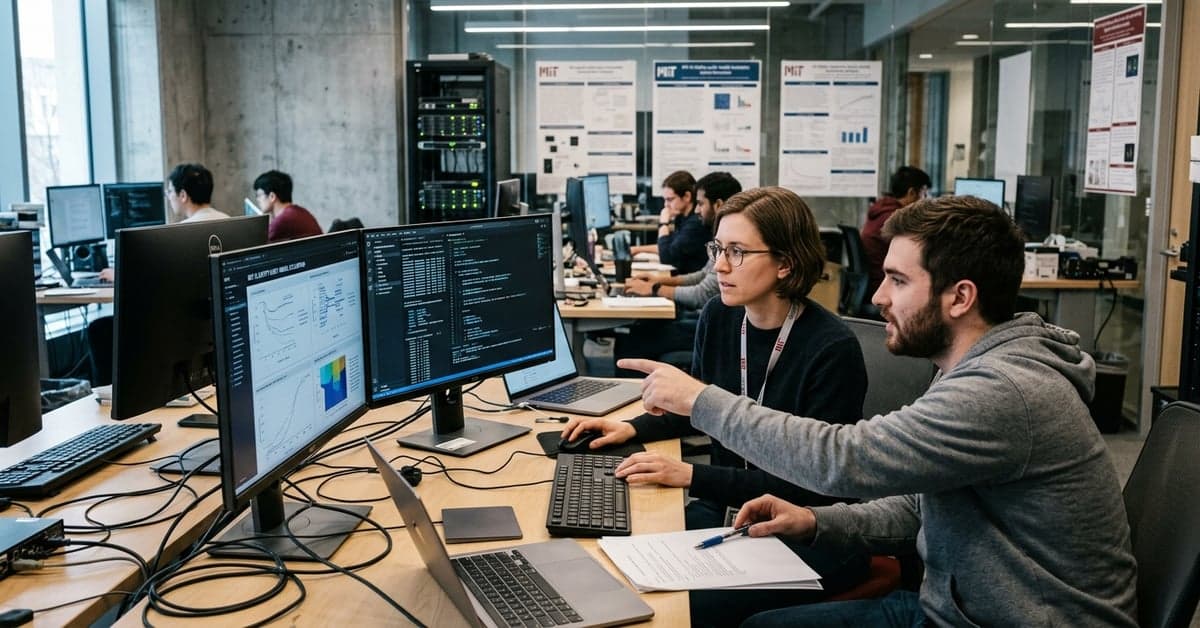
MIT researchers say they have built a way to test whether generative AI models could produce illegal content without ever asking them to do so. The new MIT AI safety audit aims at one of the hardest problems in model evaluation: proving risk without creating evidence of harm. As MIT News reports, the team focused on child-safety threats and other malicious capabilities that raise steep legal and ethical barriers for testing.
How the MIT AI safety audit works without risky prompts
Traditional red-teaming often crosses into sensitive territory by design. Testers push systems to produce disallowed material, then score how fast or how often the model slips. That approach is informative, but it also creates liability, and in some cases, contraband that should never be generated in the first place. According to MIT News, the institute’s method approaches the same question from the other side: it seeks signals of capability and intent while steering clear of illegal outputs.
The core idea is simple: measure whether a model can be nudged into states that correlate with unlawful generation, without letting it cross the line. That means evaluating model behavior around policy boundaries, tracking how it reasons about restricted topics, and checking whether it tries to reroute a blocked request into an allowed one. It’s still an audit of dangerous capabilities, just conducted in a way that doesn’t create prohibited content.
This shift matters because it makes safety work safer. Legal teams have long warned that explicit tests for child sexual abuse material (CSAM) can expose auditors and institutions to serious risk. The MIT approach tries to reduce that exposure while producing evidence strong enough to inform design changes, launch gates, or access tiers. In short, a MIT AI safety audit can flag risk without generating the thing you’re trying to prevent.
What the MIT AI audit changes for labs and platforms
For model makers, a test they can run continuously—during fine-tuning, before release, and after updates—could become part of standard quality control. For platforms, it creates a basis to demand proof from upstream vendors. If a model provider can’t show low-risk scores on a child-safety–focused assessment, a marketplace or app store can set stricter guardrails or just say no.
Enterprises also get something they can ask for in procurement. A vendor that arrives with a documented model safety audit looks more prepared than one that points only to policy text. Independent reviewers can replicate the assessment, compare scores across models, and track drift over time as models evolve.
Crucially, this raises the bar without forcing anyone to generate illegal material for the sake of a test. That could lower the friction for third-party checks, which are often avoided because of compliance concerns. It also gives external trust and safety teams a way to push feedback upstream early, when design changes are still cheap.
Policy context: from the NIST AI RMF to child-protection law
Regulators and standards bodies have been telling industry to test and monitor high-risk AI systems, but they rarely say how to do it when the risk itself is illegal to create. The U.S. government’s NIST AI Risk Management Framework calls for measurable controls and continuous evaluation. An approach that demonstrates capability risk without producing contraband neatly fits that brief.
On the legal side, the U.S. Department of Justice’s Child Exploitation and Obscenity Section underscores the severity of laws around CSAM. Safety teams need ways to validate model behavior without ever creating, storing, or transmitting illegal imagery or narrative content. That’s the compliance gap this method tries to close.
Industry groups have been moving toward clearer guidance as well. The Partnership on AI has pushed for stronger evaluation practices around generative systems; its resources on safety and transparency give implementers a map for what to test and how to report it. Readers can explore that work on the Partnership on AI site. Content provenance efforts, such as C2PA credentials, remain useful too, but they help verify where media came from after the fact. They don’t address whether a base model is inclined to produce contraband at all. That is where a MIT AI safety audit style assessment fits.
What the test can and can’t tell you
No audit is a silver bullet. Models change. Attackers adapt. And risk often migrates from one failure mode to another. A test suite that measures borderline behavior today may miss a new pathway tomorrow. That’s why the most effective programs keep tests fresh and combine them with real-world telemetry and incident reporting.
Another limit: scores can be misread. A low-risk assessment does not mean no risk. It means the system resisted a defined set of probes over a defined period. Organizations should document the scope of a model safety audit, tie it to release criteria, and plan for post-deployment monitoring. Those practices line up well with NIST’s guidance and with the expectations many regulators now set for high-risk AI.
Still, the practical gain is clear. If an auditor can examine a model’s proximity to illegal generation without crossing into it, more audits get done. That improvement alone can shrink exposure for minors on mainstream platforms, where most harm occurs when policy gaps meet scale.
What to watch next for the MIT AI safety audit
The next step is adoption. Do major labs and cloud providers incorporate this type of test into their pre-release gates? Do marketplaces or enterprise buyers ask for results as part of due diligence? According to MIT News, the technique was built to evaluate malicious capabilities without triggering illegal outputs, which makes it easier to standardize and share compared to high-risk red-team artifacts. If that sharing happens, we could see head-to-head comparisons of closed and open models on child-safety risk, not just on coding or reasoning benchmarks.
Researchers will likely try to extend the approach to adjacent harm areas, like grooming detection, nonconsensual intimate imagery, or instructions for violent crime. Each has unique legal contours, but the same testing dilemma applies. Safer audits open the door to more frequent checks, tighter launch policies, and faster rollback when updates go wrong.
The broader signal here is cultural. Safety teams have wanted to move fast without tripping legal wires. Product teams have wanted a single metric they can track sprint to sprint. This method gives both groups a common language for risk at the edge of illegality, and it does so without producing evidence that no one should ever see. If that becomes the norm, the MIT AI safety audit could mark a quiet shift in how the industry proves a model is ready for the real world. For more on this, see reuters.com and bloomberg.com and nytimes.com.
Related reading: Copilot • OpenAI • Productivity & AI