
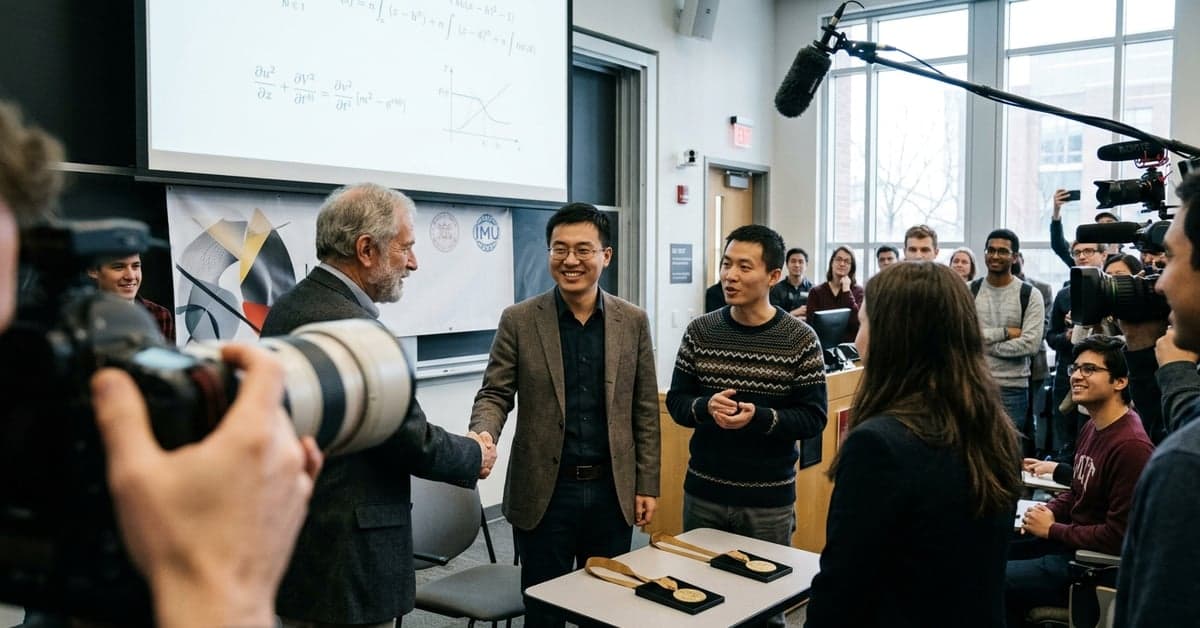
Yu Deng ’11 and Hong Wang PhD ’19 were awarded the Fields Medal, according to MIT News. Two alumni earning the highest honor in mathematics is a statement about training, mentorship, and the long pipeline that feeds elite research. It also puts policy choices about who gets to study and stay in the United States back on the table.
What the MIT Fields Medal wins say about training
The Fields Medal recognizes early-career mathematicians for extraordinary advances. The International Mathematical Union describes it as an award for “outstanding mathematical achievement” with an emphasis on future promise, and it is presented to a small cohort each cycle (IMU). That context matters: the work is hard, the bar is high, and the preparation is long.
MIT’s role in shaping that preparation is impossible to miss here. Both honorees trained at the Institute before their breakthroughs, which reinforces how much world-class teaching and advising can compress years of learning into a few. The Fields Medal is often treated as the Nobel of math. When two alumni are named in the same round, it signals depth in the graduate and undergraduate experience as much as it celebrates individual brilliance.
That signal will travel. Departments that produce Fields Medalists tend to draw the next wave of ambitious students. Faculty recruiting can get easier at the margins. Donors and foundations often take note when a lab or program repeatedly turns out leaders in a field. In that sense, the MIT Fields Medal moment is not only about prestige; it’s also about compounding effects on who applies, who enrolls, and what gets funded.
Immigration policy and the talent pipeline
The celebration landed alongside a candid reminder about policy risk. In a live appearance on GBH’s Boston Public Radio, MIT President Sally Kornbluth argued that immigration rules shape the nation’s research capacity over time. As summarized by MIT News, she said: “You’re not going to see an effect immediately. What’s going to happen is five years, 10 years, 20 years down the line, you’re going to see a pipeline that’s not full anymore—a pipeline of talent, a pipeline of basic discovery …” The point tracks with what science agencies have signaled for years about the role of international students in U.S. STEM.
That warning reads differently the week two alumni bring home the field’s top prize. Honors like these don’t appear from nowhere. They emerge from long training arcs, mixed cohorts of domestic and international scholars, and labs that thrive on open exchange. A restrictive stance today can thin classes tomorrow, then faculty rosters, and eventually the research output that wins a Fields Medal. It’s a lagging indicator with a long tail.
Policy debates around visas and work authorization often focus on short-term job markets. The research system runs on longer timelines. The National Science Foundation’s Indicators library shows how the U.S. research enterprise depends on sustained flows of talent into advanced study. Kornbluth’s framing matches that evidence, and the MIT Fields Medal news gives it sharper stakes.
Prestige, visibility, and where funding follows
A Fields win can change a department’s near-term gravity. Prospective students pay attention to where laureates trained. So do potential collaborators. Visibility also matters for philanthropy and competitive grants, which often hinge on track records and credible bets on future impact. None of that diminishes individual achievement; it documents how recognition ripples across a research network.
For MIT, the alumni honors can shape priorities inside and outside mathematics. Interdisciplinary centers recruit more confidently when they can point to proven pipelines from coursework to discovery. That story travels well to Capitol Hill, to industry partners, and to overseas applicants deciding where to stake five vital years. The MIT Fields Medal moment is an asset in those conversations.
What to watch from MIT mathematics next
Expect applications to spike, seminars to fill, and more applicants asking for time with advisers who trained Deng and Wang. Watch for new courses and reading groups built around the problems that animated their work. Also watch for movement in adjacent fields—analysis, geometry, probability—where rising students will see opportunity and momentum.
For readers outside academia, one thing is simple. Awards like the Fields Medal are a lagging readout of choices made years earlier: who got admitted, who found mentors, and who could stay long enough to do hard work well. That’s why the MIT Fields Medal news lands as both a celebration and a policy nudge. If the pipeline stays full, the next breakthrough has a place to start. For more on this, see reuters.com and bloomberg.com and nytimes.com.
Related reading: Copilot • OpenAI • Productivity & AI