
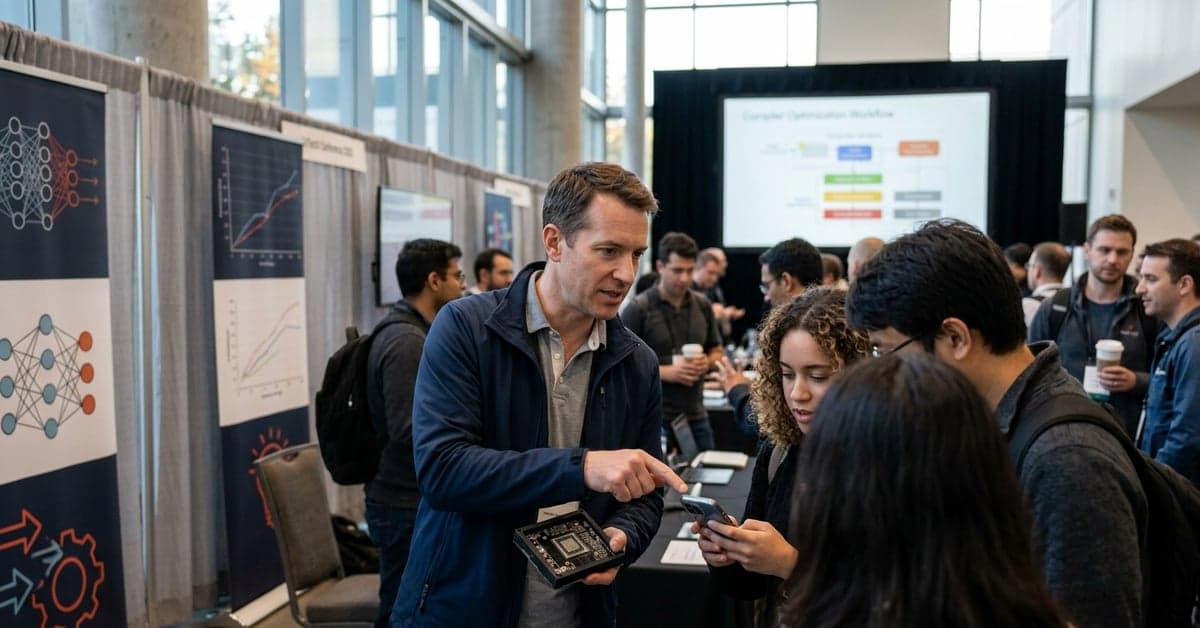
October 20–21, 2026 in San Jose isn’t just another meetup. The PyTorch Conference 2026 is being framed around concrete performance wins, cross‑hardware portability, and compiler work that can cut costs for teams shipping large models, according to PyTorch. That focus lines up with two fresh technical posts: new low‑precision FlashAttention speeds on NVIDIA’s Blackwell GPUs and out‑of‑the‑box Helion support in Hugging Face Kernels.
What PyTorch Conference 2026 is signaling
PyTorch says the San Jose event will highlight open research, tooling, and performance optimization “across compiler architecture, cross‑hardware kernel domain‑specific languages, and more,” in a preview published on September 16, 2026 (PyTorch blog). The message is clear: the framework’s near‑term agenda centers on system‑level gains that translate into lower inference bills and faster training, not just headline model demos. That strategy makes the PyTorch Conference 2026 relevant for anyone who owns throughput, latency, and reliability targets in production.
The framing also reflects how model economics are shifting. Hardware cycles are bringing new peaks, but software stacks decide who reaches them. By turning compiler and kernel work into front‑row topics, PyTorch is telling developers where the biggest multipliers now live.
FlashAttention‑4 on Blackwell: where the speed comes from
On September 16, 2026, PyTorch detailed an extension of FlashAttention‑4 to MXFP8 for forward and backward passes, reporting 2.85 PF/s forward and 2 PF/s backward on LLM shapes (PyTorch blog). On internal shapes, the team cites 2.54 PF/s forward with FA4 MX8. Those numbers matter because attention is the hot path in most transformer workloads. Shaving cycles there directly shrinks cost‑per‑token and wall‑clock training time.
Blackwell’s architecture was built for lower‑precision arithmetic and higher bandwidth, and MXFP8 is engineered to keep accuracy while packing more compute into the same power envelope. NVIDIA’s own framing of Blackwell emphasizes throughput gains and efficiency improvements (NVIDIA). PyTorch’s FA4 update shows how those gains become real for LLMs. If your budget model assumes FP16 everywhere, these MXFP8 paths can rewrite the math on cluster sizing.
For practitioners, the near‑term takeaway is pragmatic: attention kernels are still yielding compound wins when paired with modern formats. Teams that benchmark MXFP8 in pre‑prod will get an early read on accuracy trade‑offs and likely see immediate throughput relief on Blackwell‑class nodes.
Portability as a cost strategy: Helion meets Hugging Face Kernels
The second signal: portability is moving from nice‑to‑have to cost control. On September 11, 2026, PyTorch highlighted that Hugging Face Kernels now ships with Helion support, with guidance on building, autotuning, and distributing portable kernels (PyTorch blog). In practice, that means developers can author kernels once and target multiple back ends, then lean on autotuning to find performance peaks without hand‑crafting each path. For teams juggling mixed fleets or expanding to new accelerators, that’s time saved and lock‑in reduced.
Hugging Face has been pushing standardized packaging around kernels to simplify distribution and reuse (Hugging Face docs). The Helion tie‑in extends that idea to a cross‑hardware kernel DSL, which PyTorch is elevating on the conference stage. The story connects to the compiler track: the more predictable your kernel surfaces, the more a compiler like TorchInductor can do with graph transformations and scheduling.
There’s a broader implication for buyers too. If portable kernels deliver within a few percentage points of best‑case performance, procurement options widen. The cheapest available GPU hour becomes a realistic choice, not a rewrite project. That is exactly the kind of operational leverage the PyTorch Conference 2026 agenda seems designed to surface.
The compiler throughline—and why it matters now
PyTorch’s preview points to compiler architecture as a headline theme in San Jose (PyTorch blog). Compiler work is rarely glamorous, but it determines how much of the theoretical speed from formats like MXFP8 or tensor cores you actually see in production. For latency‑sensitive services, a better fusion pass, smarter layout decisions, or more aggressive graph capture can be the difference between adding a rack or deferring spend.
Expect sessions that tie kernel DSLs to compiler passes, with attention to real deployment shapes: variable sequence lengths, long‑context models, and memory‑bound decode loops. If the FA4 results are any guide, attention kernels and their scheduling will feature prominently, with Blackwell‑specific strategies in the mix.
What developers should watch in San Jose
Three practical threads to track at the PyTorch Conference 2026:
- Low‑precision adoption playbooks: when MXFP8 is “free” speed, when it needs calibration, and how to test accuracy regressions at the task level.
- Compiler‑kernel co‑design: how to write portable kernels that compilers can optimize deeply, and how graph capture interacts with dynamic shapes.
- Cost‑aware benchmarking: throughput and latency targets tied to dollars per million tokens, not just FLOPs, on Blackwell‑class hardware.
Teams that arrive with a short list of production traces—batch sizes, sequence length distributions, and memory profiles—will get more value from hallway conversations and code samples. Bring the shapes that hurt and ask how the new paths handle them.
Why this year’s focus could reset LLM economics
Individually, FA4 speedups and kernel portability are welcome. Taken together, they reshape the slope of cost curves. PyTorch is pointing to a stack where precision choices, attention kernels, and compiler passes do most of the heavy lifting. That lowers the barrier to “good enough” performance on a wider range of hardware, which in turn reduces vendor pressure and broadens capacity options.
The FA4 numbers—2.85 PF/s forward and 2 PF/s backward on LLM shapes—show there is still headroom in core operators when paired with Blackwell and MXFP8 (PyTorch blog). The Helion and Hugging Face Kernels work suggests those gains won’t be siloed to a single vendor or a single hand‑tuned path. That alignment is the real story of the PyTorch Conference 2026 agenda.
For developers and managers alike, the signal is actionable. If your roadmap depends on cheaper, faster LLMs, plan to benchmark the FA4 MXFP8 paths and evaluate portable kernel strategies before year‑end. The sessions in San Jose are set up to make that homework easier—and, if the preview holds, to make the results pay off quickly. For more on this, see developer.nvidia.com and huggingface.co.