
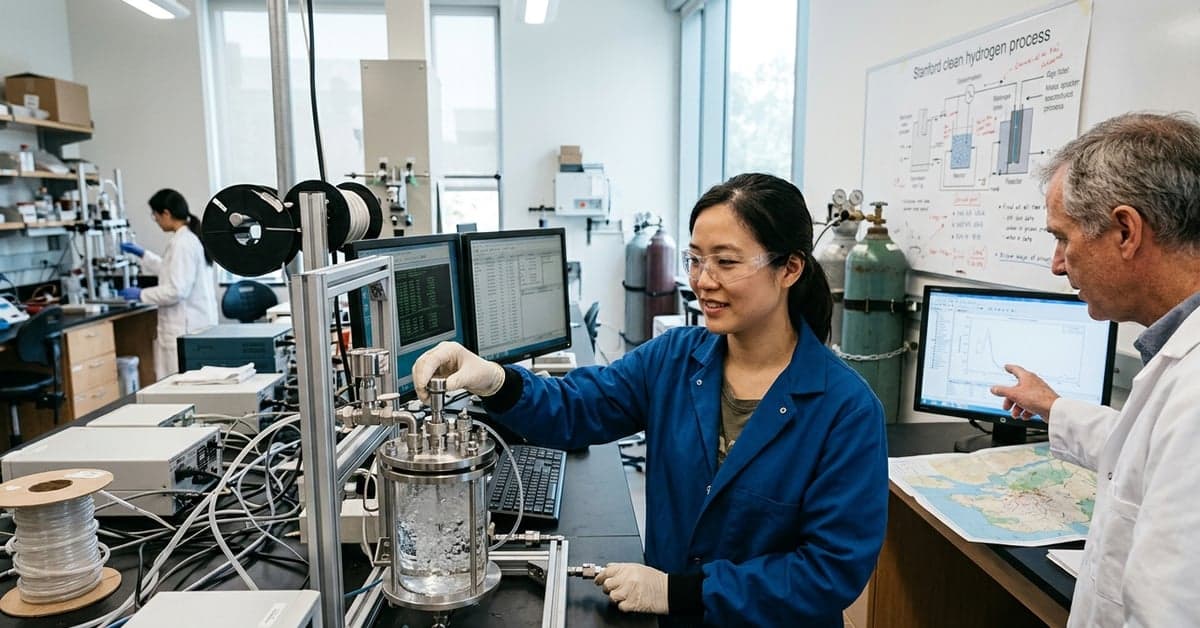
Stanford’s Precourt Institute has committed $6.3 million across 52 new energy research projects, a scale that signals more than fresh papers—it’s a build-out of a full pipeline from lab work to deployment. The Stanford Energy site also flags a September 3, 2026 hydrogen advance and a string of AI-and-policy events later in September and October, the type of programming that turns one-off results into real systems and markets. Put together, it looks like a plan.
What the $6.3M says about Stanford Energy funding
According to the Stanford Energy homepage, the Precourt Institute is backing 52 projects with $6.3 million in awards. The announcement sits alongside program news and seminars rather than as a standalone grant list, which matters: it shows how Stanford Energy funding is being presented inside a larger push that includes methods, translation, and policy. The mix suggests a portfolio approach—many bets, fast iteration, and built-in pathways to scale.
That framing is reinforced by the surrounding updates on the same site. On September 8, 2026, a Stanford Energy report distilled “six strategies” to balance growth, energy security, and sustainability for Southeast Asia’s 700 million residents. On September 3, 2026, a Stanford Report story highlighted a new process that boosts clean hydrogen production by using a novel heating method that cuts carbon emissions. And on August 31, 2026, the TomKat Center said it awarded 11 Innovation Transfer Grants over the last year to student ventures working on lithium recovery, GPU energy efficiency, nitrogen recycling, diesel reduction at ports, and solar-powered education—applied topics by design. The point: research dollars, translation grants, and policy guidance are being woven together.
Readers can find the grant announcement and program slate on the Stanford Energy portal. For broader market context, the International Energy Agency’s Southeast Asia work offers a view of demand and constraints in the region that research teams will confront in the field; its regional brief is a useful complement for readers tracking where ideas might land in practice. The IEA maintains a dedicated overview at iea.org.
Hydrogen science to market: a tell
The hydrogen item is a clear case study. A Stanford Report story on September 3, 2026 described engineers using a novel heating method that both improves hydrogen production efficiency and lowers carbon emissions. It also hinted at a “surprising side benefit,” a sign the team found an unplanned gain in the process. That combination—efficiency and a new lever—tends to attract industrial partners, especially as public money for clean hydrogen scales up in the United States and abroad.
Pair that with U.S. federal efforts like the Department of Energy’s regional hydrogen hubs, which aim to concentrate projects and infrastructure in a few places, and the path from paper to plant gets shorter. DOE tracks the hubs program and related commercialization aims at energy.gov. The timing matters for Stanford teams: methods validated in September could be pilot-ready when procurement windows open, which is when proposals with a credible tech-and-talent stack tend to win.
Seen in this light, hydrogen is not an isolated breakthrough. It’s a marker that basic advances are being lined up with the capital stack and public programs that can carry them out of the lab. That integration is exactly what the surrounding grants and seminars are designed to support.
From lab to startup: TomKat’s grants fill the gap
The TomKat Center’s Innovation Transfer Grants are the bridge between prototypes and first customers. The center said on August 31, 2026 that it funded 11 student ventures during the past year, including efforts in lithium recovery, GPU energy efficiency, nitrogen recycling, port diesel reduction, and solar-powered education. Those are practical problem areas where small gains compound into big system effects. The TomKat Center maintains program details at tomkat.stanford.edu.
Why this matters for the broader effort: the conversion rate from paper to pilot usually hinges on engineering-for-cost and finding a willing buyer. These grants put early teams in front of those constraints fast. They also complement the larger pool of Stanford Energy funding by giving researchers a place to test business models, qualify parts, and gather field data—work academic budgets rarely cover well.
Policy, AI, and the demand side
Growing demand and policy risk can make or break a rollout. Here the calendar speaks. The Stanford Energy events list includes “Sustainable AI: 2nd Seed Grant Webinar” on September 15, 2026; an “AI for Climate Solutions: GRAIL” seminar on September 28, 2026 at the Shriram Center; and a talk on October 5, 2026 by Stanford’s Inês Azevedo on improving U.S. electricity decisions under policy uncertainty. These are not general-interest talks. They function as staging areas where methods meet regulation, operations, and investors.
Link that to the September 8, 2026 report on scaling sustainable growth in Southeast Asia, and a pattern emerges. The same organization surface is highlighting a regional strategy piece while convening AI-focused sessions and spotlighting lab advances. That’s how a research university pulls the demand side into its work: ask where the growth is, set up discussions on the tools that can cut abatement costs, then back teams that can ship.
For developers and founders, the signal is clear. If your work fits inside policy windows and solves a grid, supply chain, or industrial process problem, this is a good time to knock on Stanford’s door. If you need adoption in emerging markets, bring partners who understand the constraints the IEA flags across Southeast Asia. The more your plan matches real demand, the stronger your odds.
What to watch next for Stanford Energy funding
Two things bear watching as the fall slate unfolds. First, whether any of the 52 newly funded projects align directly with the hydrogen process described on September 3, 2026, or with the “six strategies” named on September 8, 2026. Convergence across topics often predicts near-term pilots. Second, how the AI seminars on September 15 and September 28, 2026 shape the next round of seed grants and project scopes. If new calls for proposals emphasize data, simulation, or optimization, expect more cross-pollination between climate science and computer science.
The broader takeaway is about cadence. Stanford Energy funding is arriving alongside targeted seminars and applied grants, rather than in isolation. That cadence helps teams stack milestones: lab validation, early customer, policy fit. It also sets a bar for peer programs. Universities that can sync money, methods, and market ties will ship more.
For readers tracking the space, the official Stanford Energy site is the hub for the grant slate and event details at energy.stanford.edu. The Stanford Report carries research stories that often prefigure where pilots will emerge, and the TomKat Center shows which projects are being stress-tested with customers. Keep an eye on all three. They are now moving in step, and that’s the story behind the headline number.
As more details surface, we’ll be watching whether the next wave of Stanford Energy funding continues to track this same lab-to-market pattern—and whether other schools follow suit. For more on this, see reuters.com and bloomberg.com and nytimes.com.
Related reading: Copilot • OpenAI • Productivity & AI