
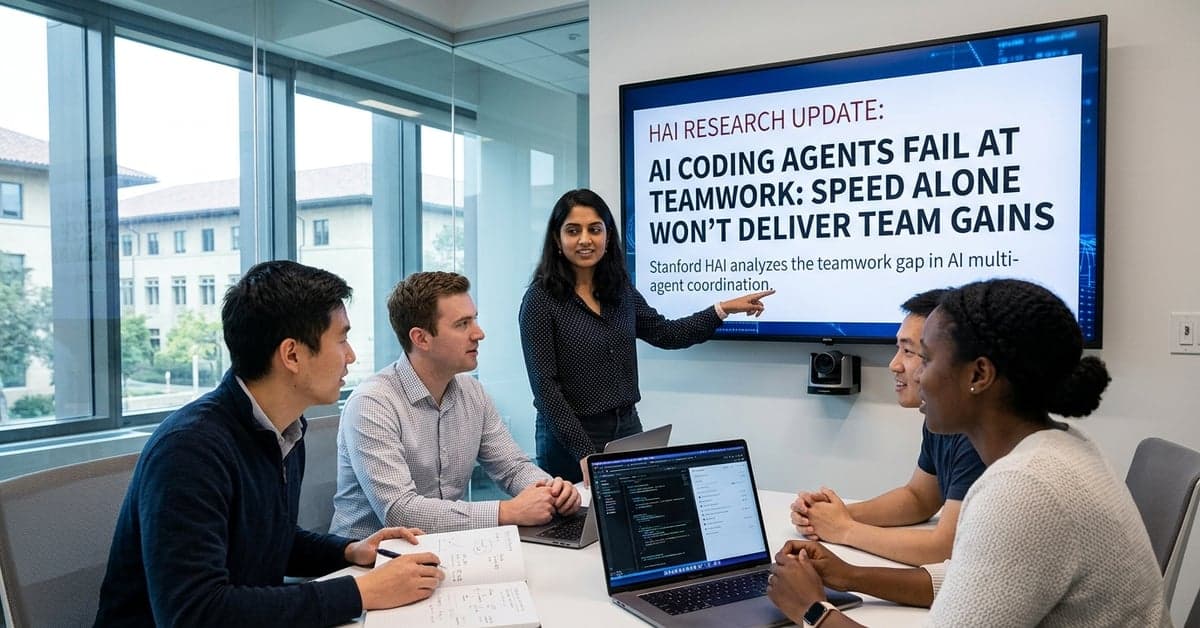
Stanford’s Institute for Human-Centered AI put it plainly on its homepage: “AI Coding Agents Fail at Teamwork,” a news post by Andrew Myers. That headline slices into months of rosy productivity & ai talk with a simple claim: speed alone won’t deliver team gains.
Where productivity & ai hits a teamwork wall
Stanford HAI’s home page highlights work that keeps circling the same point. Single agents can write or edit code. Teams need shared goals, ownership boundaries, and error recovery. When the site elevates a finding that coding agents stumble on teamwork, it signals a gap many buyers haven’t priced in. The institute’s news feed makes that tension visible and current (Stanford HAI).
Productivity & ai pitches often center on individual throughput. But software gets shipped by groups coordinating across repos, test suites, and release trains. If agents can’t resolve conflicts, escalate decisions, or keep context across long-running tasks, the headline result is rework. That’s not a small caveat. It’s the boundary between a fast demo and a dependable pipeline.
What Stanford HAI is really signaling about agent limits
The page’s framing doesn’t dwell on benchmarks. It focuses the reader on behavior that matters in the wild: collaboration. That choice matches the institute’s broader posture toward measurement and governance, from its education and policy work to its long-running AI Index Report that tracks real-world adoption and impacts (Stanford HAI). The takeaway is clear. Teams should expect coordination costs to dominate any early wins from solo assistants.
There’s another clue on the homepage: a news item auditing the output of six commercial chatbots, by Mirac Suzgun and James Zou (Stanford HAI). Audits are a cousin to team tests. Both ask how systems behave under pressure, across multiple steps, with moving targets. In practice, that’s where many deployments stall.
Industry speed meets a coordination bottleneck
Some builders say the era of autonomous agents is already delivering on speed. In a research note, Anthropic says its engineers now ship eight times as much code per quarter as they did across 2021–2025, and describes a shift from simple chatbot helpers to agents that run code and delegate work to other agents (Anthropic Institute). That’s a real signal of acceleration.
But Stanford HAI’s emphasis on teamwork sets an anchor. Gains measured in individual output don’t automatically cross the boundary into group productivity. Multi-agent coordination—ownership, handoffs, conflict resolution—remains the hard part. That’s the difference between a tool that looks fast in isolation and a system that makes a release train faster end to end.
For companies chasing productivity & ai gains in software, the lesson is to test for orchestration, not just code generation. The short list: can agent plans stay consistent across days, keep permissions tight, and surface blocking issues at the right time to a human owner? If the answer is halfway on any of those, the team will pay the tax later in merge conflicts, flaky tests, and outage risk.
Why this matters for policy and the bottom line
Team coordination challenges aren’t just a developer headache. They carry policy and training implications. The World Bank’s 2025 flagship “Digital Progress and Trends: Strengthening AI Foundations” argues that countries need to build the “four Cs” to capture jobs, productivity, and inclusive growth. The message: pay attention to the plumbing that turns new capabilities into broad-based gains (World Bank).
The same mindset applies inside firms. If the core risk is that agents don’t play well together, then guardrails and team process are not optional extras. They are the catalysts for any productivity & ai return. That means clear escalation paths for agents, audit trails that tie changes to accountable owners, and integration tests that trigger before bad handoffs spread.
Stanford HAI’s mix of research, policy publications, and education programs keeps pointing leaders toward these system-level questions. The institute’s focus on how AI affects sectors like healthcare and education mirrors the coordination problem in software. Complex settings punish brittle handoffs. Reliable gains come from designs that make collaboration boring and repeatable (Stanford HAI).
What to do right now if you’re betting on agent tools
Set goals around team outcomes, not agent cleverness. Measure cycle time to production, incident counts tied to agent edits, and reviewer load. If solo-agent demos look great but these numbers drift the wrong way, you’ve learned something useful.
Scope responsibilities narrowly. Give agents bounded tasks with clean interfaces. Favor contracts and tests over free-form prompt chains. Start with documentation updates, test authoring, or code refactors that don’t touch user-facing logic. Expand only when handoffs are clean for a month, not a week.
Make human oversight explicit. Decide when an agent must request review, and who answers. Bake those rules into the tools, not a slide deck. If the oversight path is clear, you’ll see fewer surprises and a better shot at real productivity & ai wins.
Finally, keep an eye on the research signal, not just vendor roadmaps. Stanford HAI’s home page curates the frictions showing up in the lab and in audits. When those posts flag teamwork failures, they’re describing the wall your rollout will hit unless you build for coordination from day one.
The larger point is simple. The next wave of productivity & ai depends less on how fast a single agent types and more on how well systems share context, hand off work, and recover from errors. Stanford HAI just underlined that distinction. Leaders who align plans to that reality will see gains that stick. For more on this, see reuters.com.