
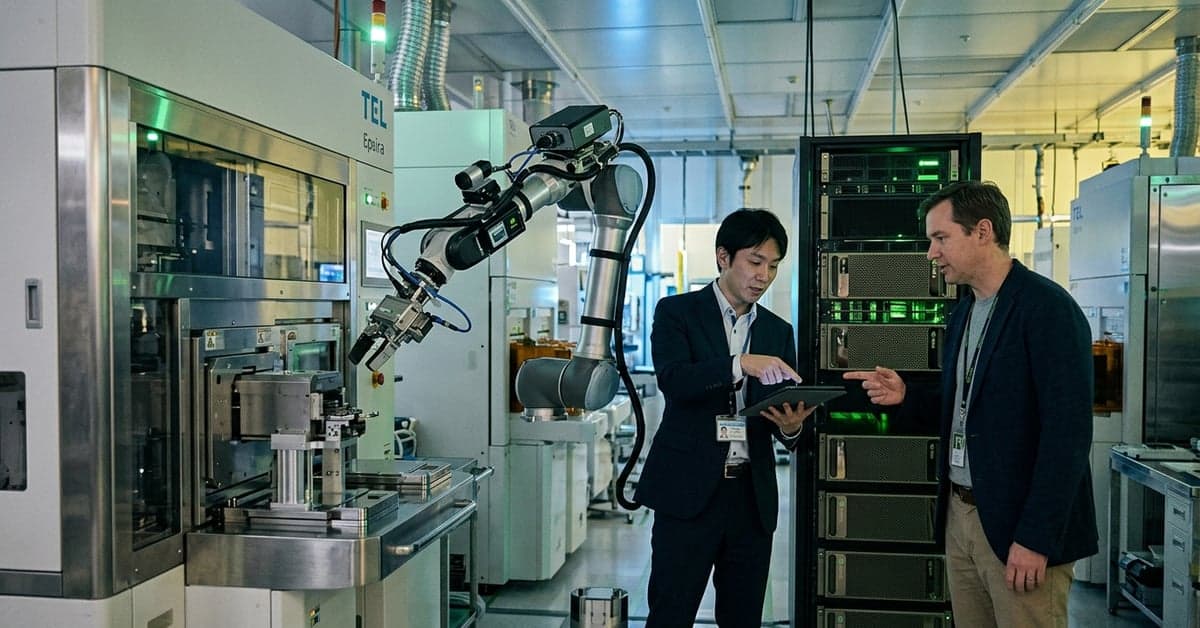
On July 16, 2026, Tokyo Electron said it is expanding its work with NVIDIA to bring agentic AI and robotics into its Epsira digital transformation platform for semiconductor tools. The announcement outlines a technical stack that blends NVIDIA’s Agent Toolkit—including NeMo, NIM, and NemoClaw blueprints—with the NVIDIA Isaac robotics platform and Omniverse-powered digital twins.
What the Tokyo Electron NVIDIA partnership covers
According to Tokyo Electron, the integration centers on two tracks. First, agentic AI for tool intelligence: NeMo will drive agent training, tuning, and evaluation, while NemoClaw simplifies operations and hardens deployment. Second, robotics and simulation: TEL will feed equipment designs into digital twins built with Omniverse libraries, then train maintenance robots via the Isaac platform to handle different tool configurations with higher accuracy.
Epsira’s target is blunt: more uptime and better yields. TEL says the platform aims to boost field production efficiency and increase equipment availability by reducing both scheduled and unscheduled downtime. That includes AI-driven MTBWC (Mean Time Between Wet Cleaning) extension analysis, robotics maintenance routines, and AI troubleshooting to limit tool variability and stabilize process windows.
The Tokyo Electron NVIDIA partnership signals a shift from fab-level analytics to intelligence embedded inside each tool. In practice, that means the agent that flags a drift, simulates a fix in a digital twin, and dispatches or assists a robot could all sit on one unified stack.
Why agentic AI inside fabs is different
Agentic AI moves beyond dashboards. It takes actions. In a fab, that shift matters because the cost of a wrong move can be steep. TEL’s plan puts NeMo-trained agents closer to the equipment, then uses NemoClaw to standardize how those agents are deployed and governed across many tool variants. That addresses a chronic problem in high-mix fabs: similar tools behave differently after years of swaps, upgrades, and custom tweaks.
By pairing those agents with Omniverse digital twins, TEL can test maintenance steps, calibrations, or cleaning schedules in simulation first. The same twin can feed a robot learning loop in NVIDIA Isaac, so the motion plan that works in software is far more likely to work on the floor. That closes the gap between decision and execution, which is where many “smart factory” pilots have stalled.
TEL frames Epsira as a path to “skill-free” operation for core maintenance and troubleshooting. The idea isn’t to remove people, but to codify rare expertise into agents and reusable playbooks that don’t walk out the door when a veteran retires. In a labor-tight industry, that’s no small swing.
From design files to digital twins to robots
Tokyo Electron says it will feed equipment designs directly into the twins it builds, which are integrated with Omniverse libraries. That detail matters. It implies the data handoff from mechanical and electrical design to operations is getting cleaner, reducing the guesswork that plagues physical-first training.
Once a twin exists, Isaac can train robots to service different tool configurations without trial-and-error on live high-value equipment. According to TEL, this helps speed training and improve accuracy across a fleet that never looks identical after years in production. That could compress the time it takes to roll out a new maintenance flow across sites, and lower the risk of regression when a procedure changes.
This is where the NVIDIA partnership could compound: Omniverse provides a common simulation substrate; Isaac handles robot perception and control; NeMo and NIM supply the language and reasoning layer for agents that explain steps, request confirmation, or escalate. With those layers aligned, more of Epsira’s “autonomous equipment” vision becomes testable before it touches a tool.
How the NVIDIA partnership moves from pilots to fabs
Tool-by-tool deployments live or die on standardization. TEL cites NIM, NVIDIA’s inference microservices, as part of the stack. NIM packages models and endpoints into containers for consistent rollout and scaling. NemoClaw then adds operational templates and security controls for agent behavior. Together, they reduce the bespoke engineering that often slows industrial AI beyond the pilot cell.
Governance is the other hurdle. Fabs need audit trails for the “why” behind an action, from a cleaning extension to a parts replacement. NeMo’s role in agent evaluation helps here, because it allows systematic testing against known failure modes before agents encounter them on a production tool. TEL’s statement ties these elements into its goal of minimizing variability and maximizing equipment stability across sites and vendors.
The upshot: if TEL can ship Epsira packages where the same agent, the same twin, and the same robot policy work across a class of tools, the operational lift lands once and scales many times.
What to watch next in Epsira’s rollout
Three areas will show whether this collaboration meets its promise. First, MTBWC extension outcomes. If agent-guided cleaning changes push the interval without sacrificing yield, fabs get immediate hours back. Second, cross-configuration portability. The more a procedure trained in one twin transfers to another, the lower the cost of variation. Third, operator trust. Agents that explain steps and cite twin-based tests will earn time on tool faster than black boxes.
Vendor strategy also matters. With a top-tier equipment maker adopting NVIDIA’s stack, the ecosystem around NeMo, NIM, and Isaac gets a high-stakes industrial testbed. That could influence suppliers upstream and down—from component makers instrumenting parts for better twin fidelity to integrators building pre-validated maintenance flows that drop into Epsira with minimal tuning.
Tokyo Electron has framed Epsira as infrastructure for data-driven, low-variance operations. If agents trained on TEL data and Omniverse twins consistently cut unplanned downtime and raise first-pass fix rates, fabs will treat the Tokyo Electron NVIDIA partnership as more than a press release. They’ll treat it as a template.
Why it matters: Moving agentic AI and robotics inside the tool collapses the loop between diagnosis, simulation, and action. That’s how downtime falls and yield steadies.
For now, the pieces are clear, and the stakes are, too. The next set of Epsira deployments will show how far a unified stack—agents via NeMo and NemoClaw, twins in Omniverse, and robots with Isaac—can carry fabs toward what TEL calls autonomous equipment. If that holds, the Tokyo Electron NVIDIA partnership could set the playbook for AI-driven maintenance across the industry.