
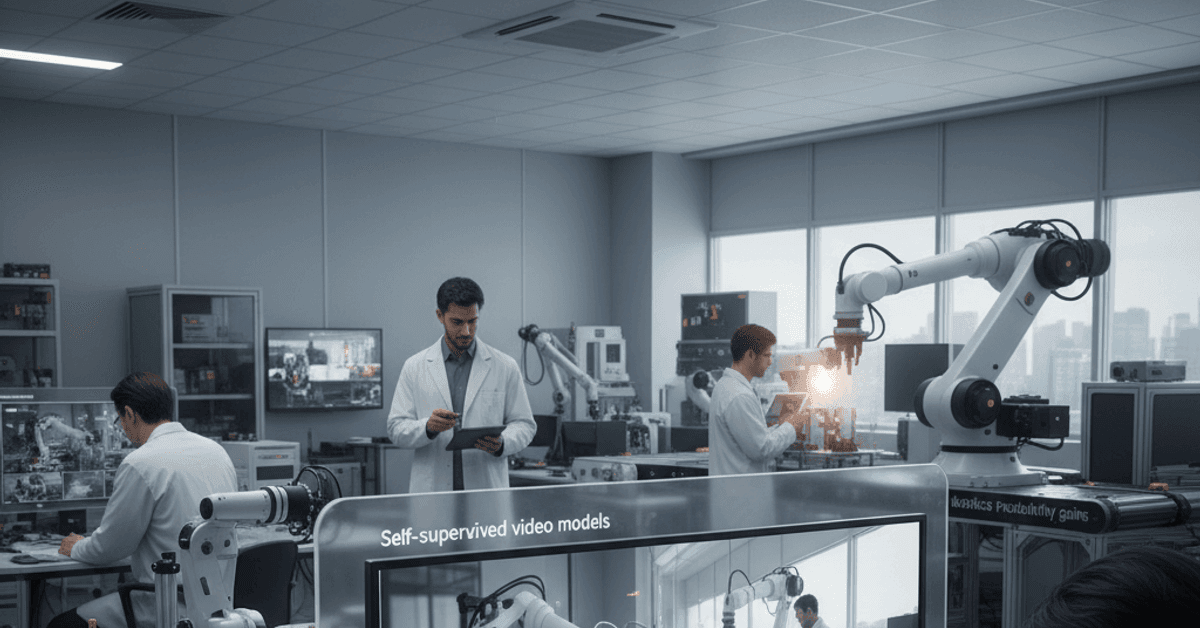
A new wave of video predictive learning is crossing from research labs into day-to-day work. The technique trains models to predict what happens next in raw video. As a result, systems learn physical patterns without labels. That shift points to productivity gains in robotics, automation, and safety-critical workflows.
Recent studies highlight why this matters. Meta’s V-JEPA project shows how models can form a basic physical intuition from ordinary videos. These systems flag violations of expected behavior, much like surprise in infants. The approach could help machines plan more reliably in complex settings. Researchers discussed these findings in depth via coverage of V-JEPA’s results.
How video predictive learning could reshape productivity
Teams want automation that adapts, not just repeats. Because predictive training relies on patterns, it can generalize across scenes. That flexibility matters in warehouses, hospitals, and field operations. Moreover, it promises fewer hand-crafted rules and less brittle behavior.
Consider daily tasks that hinge on timing and motion. A robot that forecasts how boxes slide can grip better and move faster. A camera that predicts a person’s path can slow a cart before a hazard. Therefore, predictive models can drive both speed and safety. Managers measure that as higher throughput with fewer incidents.
The gains extend beyond robots. Video-aware tools can summarize shifts, detect anomalies, and propose process tweaks. Because the model learns dynamics, it can catch subtle drifts early. That means fewer surprises on the line and quicker root-cause analysis. Consequently, teams spend more time improving and less time firefighting.
From lab demos to safer automation
Safety remains the first test for automation at work. Real streets, factory aisles, and loading docks present edge cases. Today’s systems still stumble on rare events and ambiguous signals. Predictive video training aims to cut those misses by modeling cause and effect.
Recent incidents in autonomous driving underline the stakes. Reports of vehicles mishandling school bus stops have drawn scrutiny. Investigations and software updates show how challenging real-world perception remains. For context, Engadget detailed a new recall tied to stop-sign behavior and flashing lights in an autonomous fleet (full report).
Better predictive models could help systems anticipate such scenes earlier. Buses, gates, chains, and temporary barriers require scene-level understanding. Additionally, models need to reason about what should happen next. That expectation can trigger an earlier slow-down or a complete stop. Regulators emphasize rigorous validation for these behaviors. The NHTSA automated vehicles safety guidance outlines key expectations.
In industrial settings, similar logic applies. Forklifts, humans, and pallets share tight spaces. Predictive video can reduce blind spots and awkward handoffs. It can also support policy checks, like safe distances and marked zones. Consequently, safety metrics and uptime can improve together.
Self-supervised video models and real-world constraints
Traditional vision systems depend heavily on labels. However, labels lag behind reality in fast-changing workflows. Self-supervised video models learn directly from motion and continuity. They watch, predict, and adjust their “world model” over time.
This approach scales to massive datasets. It also reduces the cost of curation. Because videos are plentiful, learning can cover many scenarios. Furthermore, the models capture higher-level structure, not just pixels. That structure supports planning and foresight in dynamic tasks.
Nevertheless, deployment demands guardrails. Predictive models can overfit to camera quirks or narrow contexts. Teams should diversify scenes, lighting, and environments during training. They should also monitor drift and recalibrate schedules. MLOps maturity becomes a decisive factor in outcomes.
AI literacy at work: skills, trust, and governance
Technology adoption rises with clear guidance and shared vocabulary. Employees need to understand what predictive systems can and cannot do. They also need easy feedback channels to flag odd behaviors. Public efforts to spread AI literacy have grown fast this year. The Verge profiled one creator who explains AI risks and myths to broad audiences (read the feature).
Enterprises can mirror that model internally. Short explainers help teams grasp key concepts like uncertainty and bias. Regular demos build intuition about edge cases. Meanwhile, transparent incident reviews strengthen trust. Over time, literacy reduces friction and speeds safe rollout.
What leaders should track next
Leaders do not need to wait for a perfect model. They can shape productive pilots now. The following practices balance ambition and control:
- Start with low-regret, high-observable tasks. Because visibility is high, teams can iterate quickly.
- Use scenario libraries with rare events and near misses. Moreover, refresh them monthly.
- Pair predictive video models with rule checks. Therefore, policy constraints remain explicit.
- Instrument everything. Capture predictions, confidence, and outcomes for post-run reviews.
- Run red-team tests for safety edge cases before each release.
- Publish short, plain-language notes for frontline staff after changes.
Vendors should also report failure modes and calibration windows. That transparency helps customers plan retraining cycles. It also clarifies when a model’s world view drifts. Consequently, organizations can budget time for updates without surprise downtime.
Measuring robotics productivity gains
Metrics matter when budgets tighten. Teams should move beyond raw accuracy scores. They should track cycle time, exception rate, near misses, and recovery time. Additionally, they should measure human workload and cognitive load. Those signals reveal whether automation truly helps.
Previously, Predictive systems can shorten exception handling. They can escalate earlier and provide context. As a result, operators resolve issues faster. Over weeks, that reduces backlog and overtime. Over months, it compounds into meaningful throughput gains.
Finally, cross-functional reviews align incentives. Safety, operations, and data teams should share dashboards. Because goals sometimes conflict, shared views prevent blind spots. This alignment keeps speed and safety advancing together.
Research to watch and practical horizons
The research pace is brisk. World models trained on diverse videos continue to improve. They handle object permanence, occlusion, and dynamics more robustly. Wired’s look at V-JEPA outlines why these capabilities matter for planning. Readers can explore the technical framing in that deep-dive analysis.
Adoption, though, will hinge on rigorous evaluation. Benchmarks should reflect real floor conditions, not just clean datasets. Moreover, procurement should demand auditable logs and clear rollback plans. The path from promising demo to durable tool runs through governance.
Regulators will keep pressing for evidence. Safety cases, traceability, and rapid patching are becoming standard. Organizations that invest early in these muscles will ship sooner. They will also recover faster when incidents occur. Industry guidance, such as the NHTSA automated vehicles resources, remains a helpful reference point.
Conclusion: steady steps toward reliable, useful AI
Video predictive learning offers a practical bridge from perception to planning. It learns from the same streams workers already generate. Consequently, it can make robots steadier, cameras smarter, and reviews faster. The result is a quieter, more predictable workday.
Still, progress will come in staged releases, not leaps. Teams that pair literacy, measurement, and safety will lead. With those basics in place, predictive video models can turn curiosity into capacity. They can turn raw footage into fewer errors and more output. That is the productivity story to watch as the next wave of AI tools arrives.
For continued updates and background, see the V-JEPA coverage on Wired, recent safety discussions anchored by Engadget’s reporting, and the U.S. regulator’s automated vehicles guidance.