
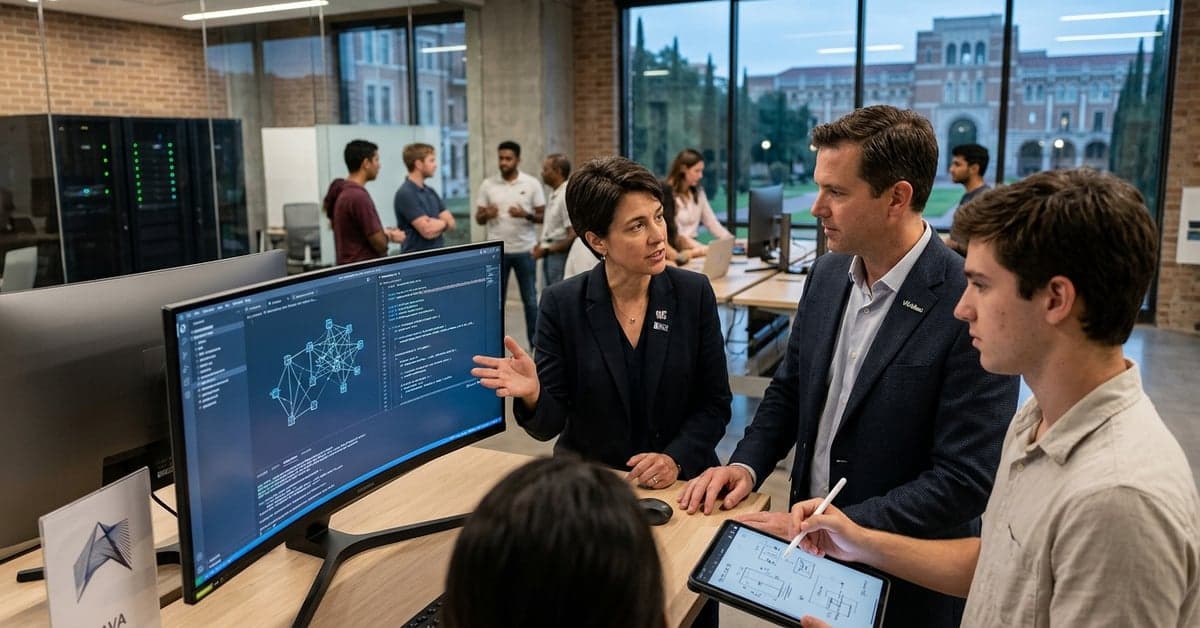
On September 9, 2026, Viridien said it became the Scientific Compute Anchor Partner for the Rice AI Venture Accelerator (RAVA). According to Viridien’s announcement, the role gives RAVA’s early-stage companies access to the firm’s scientific computing expertise, scaling guidance, and enterprise-grade infrastructure. The company cites a compute capacity above 700 PFLOPS, more than one million HPC jobs processed daily across its hubs, and a ranking among the top five industrial HPC operators outside the hyperscalers, based on Goldman Sachs analysis. The Viridien Rice AI Venture Accelerator partnership aims to help founders move faster from experiments to optimized production.
What the partnership actually puts on the table
RAVA is designed to connect founders with Rice University’s research, talent, and industry network. Viridien brings long-running HPC operations experience to that mix. That pairing matters because AI projects in science and industry often stall when prototypes meet compute limits, cost shocks, or reliability gaps under real workloads. The Viridien Rice AI Venture Accelerator tie-up attempts to close that gap by offering production-minded infrastructure and operational help at the accelerator stage, not months later.
Hyperscaler credits have become the default path for many startups, but they can nudge teams toward architectures that get expensive as usage scales. Analysts have flagged inference as a rising cost center for AI companies; for background, see a16z’s discussion of AI platform economics. An industrial HPC operator offers a different tradeoff. Rather than on-demand elasticity, founders may gain steadier throughput and predictable scheduling, features prized in simulation-heavy or batch workloads. For context on scale, the TOP500 ranking tracks the world’s fastest supercomputers, and 700+ PFLOPS places an operator in serious territory even outside the largest cloud players. Understanding how that capacity is carved up—and on what terms—will be central for startups weighing options.
Why the Viridien Rice AI Venture Accelerator tie-up matters
Scientific and industrial AI is not just another SaaS. Models fuse with physics, chemistry, and sensor streams. Jobs run in bursts, then wait on results. Data may live near instruments, rigs, or factories. An anchor partner steeped in HPC can help translate those realities into production practices—queue management, resource allocation, and repeatable performance under load. Viridien’s claim of more than one million HPC jobs a day suggests the company has tuned workflows at scale, which early-stage teams can borrow rather than reinvent.
Rice University’s ecosystem adds the other half of the equation: a steady flow of domain problems and talent. The university signals a growing focus on AI across labs and departments; its community stands to benefit if startups can keep complex compute on track without losing months to tooling and cost whiplash. Readers unfamiliar with Rice can explore its research footprint at rice.edu. If RAVA founders can pair that pipeline with Viridien’s industrial HPC operations, the program could become a landing zone for science-first ventures that often struggle in cloud-first accelerators.
RAVA’s compute promises, in practice
Viridien says its role includes scientific computing expertise, scaling guidance, and access to enterprise-grade infrastructure. For founders, three questions follow: how resources are allocated, how costs compare over a year, and what support exists when jobs fail at scale. Those answers will determine whether this is a small pilot lane or a genuine runway to production.
Not every startup will benefit equally. The partnership looks most relevant to teams whose models and data patterns match HPC-style workloads:
- AI paired with simulation or physics-informed training that requires consistent, high-throughput runs
- Industrial inspection or time-series analytics pulling from dense sensor networks
- Geospatial and subsurface analysis where data locality and repeatability matter
- Bio and materials discovery that blends experimental data with large compute sweeps
Founders building consumer apps or light inference services may still prefer hyperscaler elasticity and global reach. For readers new to the term, hyperscale computing refers to architectures operated by firms like AWS, Microsoft, and Google. The value of the Viridien Rice AI Venture Accelerator will rest on whether it offers a credible alternative path for compute-heavy companies that need predictable performance and mature operations early.
What to watch next from RAVA and Viridien
Press releases are promises; programs are proof. Over the next two cohorts, watch for specifics that reveal how much this partnership can bend the cost and time curves:
- Transparent access terms: quotas, scheduling windows, and any discounted usage for RAVA startups
- Operational support: runbooks, incident response, and help bridging from prototype scripts to production workflows
- Data governance: policies for sensitive industrial data, audit trails, and portability if a startup later moves providers
- Founder outcomes: time from demo to first paying pilot, and how compute choices influence gross margins
According to Viridien’s statement, RAVA selected the company for the depth of its scientific computing and its record running highly optimized environments at scale. If those strengths show up in founder results, the Viridien Rice AI Venture Accelerator could become a template for university programs that back science-first startups with non-hyperscaler compute from day one.
The early signal is clear: pairing an academic pipeline with an industrial HPC operator gives scientific and industrial AI ventures another path to production. If the Viridien Rice AI Venture Accelerator delivers steady throughput, clear economics, and hands-on guidance, it may nudge a slice of startups to build off cloud credits—and on to infrastructure shaped for their workloads. For more on this, see nytimes.com.
Related reading: Copilot • OpenAI • Productivity & AI