
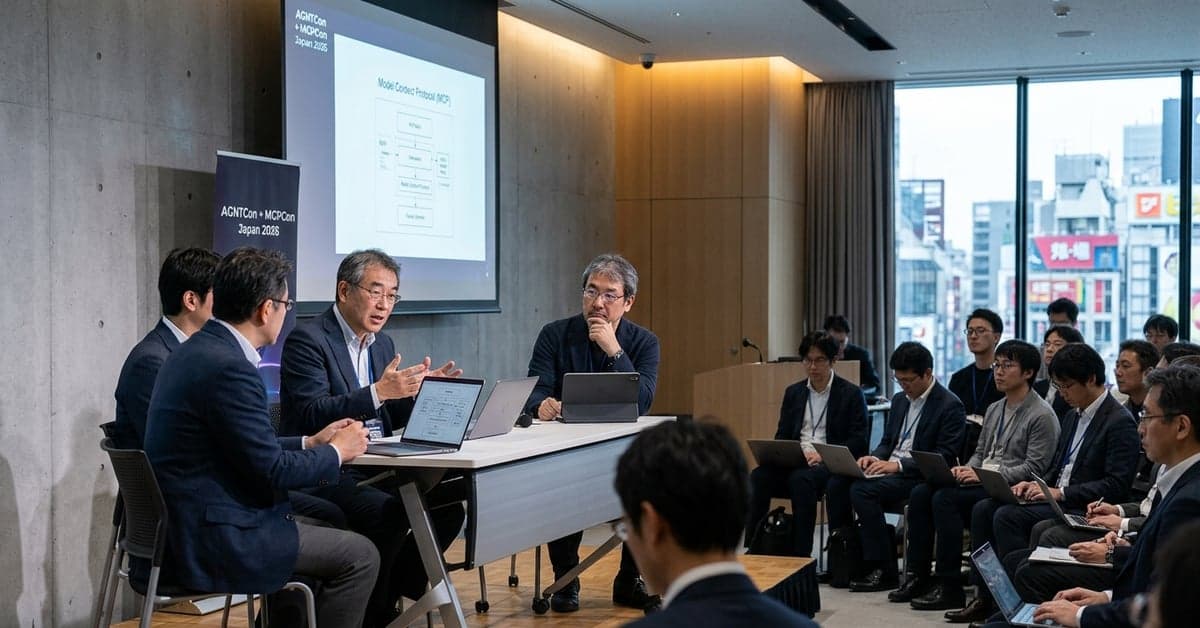
On September 10-11, 2026, the Agentic AI Foundation will host AGNTCon + MCPCon Japan at Belle Salle Shibuya Garden in Tokyo, bringing leaders from SoftBank, Hitachi, NTT, Google, Microsoft, and Anthropic together to tackle production concerns for AI agents, according to the group’s announcement on PRNewswire. The two-day program centers on standards, infrastructure, security, and governance—the gritty work required before automation touches core systems. That makes AGNTCon Japan 2026 less a show-and-tell, and more a stress test for how fast agents can move from labs to line-of-business software.
Inside AGNTCon Japan 2026: the hard problems on stage
The agenda is blunt about where teams struggle: designing reliable multi-agent systems, evaluating behavior, enforcing approval gates and audit trails, and verifying outputs under real-world constraints. The Agentic AI Foundation (AAIF), housed under the Linux Foundation, framed the gathering around those questions, signaling a push toward open, shared answers rather than one-off vendor playbooks. According to PRNewswire’s summary, tracks cover governance, observability, security, and enterprise-scale deployment, with builders from telecom, cloud, and enterprise software trading runbook lessons rather than slideware.
That emphasis matters. As Japanese enterprises wire agents into systems that cut invoices, schedule field crews, or open network change windows, trust boundaries need to be explicit. When multiple agents coordinate, who can approve what, at which step, and with what evidence? AGNTCon Japan 2026 is set up to force that conversation into the open, where the answers can be judged against operational risk rather than demo polish.
MCPCon and the push for open interfaces
The “MCPCon” half of the program points to the biggest interoperability bet on the table: Anthropic’s Model Context Protocol (MCP), which aims to standardize how agents discover and call tools and data sources. A common interface for tools looks mundane until you try to govern it at scale. Without it, every agent integration becomes a bespoke security review and a siloed audit trail. With it, policy and logging can attach to a predictable surface, making incident response and compliance far less brittle.
This is also where an open foundation helps. By convening the protocol debates inside AAIF and the Linux Foundation’s governance scaffolding, implementers can argue about spec details without arguing about whose SDKs win. If MCP gains traction across IDEs, servers, and vendor agents, expect procurement teams to start asking for it by name. If it stalls, enterprises will keep paying the tax of one-off connectors that nobody wants to maintain.
Governance and observability aren’t add-ons—they are the product
Release trains only move as fast as your ability to see what they are doing. That’s as true for agents as it was for microservices. Sessions on observability at AGNTCon Japan 2026 are likely to press for the same basics: consistent telemetry, decision traces, replayable sessions, and routes to prove that policy checks actually fired. The language from AAIF—approvals, audit trails, verification—mirrors the expectations set by frameworks like the NIST AI Risk Management Framework and, in regulated contexts, Europe’s AI Act (Regulation 2024/1689). Even when those rules don’t apply, their checklists often become the de facto bar.
For Japan’s operators, there is a practical twist. Telecom and manufacturing estates are full of approval gates already. Agents must plug into that muscle memory, not circumvent it. The promise of this conference is a playbook that tells a network team where to put the human handoff, which logs to retain, and how to evaluate a chain-of-agents workflow before it touches a production switch. If the conversations land, agent deployment stops being a science project and starts looking like change management.
What to watch in Tokyo: signals of readiness
- Clear reliability benchmarks for multi-agent coordination, expressed in failure modes and recovery steps, not just aggregate accuracy.
- Templates for approval workflows and audit trails that map to common enterprise systems of record.
- Observability guidance that includes decision tracing and secure storage of action logs for post-incident review.
- Interoperability demos that show agents calling the same tool via MCP across different runtimes and vendors.
If those elements show up on stage, the industry moves closer to a shared contract for production agent behavior. If they don’t, buyers will hear a familiar pitch with new jargon.
Why this gathering matters beyond the room
AGNTCon Japan 2026 is a test of whether the agent community can agree on boring, sturdy standards before the next hype cycle. The presence of cloud providers and Japan’s largest operators gives the effort weight; they run the systems where mistakes cost real money. It also hints at an exit ramp from vendor lock-in. Open specs for tools, data access, and telemetry shift bargaining power toward buyers who want choice without stitching their own plumbing.
There’s also a cultural signal here. By shaping the agenda around governance and observability, AAIF is telling builders that safety is a feature customers will pay for. That aligns with the Linux Foundation’s long history of putting shared infrastructure above brand theater. If the community can ship practical standards—and if vendors adopt them—procurement cycles will shorten, audits will get simpler, and agent projects will stop dying in risk committees.
The next few quarters will show whether the talk in Shibuya becomes code and contracts. For now, AGNTCon Japan 2026 looks like the moment the agent world stops chasing demos and starts writing the rules of production.
Related reading: Copilot • OpenAI • Productivity & AI