
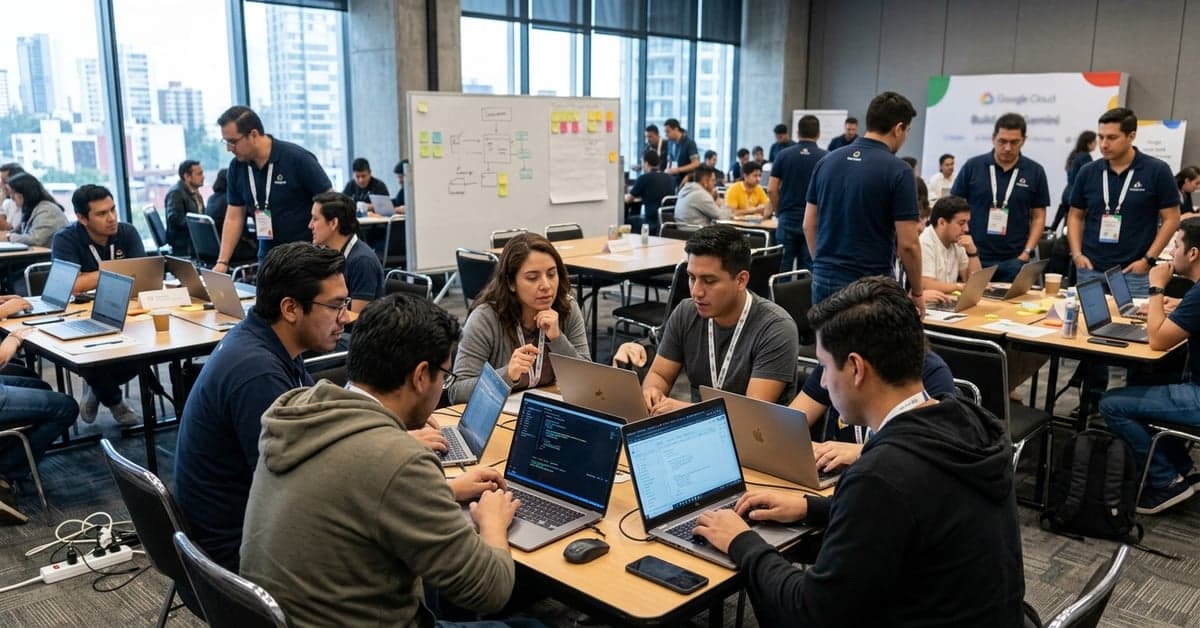
Google is stacking the calendar with hands-on Build with Gemini days, a Gemini at Work technical series, and a regional Google Cloud summit in Mexico City — all centered on building, deploying, and scaling AI agents. According to Google’s developer events hub, these sessions move past chat demos toward secure, production-ready systems that plug into real data and workflows. For teams deciding where to place their time, the message is clear: Google Gemini developer events are now designed for shipping.
What’s on the calendar: Google Gemini developer events go hands-on
The Build with Gemini workshops promise a guided, practical day with Google Cloud experts to build, scale, and deploy secure, production-ready AI agents. The format emphasizes live building rather than passive talks, which should help teams leave with working patterns they can adapt inside their own repos. Google’s description stresses security and production reliability — two hurdles that often stall promising proofs of concept.
The Cloud Technical Series: Gemini at Work extends that approach with live technical training, demos, and labs focused on custom agent builds using Gemini Enterprise. As described on the Google Cloud events listings, the series targets real deployment paths: connecting agents to corporate systems, shaping prompts and skills for task execution, and dialing in performance and cost.
Google Cloud Summit Mexico City rounds out the slate with a broader program that includes how to deploy advanced AI agents, optimize analytics at scale, and enable intelligent collaboration. That framing suggests attendees can explore the full stack around agentic AI: data pipelines, governance, and end‑user workflows. It’s a regional summit, but the focus areas signal where Google expects demand: enterprise‑grade agents, fast data, and measurable productivity gains.
From chatbots to agents: why these sessions matter for teams
The throughline across these events is a shift from conversational front ends to agentic systems that carry out work. In practice, that means connecting models to company data and tools, adding memory and planning, and setting guardrails on what an agent can do. It’s the difference between a helpful Q&A and a system that opens a ticket, updates a CRM entry, or drafts code behind a feature flag.
Google is positioning Gemini as the hub for that stack. The official product materials for Gemini in Google Cloud lean on enterprise themes: identity-aware access, auditability, data isolation, and cost controls. By shaping workshops around “production‑ready AI agents,” the company is courting platform teams that need repeatable designs, not one‑off demos. For developers, that translates to patterns for tool use, connectors, and evaluation; for security and ops, it means clear boundaries, logging, and policy hooks.
The agenda also lines up with what many organizations learned during first‑wave pilots: latency budgets, rate limits, and content safety don’t vanish when the demo ends. They become core design constraints. Sessions under the Gemini at Work banner are pitched to make those constraints explicit and solvable inside standard cloud deployment paths.
How to prepare for a Build with Gemini day
Teams get more out of hands‑on workshops when they arrive with a target task, a minimal dataset, and a plan to evaluate results. Based on Google’s event descriptions and common production hurdles, here’s a pragmatic checklist:
- Pick one high‑value workflow with clear success criteria. Keep scope focused enough to finish an end‑to‑end path in a lab setting.
- Bring a small, representative dataset and a redacted config for one system you intend to connect (for example, a ticketing tool or a read‑only data source).
- Decide on an eval slice ahead of time. Even a dozen real cases will help you compare an agent to today’s baseline.
- Draft your governance boundaries: which tools the agent may call, which it must never call, and which require human approval.
- Plan for telemetry. Define what you will log (inputs, tool calls, errors, costs) and how you’ll review it after the workshop.
This framing keeps the learning concrete. It also positions you to translate workshop prototypes into a tracked experiment at work, rather than a one‑off demo that fades. If your team is split between app dev and data, nominate one person from each group so you can cover tool integration as well as retrieval, schema, and quality.
What past sessions hint about Google’s next moves
On the same events hub, Google points to on‑demand technical content that digs into an open Agent‑to‑Agent (A2A) protocol and the Model Context Protocol (MCP). While those talks sit in the “Past events” section, their presence signals growing interest in interoperability across agent frameworks. If agents are going to call tools, other agents, and enterprise APIs safely, standard ways to describe capabilities and context will matter.
Expect that theme to thread into new workshops as well: orchestration patterns, tool schemas, system prompts, and evaluation harnesses that teams can reuse. For platform engineers, this is the work that makes agent behavior observable and governable. It also reduces the long tail of one‑off glue code that often bogs down pilots.
Google has been publishing more guidance on privacy, data control, and safety reviews in its AI materials. The Google Cloud AI/ML blog provides deeper dives on deployment and governance patterns. If the live labs mirror that writing, attendees should leave with recipes for access control, approval gates, and cost caps that suit regulated teams.
How this fits Google’s broader AI play
Teaching developers to build secure, task‑oriented agents serves two goals. It makes Gemini the default model and toolchain for new internal apps, and it nudges enterprises to adopt Google Cloud services for identity, data, and monitoring. In other words, the workshops are product education and go‑to‑market motion at once.
For developers and tech leads, the upside is practical. You can pressure‑test agent architectures in a lab, compare costs, and learn where the sharp edges are before you commit to a large roll‑out. For execs watching budgets, these sessions provide a low‑risk way to validate whether a targeted agent can beat an existing baseline on cycle time, accuracy, or ticket deflection.
If your roadmap includes customer support agents, internal helpdesk bots, code‑aware assistants, or analytics copilots, the current wave of Google Gemini developer events offers a timely, structured path to get from idea to a managed pilot.
Registration details, locations, and formats are listed on Google’s official events portal. New dates are added as programs open. If your team wants hands‑on time with Gemini Enterprise and a clearer path to production, these Google Gemini developer events are built for that jump.