
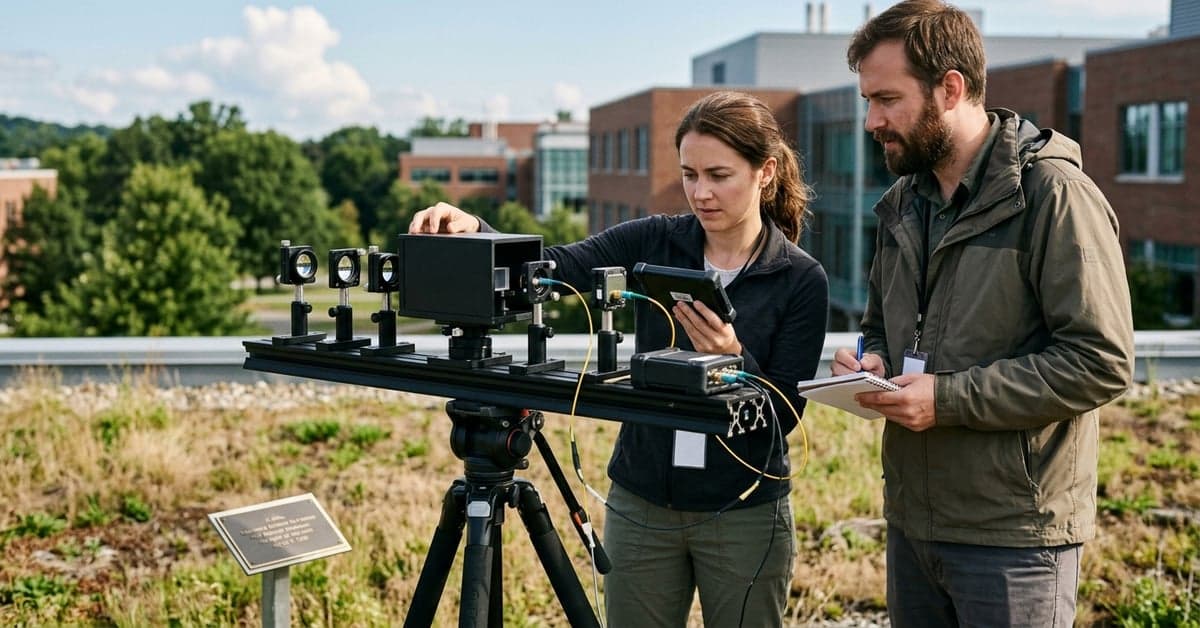
On August 7, 2026, ScienceDaily reported an outdoor experiment that generated entangled photons directly from sunlight, with about 94% similarity between the twin particles. The work hints at a lower-energy path to quantum links that today rely on carefully tuned lasers and optics (ScienceDaily).
Sunlight quantum entanglement moves from theory to field test
Most entanglement sources use a laser and a nonlinear crystal to create correlated photon pairs. That setup is standard in lab-grade quantum communications and sensing, but it costs energy and demands tight control over frequency and alignment. By contrast, this new result took the messiest light source around — the Sun — and still produced pairs showing strong correlation. According to ScienceDaily, the team measured about 94% similarity between the photons, a level that implies useful nonclassical behavior.
To appreciate why that matters, remember what entanglement buys you. In quantum key distribution (QKD), for example, correlated photons let two parties detect eavesdropping and share keys with security backed by physics. As explained by the U.S. National Institute of Standards and Technology, QKD implementations typically depend on engineered photon sources and precise detectors, all of which draw power and require stability (NIST). If nature can be coaxed into providing a similar resource with sunlight quantum entanglement, even at lower rates, the energy equation changes.
The result also challenges a common intuition: ambient light is noisy, broadband, and thermal. It shouldn’t be a good partner for delicate quantum correlations. That’s what makes the field test notable. It suggests filtering, timing, and smart detection might extract nonclassical correlations from what looks like chaos. For readers seeking background on the physics, the Stanford Encyclopedia of Philosophy offers a clear primer on what makes entanglement different from mere correlation (Stanford Encyclopedia of Philosophy).
What a solar entangled-photon source would change
Power budgets dominate many quantum deployments. Lab racks can hide watts behind walls, but a mountaintop relay, a high-altitude platform, or a small satellite cannot. If engineers can turn solar illumination into a usable entangled-photon feed, the source itself could be nearly power-free. The electronics that filter, time-tag, and detect would still matter, yet the biggest draw — the laser — might not be needed during daylight windows.
In QKD, source efficiency, channel loss, and detector noise set the key rate. Taking the laser out reduces energy consumption and complexity at the source, which helps in remote sites or battery-backed nodes. Daylight operation also matters. Many free-space quantum experiments wait for night to avoid background photons. A technique that starts with the Sun and works by design could invert that constraint. It won’t erase loss or atmospheric turbulence, but it could open new operating envelopes. That is the core practical promise of sunlight quantum entanglement.
Outside secure links, sensors stand to gain. Quantum-enhanced sensing often relies on correlated photons to push beyond classical noise limits. A photon source that piggybacks on ambient light, even if only for coarse-grained measurements, could let environmental monitors run longer between charges or operate off-grid where line power is costly or impossible.
Energy math and engineering hurdles ahead
There’s a reason the field leans on lasers. Controlled sources give predictable brightness and spectra, which simplify filtering and error models. Sunlight brings variability: clouds, angle of incidence, aerosols, and daily cycles. Extracting a clean, timing-aligned stream of correlated pairs from that flux will demand clever optics and calibration. The 94% similarity reported by ScienceDaily shows promise, but engineers will care about pair production rates, stability across seasons, and how performance degrades with weather.
Detectors and filters also set the floor. Single-photon detectors have improved markedly in efficiency and dark-count rates, yet they still trade performance for cost and temperature. A sunlight-driven source will likely push more of the complexity into the receiving and processing chain. That’s a good trade if it slashes total system power, but it’s not automatic. Expect careful studies comparing link budgets between conventional laser-pumped setups and ambient-light versions, including how error-correction overhead scales at different solar conditions.
Standards and security proofs will need attention, too. Classical randomness from fluctuating sunlight can mingle with quantum correlations in subtle ways. Security models for QKD are well developed for standard sources; extending them to an ambient-light regime will take experimental data and new proofs. The payoff, if it comes, would be lower-energy quantum links that still retain security guarantees.
A wider shift in quantum materials and devices
The timing of this result fits a broader pattern: quantum hardware inching toward practicality by cutting energy and scaling up. On its front page, MIT News highlights wafer-scale, air-stable ultrathin superconductors designed to make quantum devices easier to build at size (MIT News). Scaling quantum materials on full wafers attacks a different bottleneck — manufacturing — yet it serves the same end: more capability per watt and per dollar.
MIT News also points to new techniques to watch heat flow through layered electronics, which could improve thermal design in chips that will host quantum control and readout circuits (MIT News). Pair that with experiments that directly image electrons reorganizing into coexisting phases, and you see the trend line: researchers are moving beyond demonstrations into the engineering of quantum behavior under real-world constraints. Solar-driven entanglement, if it solidifies, would join that list as a low-power ingredient.
That broader context matters for investors and policymakers as much as scientists. Funding has poured into quantum software and algorithms, yet the hardware stack often sets the limits. Progress that trims energy, simplifies packaging, or removes cryogenic needs can compound across the system. Sunlight quantum entanglement points at a future where some links get their nonclassical resource from the sky, while improved materials and thermal control make the rest of the stack less power-hungry.
What to watch next for sunlight quantum entanglement
The next milestones are straightforward. Look for replication across sites and seasons, published rates of entangled-pair generation under varying solar conditions, and head-to-head comparisons with compact laser sources. Field trials that span rooftop-to-rooftop links in daylight would be especially telling. If those tests show stable key exchange — or even reliable correlation measurements for sensors — the case for sunlight quantum entanglement strengthens.
Until then, treat the August 7 result as a provocative proof of concept. It doesn’t replace lasers everywhere, but it sketches a path to deploy quantum links where every watt counts. If that path holds, tomorrow’s secure nodes and scientific instruments may spend less time tethered to power and more time listening to the Sun. For more on this, see bloomberg.com and nytimes.com.
Related reading: Copilot • OpenAI • Productivity & AI