
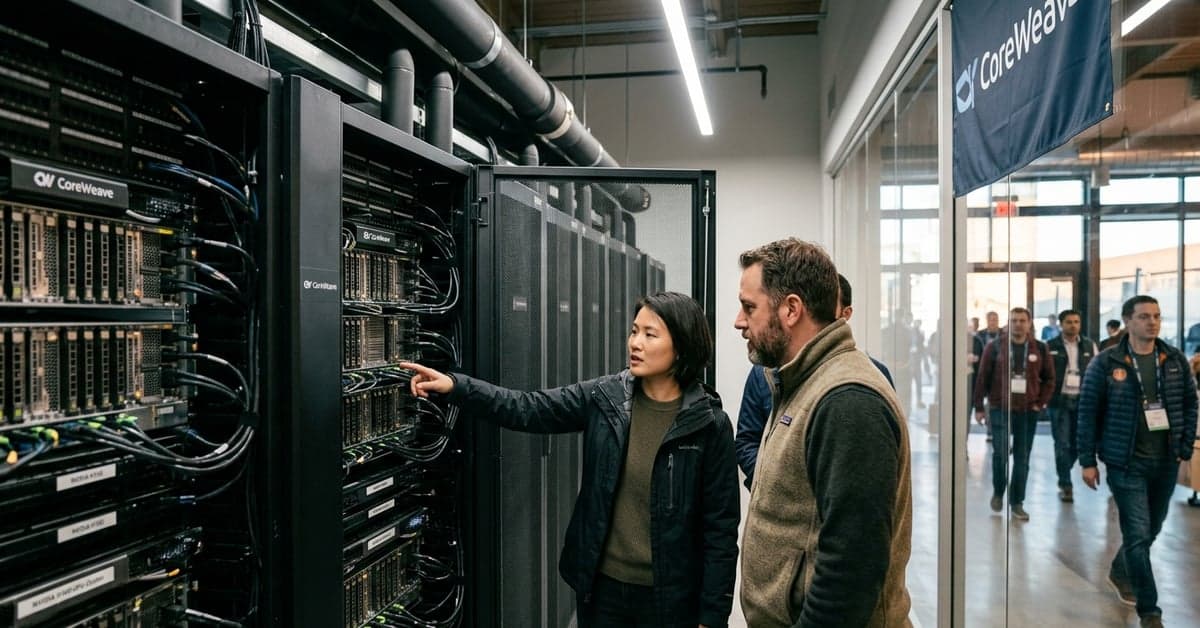
Gartner named CoreWeave a Visionary in the 2026 Magic Quadrant for Cloud AI Infrastructure, according to the company’s site. Paired with a September 29–October 1, 2026 event in San Francisco and content on running an “AI factory” at scale, the signals point to a clear bet: the CoreWeave AI cloud wants to own the messy middle of AI operations—where performance, price, and reliability collide.
What Gartner’s call says about the CoreWeave AI cloud
“Visionary” in Gartner’s framework typically reflects strong ideas and product direction. It can also imply a vendor still scaling execution relative to incumbents. While CoreWeave cites the recognition on its homepage, buyers should read that signal through the lens of their own workload mix. Gartner’s methodology emphasizes both vision and ability to execute, which helps frame tradeoffs for teams deciding between a specialized AI cloud and a general-purpose provider. For context on how Gartner evaluates vendors, its Magic Quadrant methodology outlines the criteria.
CoreWeave positions itself as “purpose-built for AI,” with next-generation infrastructure, tools, and expert support. The site highlights a Kubernetes-native environment for GPU compute, flexible storage, and high-performance networking. For developers who live in containers, that Kubernetes emphasis matters. It can reduce friction moving from on-prem test rigs to cloud clusters sized for training or high-throughput inference. Teams planning GPU-backed pods can review upstream guidance on scheduling GPUs in Kubernetes to assess fit and operational impact.
How CoreWeave’s AI-native platform targets lifecycle pain
CoreWeave’s own content leans into operations, not just capacity. The company is running a multi-part series with NVIDIA on keeping an “AI factory” running at scale, focusing on goodput and reliability. That framing fits a broader industry shift. The hardest problems have moved from single training runs to the full cycle: data pipelines, fine-tuning, evals, rollout, monitoring, and cost control. NVIDIA’s description of the AI factory captures why the bottlenecks now sit in orchestration and throughput as much as TFLOPS.
Two practical takeaways emerge from CoreWeave’s positioning. First, it’s courting customers who already know where their models stumble in production: queue times, flaky nodes, or storage that can’t keep up with tokenized traffic. Second, it’s signaling that operational transparency is a feature, not a footnote. The site stresses visibility into how workloads run. That’s a polite shot at opaque pricing, surprise quotas, and long waits that some buyers hit when demand spikes across the industry.
Pricing pressure and the post-training playbook
CoreWeave is also advertising a session called “Stop paying frontier prices,” pitched as a 40-minute deep dive into distillation, supervised fine-tuning (SFT), reinforcement learning, and post-training economics. It reads like a thesis on how to cut spend without sacrificing outcomes. Teams swapping a giant base model for a smaller distilled one can win on latency, memory footprint, and cost. The technique is well documented; see knowledge distillation for a primer and tradeoffs.
SFT and reinforcement learning from human feedback carry their own costs and risks, too. Labeling pipelines and reward modeling can balloon budgets if they aren’t scoped. The RLHF literature shows why evaluation and safety reviews become part of the unit economics. CoreWeave’s message is simple: move beyond “bigger is better,” and treat post-training as the main lever on total cost of ownership.
That stance—paired with a Kubernetes-native GPU fabric—maps to buyer pain today. Many organizations can’t justify frontier-scale training runs but still need fast, reliable inference and frequent fine-tunes. The CoreWeave AI cloud is aiming squarely at that middle, where throughput and predictability beat bragging rights.
Buyer checklist before Fully Connected 2026
CoreWeave will host its “Fully Connected 2026” conference in San Francisco on September 29–October 1, 2026, per the company’s website. Expect customer case studies and deeper dives on its platform stack. If you’re evaluating vendors now, a few questions cut through the noise:
- Capacity realism: What are current queue times for your target GPUs and regions? How are spikes handled and communicated?
- Kubernetes fit: Which GPU operators and device plugins are supported? How is pod-level isolation enforced for mixed workloads?
- Networking truth: What east-west bandwidth can you actually sustain at your desired scale, and how does that affect inference fan-out?
- Data gravity: What are your egress fees and data locality options, and how do they affect retraining and evaluation loops?
- Observability: Which metrics are first-class for AI workloads—goodput, token throughput, retry rates—and how are they exposed?
These questions align with the themes CoreWeave spotlights: reliable throughput, clear operations, and costs that track real outcomes. They also give you a neutral way to compare specialized providers with general-purpose clouds using Gartner’s execution-versus-vision lens.
Why this matters for model builders and IT leads
The center of gravity in AI has shifted. Models are table stakes; running them well is the moat. That is where a specialized provider can gain ground. If your estate is already Kubernetes-first, a platform built around container orchestration and GPUs can shorten the path from prototype to production. If your finance team is reeling from inference bills, the distillation and SFT focus may help reset assumptions and budgets.
None of that settles every tradeoff. A “Visionary” tag is encouragement, not a guarantee. Multi-region compliance, disaster recovery, and enterprise support depth still matter. Reference calls with similar workload profiles matter more than any badge. Yet the direction is clear. The CoreWeave AI cloud is pitching itself as the place where builders get predictable performance and a clearer cost story, without waiting in line.
According to CoreWeave’s site, the platform spans GPU compute in a Kubernetes-native environment, flexible storage, and high-performance networking, with an emphasis on transparency. That bundle is designed for the AI factory era, where the metric that counts is shipped improvements per dollar, not theoretical peak speed.
Watch the conference agenda and technical documentation as they land, and validate claims with your own canary workloads. If the numbers hold up, expect more teams to split stacks: keep general-purpose work on hyperscalers, and park the high-intensity training and inference on a specialist. That is the bet CoreWeave is making—and Gartner’s 2026 nod says the market is listening. For more on this, see bloomberg.com and nytimes.com.
Related reading: Copilot • OpenAI • Productivity & AI