
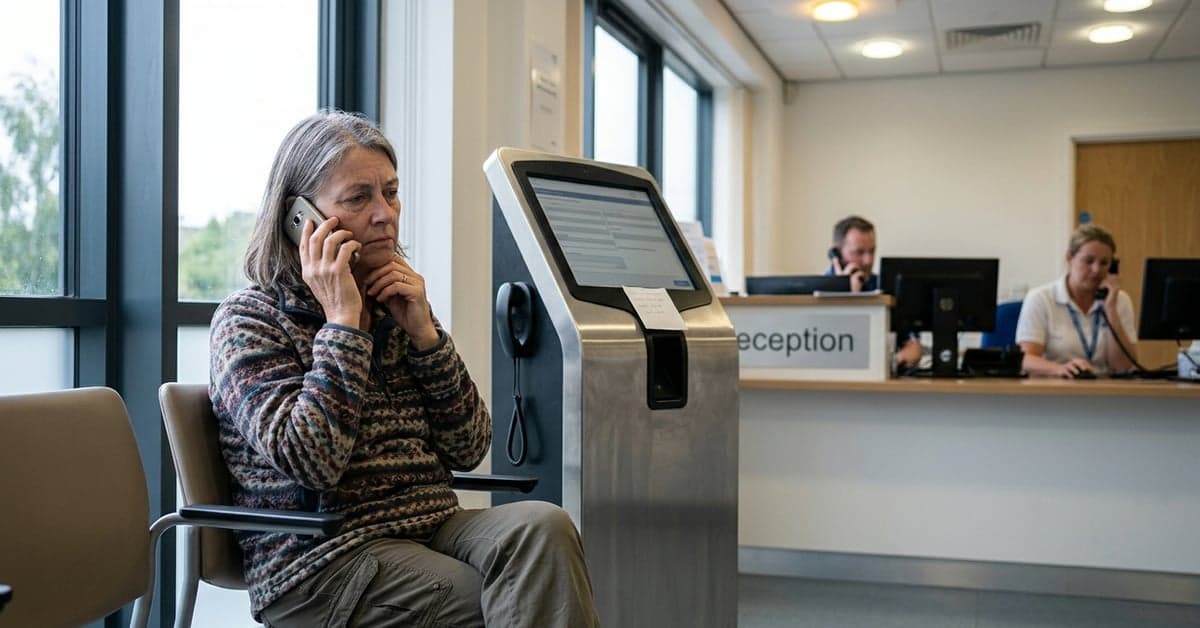
On August 20, 2026, the Guardian reported GP callers in Yorkshire hanging up after an AI receptionist failed to understand them. The paper’s AI section described the bot as “baffled” by the accent. BBC Technology also highlighted the same problem in August 2026 with a video headlined “AI GP receptionist ‘can’t understand Yorkshire accent’.” Together, the two outlets point to a deeper issue: AI accent bias is colliding with primary care access.
A GP voicebot failed on a Yorkshire call — what happened
According to the Guardian’s AI page on August 20, 2026, frustrated patients abandoned calls when a surgery’s automated receptionist misheard a Yorkshire speaker. The BBC’s Technology section published a clip in August 2026 under the line “AI GP receptionist ‘can’t understand Yorkshire accent’,” showing how a simple query derailed into repeated errors. Neither report named the vendor, but both described the same failure mode: repeated misrecognitions, then a dead end.
That’s more than an inconvenience. Missed call-backs, delayed prescriptions, and lost same-day appointment slots follow when a phone queue breaks. And because many practices still handle demand by phone, a single weak link can shut out the very people the tech is meant to help.
Why AI accent bias shows up in healthcare calls
AI accent bias starts with training data. Speech systems learn from the voices they hear most. If regional dialects are under‑represented, error rates rise when those speakers call. In healthcare, the problem is amplified by the medium: UK landline and mobile calls often arrive at 8 kHz sampling on legacy trunks, which strips audio detail that modern speech models prefer.
Academic work shows the pattern is not new. A 2020 study in the Proceedings of the National Academy of Sciences found commercial systems had far higher word error rates for some groups than for others, underscoring the risk of uneven performance at scale (PNAS). Swap out a clear studio demo for a noisy kitchen, a regional cadence, or a code‑switched phrase, and misrecognitions stack up fast.
Healthcare adds higher stakes. A wrong slot, a misheard medication, or a dead-end loop is not just a bad user experience; it can become a safety event. That is why NHS buyers should treat voice triage more like a clinical tool than a call-centre gadget.
What NHS clinics should demand before wider rollout
Procurement has to move from generic demos to evidence. The NICE Evidence Standards Framework sets the bar for digital health claims, including real‑world performance and risk management (NICE). The NHS Service Standard also expects teams to test with users who have a range of needs and contexts (NHS England).
For voicebots, that means putting AI accent bias on the contract page, not the disclaimer. Ask vendors to:
- Publish word error rates and task success rates by accent group, measured on real phone audio, not just web mic tests.
- Show fallbacks that work: a one-press transfer to a human, clear options after two failed attempts, and a callback path that preserves place in the queue.
- Prove safe handling of protected health information, including minimising retention of call recordings and transparent consent for any model tuning.
- Commit to post‑deployment monitoring and fixes within set timeframes when bias is detected.
Practices should pilot in short bursts, audit transcripts with local patient groups, and only expand once performance holds across peak hours and diverse callers. If outcomes vary by accent, pause and correct. That’s how you reduce the risk that AI accent bias becomes an access barrier.
Testing for speech recognition bias: practical checks
Before switching on by default, run a controlled test that mirrors real life. A small panel of staff and volunteer patients can surface issues in days, not months.
- Assemble callers representing Yorkshire, Scouse, Geordie, Glaswegian, and Southern English accents; include varied ages and background noise.
- Use the main surgery number on live lines at busy and quiet times; record outcomes with consent.
- Track: successful routing on first try, time to resolution, abandonment rate, and the reasons for drops.
- Repeat after vendor tweaks; require equal or better results across groups before rollout.
Keep a human-first escape in place during the pilot. Patients should hear how to reach reception at any point, including by pressing a single key.
What comes next for vendors and regulators
The Guardian’s August 20 report and the BBC’s August coverage together show the public won’t tolerate opaque failure. Vendors will need to normalise accent‑level reporting and tune on telephone audio, not just studio datasets. Buyers should insist on option parity: if a human line exists for one group, it has to be reachable for all, or you risk indirect discrimination under UK law. The Equality and Human Rights Commission explains how policies that seem neutral can disadvantage protected groups, a principle that maps to speech tech too (EHRC).
There’s a bright side if providers get the basics right. Voice interfaces can cut wait times for everyone, extend hours, and reduce pressure on reception. But the bar is higher in healthcare than in retail. After the Yorkshire incident reported by the Guardian and the BBC, the smart move is to treat accuracy, fallbacks, and transparency as part of safety. Fix those, prove them in public, and AI accent bias stops being a headline and starts being a solvable engineering task.
Related reading: Future of remote work: what research says managers must fix For more on this, see bloomberg.com and nytimes.com.
Related reading: NVIDIA • Meta AI • AI & Big Tech