
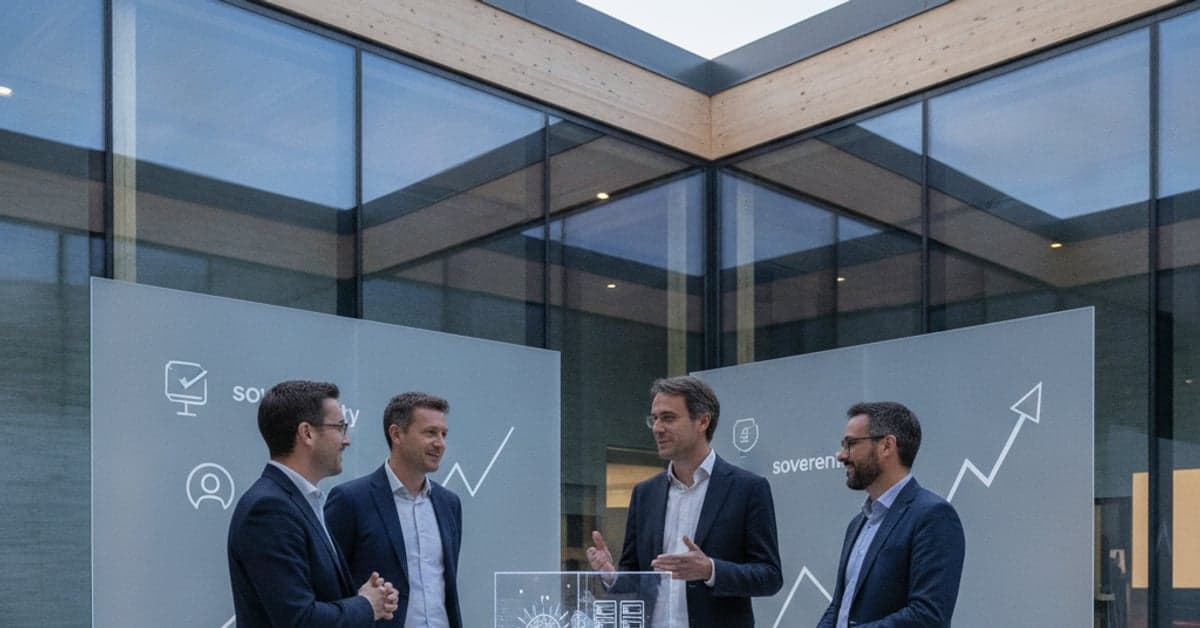
Mistral says it has raised €3 billion at a post-money valuation above €21 billion and is framing the cash as fuel for sovereignty: control over models, compute, and deployment choices. The company’s pitch ties sovereign AI funding to an open-weight, full‑stack strategy that it claims can curb vendor lock‑in while scaling to frontier research and products (Mistral).
How sovereign AI funding shapes Mistral’s full stack
The round is led by Samsung Electronics, with co-leads Scaleup Europe Fund (managed by EQT) and existing investor PSG Equity, according to the company. Mistral says the money expands compute capacity for training, grows infrastructure, and accelerates go‑to‑market. It now operates in 20 countries and supports more than 125 global enterprises, including Airbus, ASML, and HSBC. In its own framing, this is less about a splashy headline number and more about an integrated answer to a question large buyers keep asking: how to deploy powerful AI without ceding control to a single provider (Mistral).
Mistral’s claim is stark: it positions itself as the only AI company building the stack end‑to‑end—open‑weight models, the infrastructure and compute they run on, and the production‑grade products on top. That unity is the company’s core argument for sovereignty. Whether or not competitors agree with the “only” label, the logic tracks with what many CIOs want: predictable costs, data residency guarantees, and transparent performance trade‑offs.
This is where sovereign AI funding matters. Money doesn’t just buy GPUs; it buys the option to keep key capabilities in‑house or in a partner’s controlled environment, to ship open weights where needed, and to avoid being trapped by someone else’s roadmap or capacity limits. The bigger the check, the more room to hold that line when demand spikes or pricing power shifts.
What “sovereign” means for AI buyers
“Sovereignty” is often read as national policy, but Mistral uses it in a narrower, operational sense: the ability for organizations and governments to choose where models run, control the data loops that improve them, and keep options open across vendors (Mistral). That interpretation aligns with a broader European emphasis on digital autonomy and data control set out by EU policymakers, who have pushed for strategic independence in core technologies and stricter governance for high‑risk AI systems (European Commission).
For buyers, the practical questions are specific. Can we run the model in our VPC today and on‑prem next year? Can we tune with sensitive data without exposing it to a public service? Can we audit how updates change outputs? And if a provider throttles capacity or raises prices, what’s our exit? Sovereignty is the promise that the answer to each is yes—without rewriting the stack each quarter.
The company’s open‑weight stance supports that promise. Open weights let customers deploy models across clouds or in datacenters, apply their own security controls, and validate performance under their traffic patterns. They also make second‑sourcing real. That freedom is expensive to deliver at scale, which circles back to why sovereign AI funding on this order matters: it pays for the engineering, compute, and support footprint that make choice practical rather than theoretical.
The open‑weight bet and the shift away from AI rentals
The market is already tilting toward ownership and control. On July 11, 2026, AI Herald reported that the Hugging Face CEO sees roughly half the Fortune 500 favoring open source AI over rented APIs, citing cost, privacy, and customization as drivers (AI Herald). That view dovetails with Mistral’s narrative: open weights as the default for mission‑critical deployments that demand predictability over time.
There’s also a compliance dimension. As the EU’s rules for high‑risk systems come into force, auditability and data governance grow heavier. Systems that can be inspected, reproduced, and migrated reduce regulatory risk, especially for banks, aerospace, and public sector buyers. An open‑weight model with clear deployment boundaries gives legal and security teams something they can evaluate, document, and defend.
Cost pressure is another nudge. Training and serving large models remain pricey, yet buyers are wary of all‑in platform commitments that look cheap now and costly later. Open‑weight models aren’t free, but they give finance teams more levers—instance types, quantization, locality of compute, and contract terms across multiple vendors. That flexibility is hard to value in a spreadsheet, yet it’s often the difference between staying on budget and going back to the board for more cash.
Cross‑border capital and the meaning of “sovereign”
One tension in this story is symbolic: a company making the case for sovereignty raised one of Europe’s largest tech rounds with a global lead investor, Samsung Electronics. That’s not a contradiction so much as a signal about how software sovereignty actually works. Capital can be global even when control planes are local. The relevant questions are where models run, how data is handled, and whether customers retain options. By that standard, international backing can amplify, not dilute, the sovereignty pitch—if the product and support footprint honor those controls.
It also hints at a broader alignment. Suppliers of compute and memory need customers that can scale sustained demand beyond one‑off pilots. If open‑weight models win more enterprise workloads, hardware makers benefit from deployments in multiple environments—public cloud, private cloud, on‑prem—rather than a single walled garden. That diversification reduces concentration risk for both sides.
Regulators will be watching. As open‑weight deployments spread, questions about export controls, model governance, and supply chain dependencies won’t fade. The EU’s approach to AI oversight, from transparency requirements to post‑market monitoring, raises the bar for documentation and incident response. Providers that promise sovereignty need to show not just portability, but traceability—who changed what, when, and why—across the entire life cycle (European Commission).
What to watch next as the money hits compute
Mistral says the round will expand frontier research and the infrastructure under it, the foundation for its products and sovereignty pitch. If that yields stronger open‑weight models with clearer deployment recipes across clouds and on‑prem, expect more regulated industries to try them in production. If it delivers lower latency and predictable token pricing at scale, expect multi‑vendor architectures to spread faster.
Key proof points to track:
- Repeatable enterprise wins beyond the current 125+ logos in sectors where auditability is strict.
- Transparent model cards and ops patterns that make migrations possible without six‑month rewrites.
- Concrete performance gains tied to new compute, not just bigger training runs.
- Clear interoperability with security and observability tools enterprises already run.
The funding also raises the bar for competitors selling control while keeping weights closed. Some customers will still prefer fully managed platforms; others will keep a mix. But as sovereign AI funding scales and open weights mature, the middle ground—strong models with real exit options—looks more attractive by the quarter.
Mistral’s bet is that sovereignty is a product attribute buyers will pay for, not just a talking point. If the company can turn this cash into better models, clearer deployment paths, and credible second‑sourcing, it won’t just defend its narrative. It will force rivals to meet customers where they want to be: in control of their own stack.
That’s the quiet shift under the headline. The check is big, but the test is simple. Can a full‑stack, open‑weight approach translate sovereign AI funding into durable control for the teams that build and run critical systems? For more on this, see bloomberg.com and nytimes.com.