
On July 22, 2026, the Department of Energy said partners had pledged more than $800 million to its Genesis Mission and that the first Genesis Mission projects had been selected. Both updates appear on the agency’s program page, signaling the shift from plans to funded work and from concept to delivery (Department of Energy).
What the Genesis Mission projects aim to prove
The DOE pitches Genesis as a way to apply AI to hard problems in energy, discovery science, and national security. The agency frames these as national challenges with near-term public benefit, to be tackled by shared platforms and cross-sector teams (Department of Energy). The first Genesis Mission projects will test whether that model can cut time from idea to validated result inside real laboratories, not just on benchmarks.
DOE’s outline leans on mission focus rather than open-ended exploration. The program page points to defined “National Science and Technology Challenges” and promises measurable outcomes delivered through AI platforms and partnerships. That framing matters: without bounded goals, collaborations of this size often sprawl and stall.
The timeline also shows intent. In March 2026, the department issued a request for applications under “The Genesis Mission: Transforming Science and Energy with AI,” inviting proposals to hit those challenge areas (Department of Energy). Four months later, DOE says the first wave of Genesis Mission projects is in. Speed won’t guarantee success, but it suggests the agency wants results on the board while momentum and partner funding are fresh.
Inside DOE’s Genesis platform for science and security
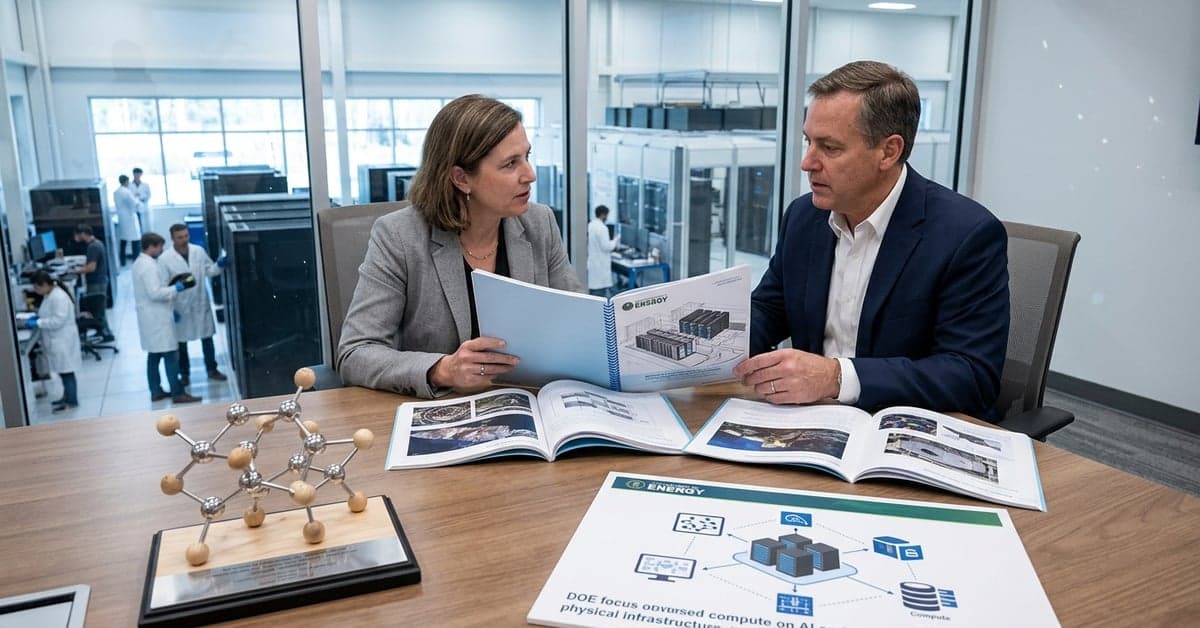
At the center is the American Science and Security Platform, described as a complex, integrated environment that links supercomputers, experimental facilities, AI systems, and high-value datasets. The pitch is to bring compute, instruments, and data under one umbrella so models can reason across them rather than in silos (Department of Energy).
In practice, that means connecting sites like exascale systems with beamlines, microscopes, and fusion or materials testbeds. For a sense of the compute class, the Frontier supercomputer at Oak Ridge is a public example of the kind of resource DOE stewards today. Tying such machines to live experiments and curated datasets is the core promise of the Genesis platform. If it works, researchers should be able to run closed-loop workflows where AI plans, instruments execute, and models refine hypotheses in near real time.
Governance will matter as much as wiring. Genesis is set up as a consortium drawing national labs, industry, and universities, which the program page says is meant to “solve critical challenges at unprecedented speed.” That breadth can unlock talent and specialized tools, but it also raises familiar questions about data rights, sharing norms, and how results move from lab demos to field deployment. DOE’s national laboratories network provides the backbone for this kind of coordination (DOE National Laboratories).
Why outside money changes the timeline
DOE’s page cites “more than $800 million in partner commitments” to the Genesis Mission, alongside the first project selections dated July 22, 2026. Those dollars are not federal appropriations; they are pledges from outside organizations, which matters for speed and scope (Department of Energy).
Non-federal commitments can stand up shared compute, procure specialized sensors, and back teams without waiting for the full federal budget cycle. They also create a forcing function: if universities and companies have skin in the game, they will push for concrete milestones and access to shared assets. The flip side is coordination risk. DOE now has to keep a growing set of partners aligned on priorities, interoperability, and success metrics while guarding against fragmentation across labs and sites.
Anchoring the program to a defined platform helps. The Genesis plan to integrate AI systems with supercomputers and experimental facilities gives partners a common target architecture. It also makes evaluation more tangible: throughput, instrument uptime, data quality, and end-to-end cycle time are measurable. If DOE reports those metrics project by project, stakeholders can see whether the Genesis Mission projects deliver faster science, cheaper runs, or more reliable outputs than today’s workflows.
The choice that will decide impact in 2027
Picking the right problems is the lever. On July 17, 2026, the Institute for Progress argued that DOE should select specific priority areas for Genesis where AI can unlock step-changes, and avoid spreading effort thinly across too many fronts (Institute for Progress). That advice aligns with DOE’s own framing of “national challenges,” but real discipline shows up in the project list and milestones, not the mission statement.
Two signals to watch: first, whether selected efforts publish clear, public deliverables tied to the American Science and Security Platform; second, whether data and models from successful efforts move into shared repositories fast enough for other labs and partners to reuse. DOE’s page stresses unique datasets and world-class facilities. To change the cadence of discovery, those assets need well-documented interfaces and predictable access, not bespoke one-offs.
As the Genesis Mission projects ramp up, expect pressure to show gains that matter outside lab walls. In energy, that could mean models that squeeze more insight out of grid telemetry or accelerate materials screening for batteries. In discovery science, it could be closed-loop experiments that compress months of iteration into days. The details will come down to the specific selections DOE just previewed on its site (Department of Energy).
The program has moved quickly: an RFA in March 2026, then partner money and initial selections by July 22, 2026. If DOE can keep projects tightly scoped, instrument the platform with clear metrics, and publish what works, the Genesis Mission projects could mark a real change in how national labs, universities, and industry do AI-for-science at scale. For more on this, see reuters.com.
Related reading: Copilot • OpenAI • Productivity & AI