
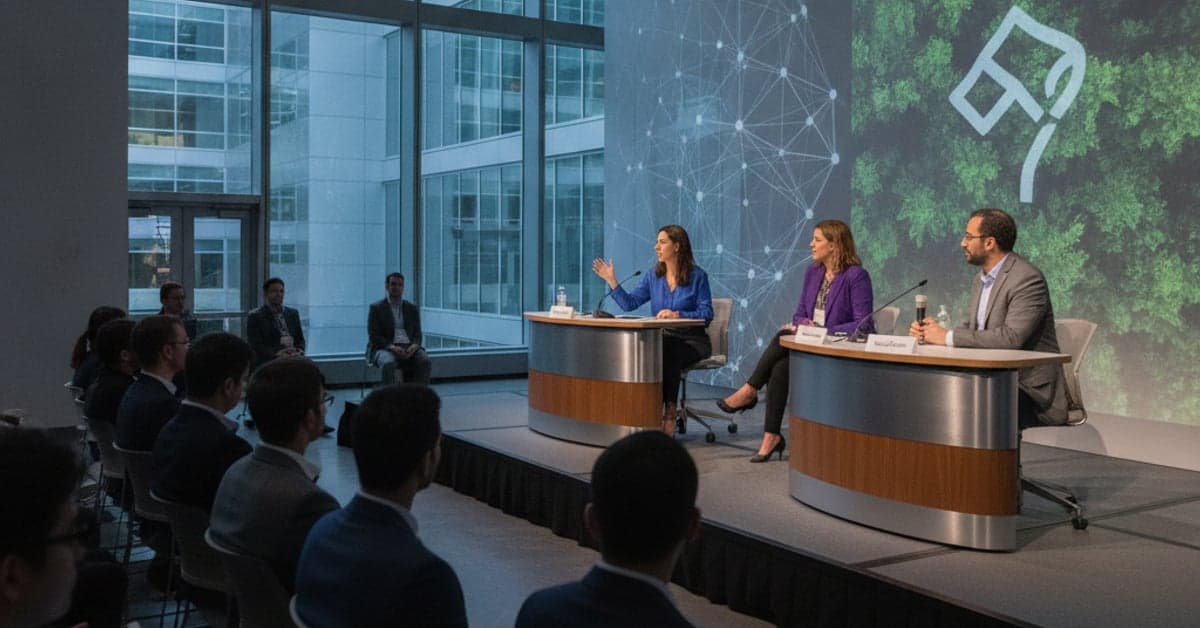
On August 19, 2026, Northwestern University’s Network for Collaborative Intelligence hosted Meta’s Madeline Hinkamp and Technion’s Yossi Keshet for Summer Speaker Series talks on using open-source AI for work ranging from forest canopies to speech recognition, according to the program’s site. Three weeks earlier, on July 31, 2026, the network highlighted an AI-driven method for revealing material interfaces from Professor Chris Wolverton at Northwestern’s McCormick School of Engineering. Together, those signals show a young initiative already linking outside voices with concrete lab results—and why the shift to a campus-wide model matters.
What Northwestern’s Network for Collaborative Intelligence is building
Northwestern describes the Network for Collaborative Intelligence as a community uniting experts across its top schools to advance responsible, high-impact work in data science and AI. The aim spans research, education, and translation, with tools for modeling, prediction, and decision-making across high-dimensional data. That is the university’s pitch, and it aligns with a wider push in academia to organize AI as a network, not a single center (NNCI).
The network’s public call to faculty, educators, students, and industry to “connect” is notable. It functions as a front door for partners who want to co-develop projects, guest-teach, or recruit. For researchers, it promises shorter paths to collaborators in other departments and quicker routes from a promising model to a deployable tool.
From talks to outputs: early signs the model works
The August 2026 sessions brought in Hinkamp from Meta and Keshet from Technion. As summarized by the network, both talks focused on applying open-source AI to real problems. That choice of speakers signals a bias toward reproducible practice and shared tooling rather than black-box demos. For context on the open ecosystem the talks referenced, see Meta’s public tools catalog, which has become a key on-ramp for developers building with shared models (Meta AI tools), and the research profile of Keshet, a Technion computer scientist known for work in speech and audio (Technion profile).
The July 2026 research item, drawn from McCormick, points to the other half of the equation: lab output that travels. Wolverton’s team used a computational approach that blends machine learning with advanced structure searches and quantum-mechanical calculations to reveal material interfaces, which could inform more durable electronics, according to the network’s summary. That mix—ML married to physics-grounded methods—is exactly where many materials breakthroughs are happening, and it dovetails with the broader rise of materials informatics.
In short, talks that foreground open methods plus a lab demo with a clear application are a healthy early pattern for the Network for Collaborative Intelligence. It suggests the group is prioritizing work that others can adopt or extend, not just publish-and-park. The approach also meets a growing expectation from funders that AI projects document risks, testing, and post-deployment monitoring, rather than stopping at model accuracy.
How Northwestern’s AI network could change partnerships
For industry and civic groups, a cross-campus AI network is simpler to engage than a patchwork of labs. One intake, a wider bench. Northwestern’s site explicitly invites “industry leaders” into that pipeline, which signals an appetite for co-designed pilots and quicker tech transfer (NNCI).
That structure can also help with responsible AI practices. Centralized guidance makes it easier to route projects through shared playbooks on risk and evaluation. External frameworks offer a ready supplement, including the U.S. National Institute of Standards and Technology’s AI Risk Management Framework, which is designed to help organizations identify, assess, and manage AI risks across the lifecycle (NIST AI RMF).
For researchers, the upside is speed. Cross-school working groups can form around data access or domain needs without waiting for new institutes. For students, the benefit is exposure: seminars, applied courses, and internships shaped by both campus labs and visiting practitioners. If the network keeps leaning on open-source tools, it also lowers the barrier for students and partners to reproduce results on commodity hardware or in the cloud.
There’s a funding angle, too. Agencies have spent years nudging universities toward cross-disciplinary AI work, often through consortia. The National Science Foundation’s AI Institutes program is one visible example, with awards built around large, multi-partner teams (NSF AI Institutes). While Northwestern’s network is distinct from such grants, it sets the table for them by knitting teams that can compete for large, multi-year awards.
What to watch next from the Network for Collaborative Intelligence
The early markers are promising, but the test for the Network for Collaborative Intelligence will come from output and adoption. Three indicators to track:
- Whether the speaker series turns into repeat collaborations, shared datasets, or open-source releases tied to the talks.
- How often lab results, like the materials interface work, move into partnerships with industry or public agencies.
- Clear pathways for students to contribute to those projects and publish code they can carry into jobs.
The network’s site already acts as a hub for events and updates. If it keeps pulling in outside experts and pairing them with cross-disciplinary teams, expect more case studies that span departments and sponsors. That pattern would strengthen the argument that a campus-wide network beats a single center for getting AI into practice.
Why this campus model matters now
AI is past the novelty phase. Partners want tested methods, reproducibility, and a shared lane for risk. Northwestern’s Network for Collaborative Intelligence is setting itself up to deliver on that by connecting talks with transferable code and applied science. If the pace from July and August 2026 holds, the next wave should show up as multi-party pilots and artifacts others can reuse. That is how a university network proves its value—by shipping ideas people outside the lab can pick up the next day. For more on this, see reuters.com and bloomberg.com and nytimes.com.
Related reading: Copilot • OpenAI • Productivity & AI