
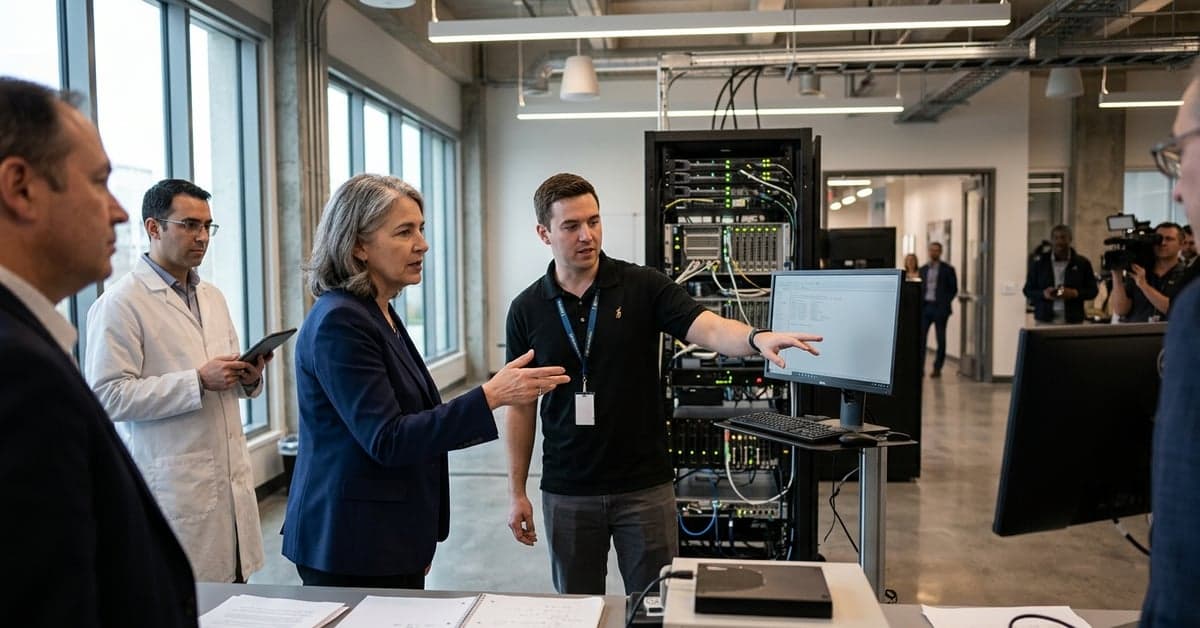
On July 22, 2026, the Department of Energy said partners pledged more than $800 million to its Genesis Mission. It also named the first projects in the effort to use AI across energy, science, and security. The move shifts Genesis from pitch deck to build phase, and puts Genesis Mission funding in sharper public view.
The program’s mandate is broad. According to the Department of Energy’s overview, the Genesis Mission will link the nation’s best supercomputers, experimental facilities, AI systems, and unique datasets through a single integrated platform. The effort is framed around defined National Challenges meant to drive U.S. innovation in energy, discovery science, and national security, with new partnerships and project calls to speed work from idea to impact. In March 2026, DOE issued a request for applications to “Transform Science and Energy with AI,” signaling the first tranche of opportunities for teams inside and outside government.
What the Genesis Mission funding unlocks next
The immediate effect of the $800 million in partner commitments is capacity. According to DOE’s Genesis Mission page, the agency aims to coordinate assets that are usually siloed: compute, instruments, and data. Partner money and in-kind support can help stand up shared services faster, pay for integration work that grants rarely cover, and reduce friction across the DOE national laboratory network.
The bigger prize is the “American Science and Security Platform,” DOE’s term for a common stack that teams can use to run experiments end to end. If that stack matures, a materials group could run AI-guided experiments on beamlines while tapping exascale compute for inference and simulation. A grid modeling team could pair live telemetry with forecasting models, then test control policies on hardware-in-the-loop rigs. Those examples describe a pattern: less file shuttling, more closed-loop science.
Genesis Mission funding is only part of the story. The platform approach matters because it can cut cycle time between ideas and results. It also creates a common interface for security reviews and data governance, which becomes essential once defense-adjacent projects enter the mix. That shared frame, if executed well, is what converts partner checks and federal dollars into durable capability.
Inside the American Science and Security Platform
DOE’s description points to a federated design that connects “the world’s best supercomputers, experimental facilities, AI systems, and unique datasets.” In practice, that means routing work to machines like Frontier at Oak Ridge, wiring up instruments and testbeds, and standardizing data access across programs. The more those pieces interoperate, the less time researchers spend wrangling bespoke tooling.
Two things will make or break the build. First, repeatable workflows. Researchers need the same pipeline to run on a supercomputer, an instrument control rack, and a secure enclave without rewriting the job each time. Second, data liquidity with guardrails. Teams need frictionless access to labeled datasets and experimental logs, but with clear lineage, consent, and policy controls baked in. DOE’s framing suggests the platform is designed with these needs in mind, though details on service-level guarantees and onboarding remain to be published.
One more practical win would be hardware awareness. If the platform can target the right accelerator, CPU, or instrument queue automatically, it can keep labs busy and costs in check. That is where partner engineering support can help, turning one-off integrations into shared libraries for everyone on the network.
Where DOE spends its Genesis budget will decide impact
Before the July announcements, the Institute for Progress argued that DOE should pick a tight set of focus areas for Genesis. In a July 17, 2026 report, the think tank urged the department to choose challenges where AI can bend timelines by years, not months, and to define milestones that the public can verify (Institute for Progress). That advice speaks to a common risk in large programs: trying to do everything at once.
DOE’s own framing around National Challenges points in the same direction, though the categories are broad by design. The test now is specificity. Does a “grid reliability” category translate into a concrete win like better outage prediction at a named utility? Does a “secure science” theme yield a documented cut in model training exposure for a sensitive dataset? Those are the kinds of claims that will prove the case for the mission.
The right structure can help. Tie platform access to measurable project plans. Publish dashboards that show compute hours, instrument runtime, and experimental throughput per challenge area. Fund integration engineers and data managers alongside PIs, so teams can ship working systems, not just papers. Clarity about how Genesis Mission funding flows and who owns delivery will keep incentives aligned.
What to watch over the next year
Three threads deserve close attention as projects stand up. First, selection transparency. DOE named the first cohort on July 22, 2026; publishing evaluation rubrics and post-award milestones will build trust and help outside teams calibrate proposals (DOE). Second, data policy. The platform will touch sensitive scientific and security data. Clear rules on access, retention, and content provenance will matter as much as model performance. Third, delivery cadence. Quarterly checks on model-to-lab integration, not just citations or benchmarks, will keep the mission focused on field results.
There are risks. Platform sprawl can creep in if each project builds its own stack. Talent can bottleneck if labs can’t hire or borrow enough software engineers and data stewards. And security posture can drift if controls aren’t enforced uniformly across sites. All three are solvable with shared services, clear ownership, and open documentation.
The signal so far is encouraging. DOE now has partner dollars, a unifying platform concept, and a first wave of projects. If the department narrows its bets and measures what matters, the mission can turn ambitious rhetoric into faster discovery and deployment. Watch how Genesis Mission funding turns into measurable results by mid‑2027—on named testbeds, with public metrics, and with code that other teams can actually run.
Related reading: Copilot • OpenAI • Productivity & AI